

Topics in Current Chemistry (2019) 377:24
1 3
techniques, although these are morphological parameters mentioned in the previous
paragraph. Defect nature and distribution is additionally analyzed with the combination of diffraction and Raman with electron paramagnetic resonance (EPR) and
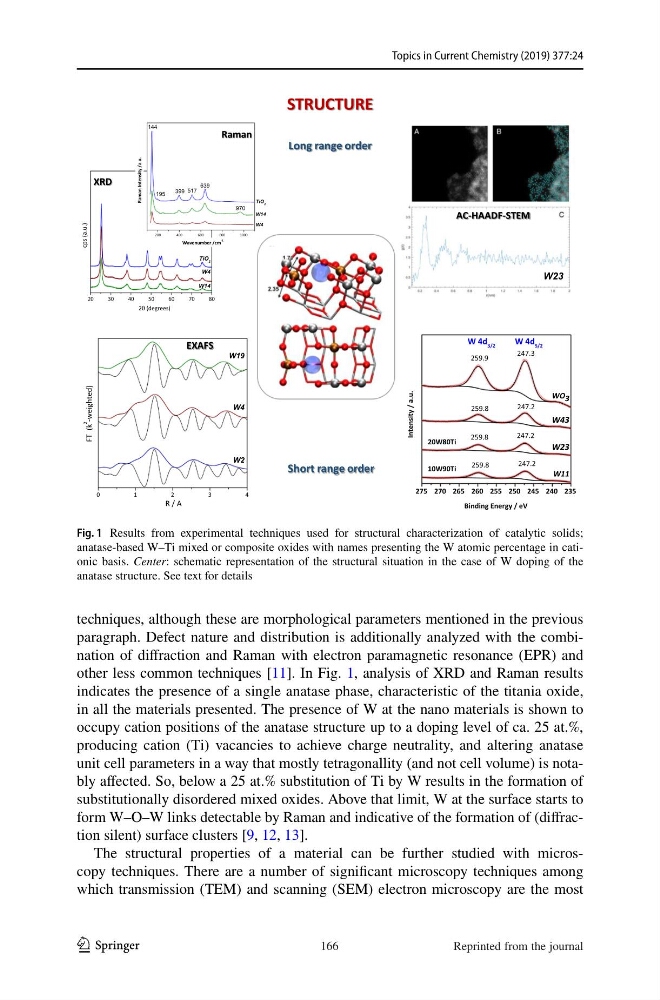
other less common techniques [11]. In Fig. 1, analysis of XRD and Raman results
indicates the presence of a single anatase phase, characteristic of the titania oxide,
in all the materials presented. The presence of W at the nano materials is shown to
occupy cation positions of the anatase structure up to a doping level of ca. 25 at.%,
producing cation (Ti) vacancies to achieve charge neutrality, and altering anatase
unit cell parameters in a way that mostly tetragonallity (and not cell volume) is notably affected. So, below a 25 at.% substitution of Ti by W results in the formation of
substitutionally disordered mixed oxides. Above that limit, W at the surface starts to
form W–O–W links detectable by Raman and indicative of the formation of (diffraction silent) surface clusters [9, 12, 13].
The structural properties of a material can be further studied with microscopy techniques. There are a number of significant microscopy techniques among
which transmission (TEM) and scanning (SEM) electron microscopy are the most
STRUCTURE
Long range order
Short range order
20
30
40
50
60
70
80
cps (a.u.)
2θ (degrees)
TiO 2
W4
W14
0
1
2
3
4
FT (k
2
-weighted)
R / A
W2
W4
W19
200
4 00
600
8 00
1000
144
W14
970
195
399 517
W4
TiO 2
Raman Intensity /a.u.
Wavenumber /cm
-1
639
Raman
XRD
EXAFS
AC-HAADF-STEM
275 270 265 260 255 250 245 240 235
W11
W23
20W80Ti
10W90Ti
Intensity / a.u.
Binding Energy / eV
247.3
247.2
247.2
247.2
259.9
259.8
259.8
259.8
W 4d 3/2
W 4d 5/2
WO 3
W43
W23
Fig. 1 Results from experimental techniques used for structural characterization of catalytic solids;
anatase-based W–Ti mixed or composite oxides with names presenting the W atomic percentage in cationic basis. Center: schematic representation of the structural situation in the case of W doping of the
anatase structure. See text for details
166
Reprinted from the journal
1 3
techniques, although these are morphological parameters mentioned in the previous
paragraph. Defect nature and distribution is additionally analyzed with the combination of diffraction and Raman with electron paramagnetic resonance (EPR) and
other less common techniques [11]. In Fig. 1, analysis of XRD and Raman results
indicates the presence of a single anatase phase, characteristic of the titania oxide,
in all the materials presented. The presence of W at the nano materials is shown to
occupy cation positions of the anatase structure up to a doping level of ca. 25 at.%,
producing cation (Ti) vacancies to achieve charge neutrality, and altering anatase
unit cell parameters in a way that mostly tetragonallity (and not cell volume) is notably affected. So, below a 25 at.% substitution of Ti by W results in the formation of
substitutionally disordered mixed oxides. Above that limit, W at the surface starts to
form W–O–W links detectable by Raman and indicative of the formation of (diffraction silent) surface clusters [9, 12, 13].
The structural properties of a material can be further studied with microscopy techniques. There are a number of significant microscopy techniques among
which transmission (TEM) and scanning (SEM) electron microscopy are the most
STRUCTURE
Long range order
Short range order
20
30
40
50
60
70
80
cps (a.u.)
2θ (degrees)
TiO 2
W4
W14
0
1
2
3
4
FT (k
2
-weighted)
R / A
W2
W4
W19
200
4 00
600
8 00
1000
144
W14
970
195
399 517
W4
TiO 2
Raman Intensity /a.u.
Wavenumber /cm
-1
639
Raman
XRD
EXAFS
AC-HAADF-STEM
275 270 265 260 255 250 245 240 235
W11
W23
20W80Ti
10W90Ti
Intensity / a.u.
Binding Energy / eV
247.3
247.2
247.2
247.2
259.9
259.8
259.8
259.8
W 4d 3/2
W 4d 5/2
WO 3
W43
W23
Fig. 1 Results from experimental techniques used for structural characterization of catalytic solids;
anatase-based W–Ti mixed or composite oxides with names presenting the W atomic percentage in cationic basis. Center: schematic representation of the structural situation in the case of W doping of the
anatase structure. See text for details
166
Reprinted from the journal