

Topics in Current Chemistry (2020) 378:6
1 3
Guijarro et al. [186] used β-FeOOH as a starting material to obtain MgFe 2 O 4 ,
CuFe 2 O 4 and ZnFe 2 O 4 thin films. After the elimination of MgO, CuO and ZnO
impurities by etching in highly acidic (for CuFe 2 O 4 , MgFe 2 O 4 ) or alkaline (for
ZnFe 2 O 4 ) conditions, the activity of the films improved when additional NiFe 2 O x
was deposited and a reductive calcination in H 2 was performed after the synthesis.
Remarkable faradaic efficiencies were described (97%), albeit with considerable
degree of recombination and Fermi level pinning at 0.9 V vs. RHE.
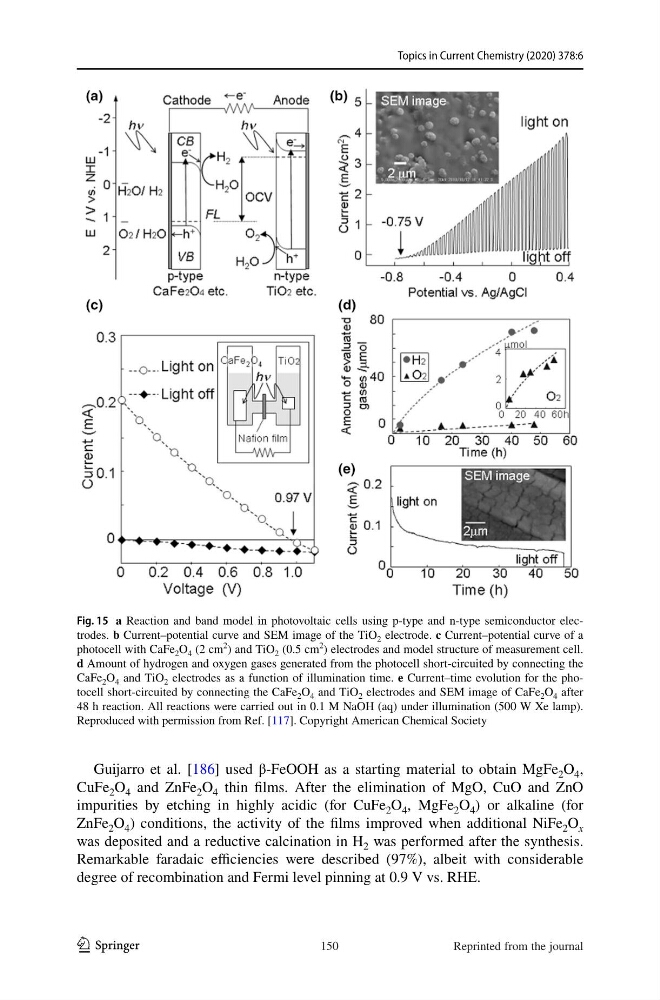
Fig. 15 a Reaction and band model in photovoltaic cells using p-type and n-type semiconductor electrodes. b Current–potential curve and SEM image of the TiO 2 electrode. c Current–potential curve of a
photocell with CaFe 2 O 4 (2 cm
2 ) and TiO 2 (0.5 cm
2
) electrodes and model structure of measurement cell.
d Amount of hydrogen and oxygen gases generated from the photocell short-circuited by connecting the
CaFe 2 O 4 and TiO 2 electrodes as a function of illumination time. e Current–time evolution for the photocell short-circuited by connecting the CaFe 2 O 4 and TiO 2 electrodes and SEM image of CaFe 2 O 4 after
48 h reaction. All reactions were carried out in 0.1 M NaOH (aq) under illumination (500 W Xe lamp).
Reproduced with permission from Ref. [117]. Copyright American Chemical Society
150
Reprinted from the journal
1 3
Guijarro et al. [186] used β-FeOOH as a starting material to obtain MgFe 2 O 4 ,
CuFe 2 O 4 and ZnFe 2 O 4 thin films. After the elimination of MgO, CuO and ZnO
impurities by etching in highly acidic (for CuFe 2 O 4 , MgFe 2 O 4 ) or alkaline (for
ZnFe 2 O 4 ) conditions, the activity of the films improved when additional NiFe 2 O x
was deposited and a reductive calcination in H 2 was performed after the synthesis.
Remarkable faradaic efficiencies were described (97%), albeit with considerable
degree of recombination and Fermi level pinning at 0.9 V vs. RHE.
Fig. 15 a Reaction and band model in photovoltaic cells using p-type and n-type semiconductor electrodes. b Current–potential curve and SEM image of the TiO 2 electrode. c Current–potential curve of a
photocell with CaFe 2 O 4 (2 cm
2 ) and TiO 2 (0.5 cm
2
) electrodes and model structure of measurement cell.
d Amount of hydrogen and oxygen gases generated from the photocell short-circuited by connecting the
CaFe 2 O 4 and TiO 2 electrodes as a function of illumination time. e Current–time evolution for the photocell short-circuited by connecting the CaFe 2 O 4 and TiO 2 electrodes and SEM image of CaFe 2 O 4 after
48 h reaction. All reactions were carried out in 0.1 M NaOH (aq) under illumination (500 W Xe lamp).
Reproduced with permission from Ref. [117]. Copyright American Chemical Society
150
Reprinted from the journal