

1 3
Topics in Current Chemistry (2020) 378:6
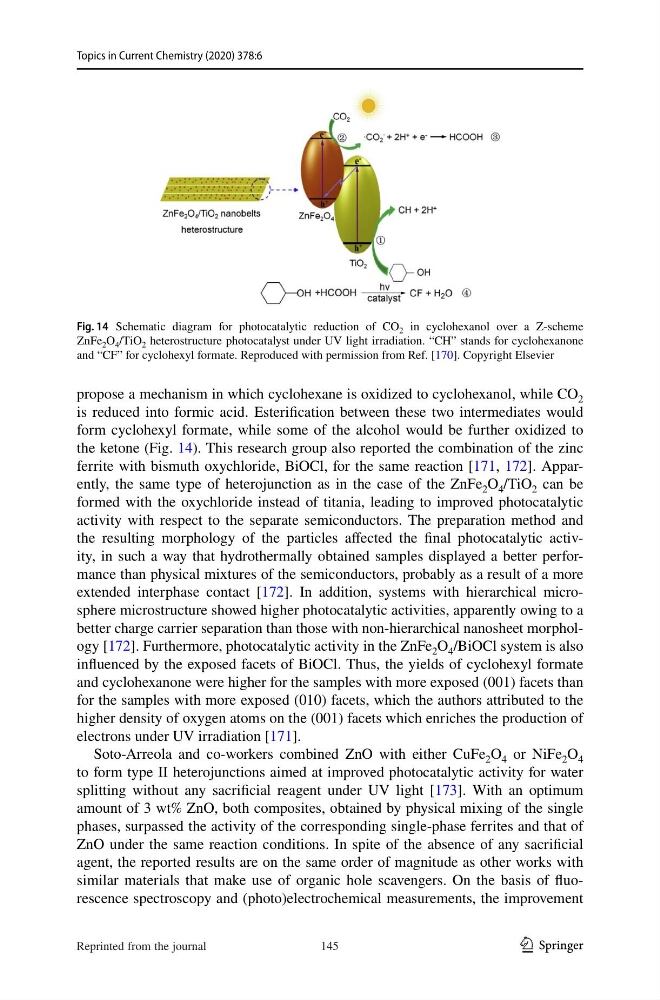
propose a mechanism in which cyclohexane is oxidized to cyclohexanol, while CO 2
is reduced into formic acid. Esterification between these two intermediates would
form cyclohexyl formate, while some of the alcohol would be further oxidized to
the ketone (Fig. 14). This research group also reported the combination of the zinc
ferrite with bismuth oxychloride, BiOCl, for the same reaction [171, 172]. Apparently, the same type of heterojunction as in the case of the ZnFe 2 O 4 /TiO 2 can be
formed with the oxychloride instead of titania, leading to improved photocatalytic
activity with respect to the separate semiconductors. The preparation method and
the resulting morphology of the particles affected the final photocatalytic activity, in such a way that hydrothermally obtained samples displayed a better performance than physical mixtures of the semiconductors, probably as a result of a more
extended interphase contact [172]. In addition, systems with hierarchical microsphere microstructure showed higher photocatalytic activities, apparently owing to a
better charge carrier separation than those with non-hierarchical nanosheet morphology [172]. Furthermore, photocatalytic activity in the ZnFe 2 O 4 /BiOCl system is also
influenced by the exposed facets of BiOCl. Thus, the yields of cyclohexyl formate
and cyclohexanone were higher for the samples with more exposed (001) facets than
for the samples with more exposed (010) facets, which the authors attributed to the
higher density of oxygen atoms on the (001) facets which enriches the production of
electrons under UV irradiation [171].
Soto-Arreola and co-workers combined ZnO with either CuFe 2 O 4 or NiFe 2 O 4
to form type II heterojunctions aimed at improved photocatalytic activity for water
splitting without any sacrificial reagent under UV light [173]. With an optimum
amount of 3 wt% ZnO, both composites, obtained by physical mixing of the single
phases, surpassed the activity of the corresponding single-phase ferrites and that of
ZnO under the same reaction conditions. In spite of the absence of any sacrificial
agent, the reported results are on the same order of magnitude as other works with
similar materials that make use of organic hole scavengers. On the basis of fluorescence spectroscopy and (photo)electrochemical measurements, the improvement
Fig. 14 Schematic diagram for photocatalytic reduction of CO 2 in cyclohexanol over a Z-scheme
ZnFe 2 O 4 /TiO 2 heterostructure photocatalyst under UV light irradiation. “CH” stands for cyclohexanone
and “CF” for cyclohexyl formate. Reproduced with permission from Ref. [170]. Copyright Elsevier
145
Reprinted from the journal
Topics in Current Chemistry (2020) 378:6
propose a mechanism in which cyclohexane is oxidized to cyclohexanol, while CO 2
is reduced into formic acid. Esterification between these two intermediates would
form cyclohexyl formate, while some of the alcohol would be further oxidized to
the ketone (Fig. 14). This research group also reported the combination of the zinc
ferrite with bismuth oxychloride, BiOCl, for the same reaction [171, 172]. Apparently, the same type of heterojunction as in the case of the ZnFe 2 O 4 /TiO 2 can be
formed with the oxychloride instead of titania, leading to improved photocatalytic
activity with respect to the separate semiconductors. The preparation method and
the resulting morphology of the particles affected the final photocatalytic activity, in such a way that hydrothermally obtained samples displayed a better performance than physical mixtures of the semiconductors, probably as a result of a more
extended interphase contact [172]. In addition, systems with hierarchical microsphere microstructure showed higher photocatalytic activities, apparently owing to a
better charge carrier separation than those with non-hierarchical nanosheet morphology [172]. Furthermore, photocatalytic activity in the ZnFe 2 O 4 /BiOCl system is also
influenced by the exposed facets of BiOCl. Thus, the yields of cyclohexyl formate
and cyclohexanone were higher for the samples with more exposed (001) facets than
for the samples with more exposed (010) facets, which the authors attributed to the
higher density of oxygen atoms on the (001) facets which enriches the production of
electrons under UV irradiation [171].
Soto-Arreola and co-workers combined ZnO with either CuFe 2 O 4 or NiFe 2 O 4
to form type II heterojunctions aimed at improved photocatalytic activity for water
splitting without any sacrificial reagent under UV light [173]. With an optimum
amount of 3 wt% ZnO, both composites, obtained by physical mixing of the single
phases, surpassed the activity of the corresponding single-phase ferrites and that of
ZnO under the same reaction conditions. In spite of the absence of any sacrificial
agent, the reported results are on the same order of magnitude as other works with
similar materials that make use of organic hole scavengers. On the basis of fluorescence spectroscopy and (photo)electrochemical measurements, the improvement
Fig. 14 Schematic diagram for photocatalytic reduction of CO 2 in cyclohexanol over a Z-scheme
ZnFe 2 O 4 /TiO 2 heterostructure photocatalyst under UV light irradiation. “CH” stands for cyclohexanone
and “CF” for cyclohexyl formate. Reproduced with permission from Ref. [170]. Copyright Elsevier
145
Reprinted from the journal