

1 3
Topics in Current Chemistry (2020) 378:6
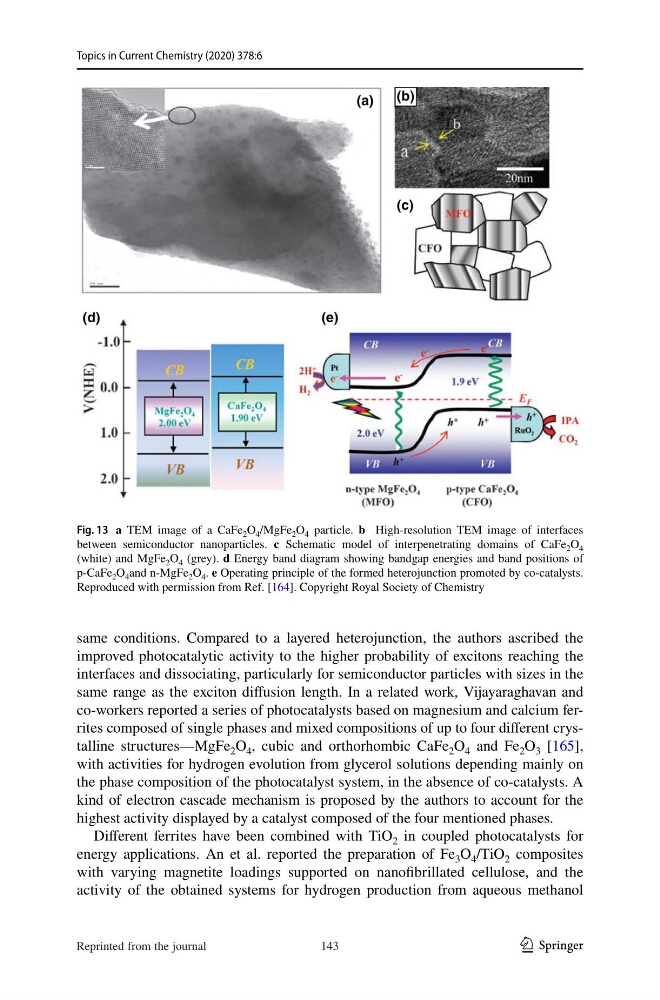
same conditions. Compared to a layered heterojunction, the authors ascribed the
improved photocatalytic activity to the higher probability of excitons reaching the
interfaces and dissociating, particularly for semiconductor particles with sizes in the
same range as the exciton diffusion length. In a related work, Vijayaraghavan and
co-workers reported a series of photocatalysts based on magnesium and calcium ferrites composed of single phases and mixed compositions of up to four different crystalline structures—MgFe 2 O 4 , cubic and orthorhombic CaFe 2 O 4 and Fe 2 O 3 [165],
with activities for hydrogen evolution from glycerol solutions depending mainly on
the phase composition of the photocatalyst system, in the absence of co-catalysts. A
kind of electron cascade mechanism is proposed by the authors to account for the
highest activity displayed by a catalyst composed of the four mentioned phases.
Different ferrites have been combined with TiO 2 in coupled photocatalysts for
energy applications. An et al. reported the preparation of Fe 3 O 4 /TiO 2 composites
with varying magnetite loadings supported on nanofibrillated cellulose, and the
activity of the obtained systems for hydrogen production from aqueous methanol
Fig. 13 a TEM image of a CaFe 2 O 4 /MgFe 2 O 4 particle. b High-resolution TEM image of interfaces
between semiconductor nanoparticles. c Schematic model of interpenetrating domains of CaFe 2 O 4
(white) and MgFe 2 O 4 (grey). d Energy band diagram showing bandgap energies and band positions of
p-CaFe 2 O 4 and n-MgFe 2 O 4 . e Operating principle of the formed heterojunction promoted by co-catalysts.
Reproduced with permission from Ref. [164]. Copyright Royal Society of Chemistry
143
Reprinted from the journal
Topics in Current Chemistry (2020) 378:6
same conditions. Compared to a layered heterojunction, the authors ascribed the
improved photocatalytic activity to the higher probability of excitons reaching the
interfaces and dissociating, particularly for semiconductor particles with sizes in the
same range as the exciton diffusion length. In a related work, Vijayaraghavan and
co-workers reported a series of photocatalysts based on magnesium and calcium ferrites composed of single phases and mixed compositions of up to four different crystalline structures—MgFe 2 O 4 , cubic and orthorhombic CaFe 2 O 4 and Fe 2 O 3 [165],
with activities for hydrogen evolution from glycerol solutions depending mainly on
the phase composition of the photocatalyst system, in the absence of co-catalysts. A
kind of electron cascade mechanism is proposed by the authors to account for the
highest activity displayed by a catalyst composed of the four mentioned phases.
Different ferrites have been combined with TiO 2 in coupled photocatalysts for
energy applications. An et al. reported the preparation of Fe 3 O 4 /TiO 2 composites
with varying magnetite loadings supported on nanofibrillated cellulose, and the
activity of the obtained systems for hydrogen production from aqueous methanol
Fig. 13 a TEM image of a CaFe 2 O 4 /MgFe 2 O 4 particle. b High-resolution TEM image of interfaces
between semiconductor nanoparticles. c Schematic model of interpenetrating domains of CaFe 2 O 4
(white) and MgFe 2 O 4 (grey). d Energy band diagram showing bandgap energies and band positions of
p-CaFe 2 O 4 and n-MgFe 2 O 4 . e Operating principle of the formed heterojunction promoted by co-catalysts.
Reproduced with permission from Ref. [164]. Copyright Royal Society of Chemistry
143
Reprinted from the journal