

1 3
Topics in Current Chemistry (2020) 378:6
crystallinity and surface area is reached. The effect of particle size and distribution
is revealed by the lower efficiency of NiFe 2 O 4 synthesized without any structuredirecting agent, which was formed by inhomogeneous agglomerations of particles.
X-ray diffraction (XRD) and X-ray photoelectron spectroscopy (XPS) studies of the
solid together with inductively coupled plasma atomic emission spectroscopy (ICPAES) analyses of the liquid reaction medium and consecutive activity runs confirmed the stability of the ferrite in the reaction conditions. In the absence of any
sacrificial reagent, some hydrogen evolution was observed in water spitting experiments, although without any oxygen production, which suggests the possibility of
self-oxidation or the possible role of organic matter remaining from the synthesis
as hole scavenger. A structure-directing agent, in this case Pluronic F-127, was also
used by Hong and co-workers to obtain mesoporous NiFe 2 O 4 photocatalysts with
high crystallinity and large surface area by a self-assembly associated aerosol spray
pyrolysis method [146], which were tested for methanol photoreforming under visible light irradiation (λ > 420 nm). Again, the highest activity of all the catalysts
appears as a compromise between crystallinity and surface area, with well-crystallized mesoporous samples resulting in higher H 2 evolution rates than amorphous
ones with small pore size and high Brunauer–Emmett–Teller (BET) values, but also
higher than a non-mesoporous, highly crystalline ferrite with relatively low surface
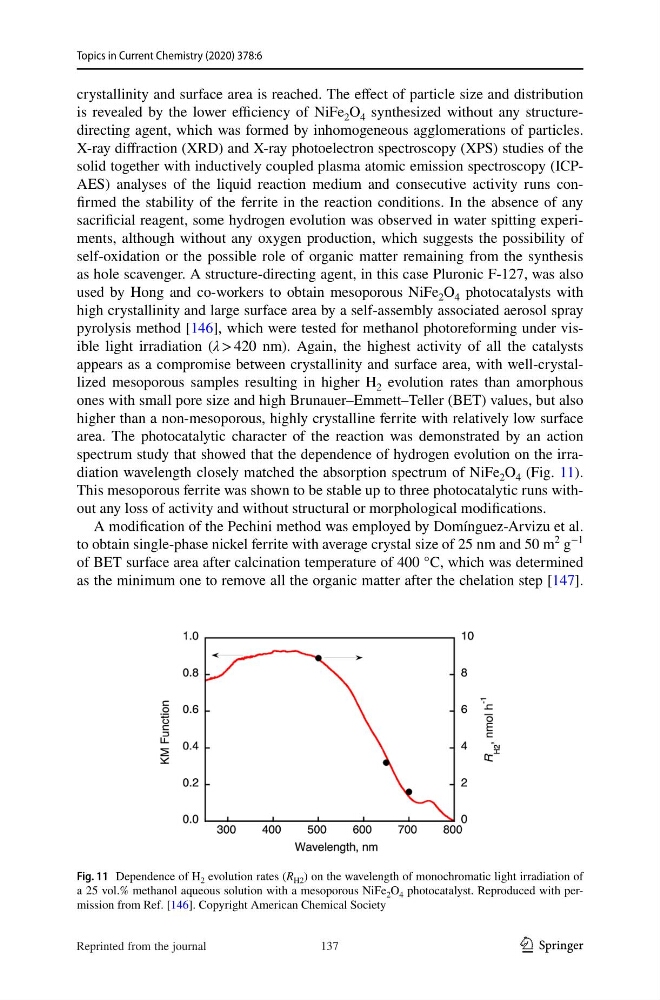
area. The photocatalytic character of the reaction was demonstrated by an action
spectrum study that showed that the dependence of hydrogen evolution on the irradiation wavelength closely matched the absorption spectrum of NiFe 2 O 4 (Fig. 11).
This mesoporous ferrite was shown to be stable up to three photocatalytic runs without any loss of activity and without structural or morphological modifications.
A modification of the Pechini method was employed by Domínguez-Arvizu et al.
to obtain single-phase nickel ferrite with average crystal size of 25 nm and 50 m
2
g
−1
of BET surface area after calcination temperature of 400 °C, which was determined
as the minimum one to remove all the organic matter after the chelation step [147].
Fig. 11 Dependence of H 2 evolution rates (R H2 ) on the wavelength of monochromatic light irradiation of
a 25 vol.% methanol aqueous solution with a mesoporous NiFe 2 O 4 photocatalyst. Reproduced with permission from Ref. [146]. Copyright American Chemical Society
137
Reprinted from the journal
Topics in Current Chemistry (2020) 378:6
crystallinity and surface area is reached. The effect of particle size and distribution
is revealed by the lower efficiency of NiFe 2 O 4 synthesized without any structuredirecting agent, which was formed by inhomogeneous agglomerations of particles.
X-ray diffraction (XRD) and X-ray photoelectron spectroscopy (XPS) studies of the
solid together with inductively coupled plasma atomic emission spectroscopy (ICPAES) analyses of the liquid reaction medium and consecutive activity runs confirmed the stability of the ferrite in the reaction conditions. In the absence of any
sacrificial reagent, some hydrogen evolution was observed in water spitting experiments, although without any oxygen production, which suggests the possibility of
self-oxidation or the possible role of organic matter remaining from the synthesis
as hole scavenger. A structure-directing agent, in this case Pluronic F-127, was also
used by Hong and co-workers to obtain mesoporous NiFe 2 O 4 photocatalysts with
high crystallinity and large surface area by a self-assembly associated aerosol spray
pyrolysis method [146], which were tested for methanol photoreforming under visible light irradiation (λ > 420 nm). Again, the highest activity of all the catalysts
appears as a compromise between crystallinity and surface area, with well-crystallized mesoporous samples resulting in higher H 2 evolution rates than amorphous
ones with small pore size and high Brunauer–Emmett–Teller (BET) values, but also
higher than a non-mesoporous, highly crystalline ferrite with relatively low surface
area. The photocatalytic character of the reaction was demonstrated by an action
spectrum study that showed that the dependence of hydrogen evolution on the irradiation wavelength closely matched the absorption spectrum of NiFe 2 O 4 (Fig. 11).
This mesoporous ferrite was shown to be stable up to three photocatalytic runs without any loss of activity and without structural or morphological modifications.
A modification of the Pechini method was employed by Domínguez-Arvizu et al.
to obtain single-phase nickel ferrite with average crystal size of 25 nm and 50 m
2
g
−1
of BET surface area after calcination temperature of 400 °C, which was determined
as the minimum one to remove all the organic matter after the chelation step [147].
Fig. 11 Dependence of H 2 evolution rates (R H2 ) on the wavelength of monochromatic light irradiation of
a 25 vol.% methanol aqueous solution with a mesoporous NiFe 2 O 4 photocatalyst. Reproduced with permission from Ref. [146]. Copyright American Chemical Society
137
Reprinted from the journal