

1 3
Topics in Current Chemistry (2020) 378:6
Recently, Li et al. [105] obtained a metal-doped zinc ferrite material by a modified microwave hydrothermal method. The authors compared synthesis using metals
in wastewater and also using chemical precursors. The catalytic test showed that the
doped material synthesized by using metals contained in wastewater was much more
active than the one using chemical precursors. Also, the substituted ferrite exhibited better efficiency than the pristine ZnFe 2 O 4 . The authors postulated that HO· are
formed through photo-generated h
+
and H 2 O 2 decomposition by Fe
3+
and Mn
3+
on
the catalyst surface. After the first cycle of reaction, 95% of Congo red was depleted
within 3 h which led to 60% of TOC conversion. After the third cycle of reaction,
75% decoloration was reached, indicating a slight loss of activity of the material.
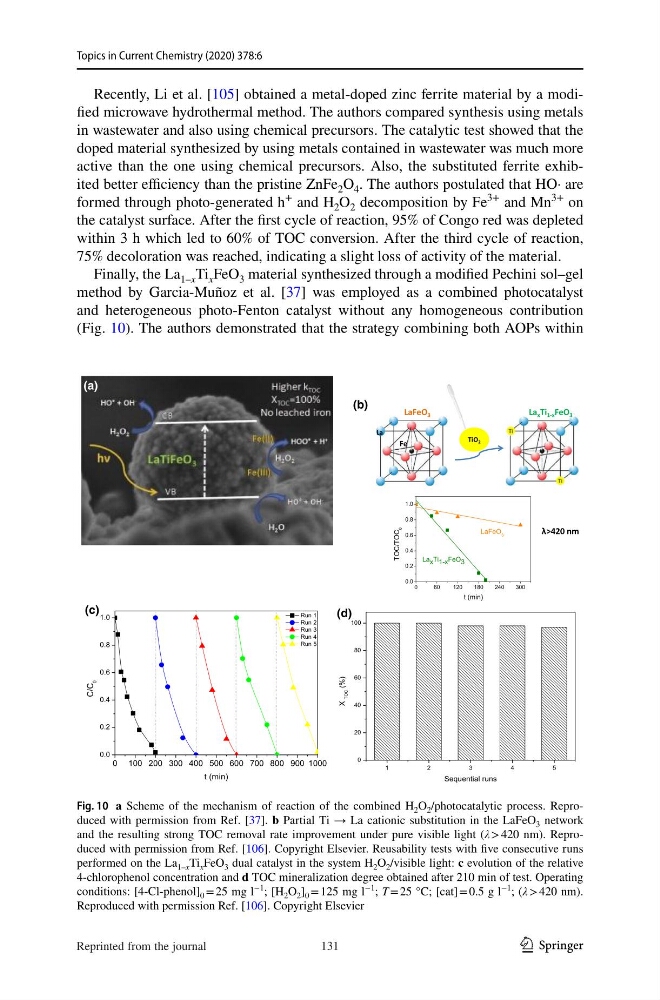
Finally, the La 1–x Ti x FeO 3 material synthesized through a modified Pechini sol–gel
method by Garcia-Muñoz et al. [37] was employed as a combined photocatalyst
and heterogeneous photo-Fenton catalyst without any homogeneous contribution
(Fig. 10). The authors demonstrated that the strategy combining both AOPs within
0
6 0
120
180
240
300
0.0
0.2
0.4
0.6
0.8
1.0
C
O
T
/
C
O
T
0
t (min)
La x Ti 1-x FeO 3
LaFeO 3
La
Fe
La x Ti 1-x FeO 3
LaFeO 3
λ>420 nm
TiO 2
0 100 200 300 400 500 600 700 800 900 1000
0.0
0.2
0.4
0.6
0.8
1.0
Run 1
Run 2
Run 3
Run 4
Run 5
C
/
C
0
t (min)
1
2
3
4
5
0
20
40
60
80
100
X
TOC
)
%
(
Sequential runs
(a)
(b)
(c)
(d)
Fig. 10 a Scheme of the mechanism of reaction of the combined H 2 O 2 /photocatalytic process. Reproduced with permission from Ref. [37]. b Partial Ti → La cationic substitution in the LaFeO 3 network
and the resulting strong TOC removal rate improvement under pure visible light (λ > 420 nm). Reproduced with permission from Ref. [106]. Copyright Elsevier. Reusability tests with five consecutive runs
performed on the La 1–x Ti x FeO 3 dual catalyst in the system H 2 O 2 /visible light: c evolution of the relative
4-chlorophenol concentration and d TOC mineralization degree obtained after 210 min of test. Operating
conditions: [4-Cl-phenol] 0 = 25 mg l
−1
; [H 2 O 2 ] 0 = 125 mg l
−1
; T = 25 °C; [cat] = 0.5 g l
−1
; (λ > 420 nm).
Reproduced with permission Ref. [106]. Copyright Elsevier
131
Reprinted from the journal
Topics in Current Chemistry (2020) 378:6
Recently, Li et al. [105] obtained a metal-doped zinc ferrite material by a modified microwave hydrothermal method. The authors compared synthesis using metals
in wastewater and also using chemical precursors. The catalytic test showed that the
doped material synthesized by using metals contained in wastewater was much more
active than the one using chemical precursors. Also, the substituted ferrite exhibited better efficiency than the pristine ZnFe 2 O 4 . The authors postulated that HO· are
formed through photo-generated h
+
and H 2 O 2 decomposition by Fe
3+
and Mn
3+
on
the catalyst surface. After the first cycle of reaction, 95% of Congo red was depleted
within 3 h which led to 60% of TOC conversion. After the third cycle of reaction,
75% decoloration was reached, indicating a slight loss of activity of the material.
Finally, the La 1–x Ti x FeO 3 material synthesized through a modified Pechini sol–gel
method by Garcia-Muñoz et al. [37] was employed as a combined photocatalyst
and heterogeneous photo-Fenton catalyst without any homogeneous contribution
(Fig. 10). The authors demonstrated that the strategy combining both AOPs within
0
6 0
120
180
240
300
0.0
0.2
0.4
0.6
0.8
1.0
C
O
T
/
C
O
T
0
t (min)
La x Ti 1-x FeO 3
LaFeO 3
La
Fe
La x Ti 1-x FeO 3
LaFeO 3
λ>420 nm
TiO 2
0 100 200 300 400 500 600 700 800 900 1000
0.0
0.2
0.4
0.6
0.8
1.0
Run 1
Run 2
Run 3
Run 4
Run 5
C
/
C
0
t (min)
1
2
3
4
5
0
20
40
60
80
100
X
TOC
)
%
(
Sequential runs
(a)
(b)
(c)
(d)
Fig. 10 a Scheme of the mechanism of reaction of the combined H 2 O 2 /photocatalytic process. Reproduced with permission from Ref. [37]. b Partial Ti → La cationic substitution in the LaFeO 3 network
and the resulting strong TOC removal rate improvement under pure visible light (λ > 420 nm). Reproduced with permission from Ref. [106]. Copyright Elsevier. Reusability tests with five consecutive runs
performed on the La 1–x Ti x FeO 3 dual catalyst in the system H 2 O 2 /visible light: c evolution of the relative
4-chlorophenol concentration and d TOC mineralization degree obtained after 210 min of test. Operating
conditions: [4-Cl-phenol] 0 = 25 mg l
−1
; [H 2 O 2 ] 0 = 125 mg l
−1
; T = 25 °C; [cat] = 0.5 g l
−1
; (λ > 420 nm).
Reproduced with permission Ref. [106]. Copyright Elsevier
131
Reprinted from the journal