

Topics in Current Chemistry (2020) 378:6
1 3
agglomeration of particles) of those kinds of catalysts characterized by relatively
small surface areas. Therefore, more complex further studies are needed.
Only two works with pure single ferrite have been published up to now, to the
best of our knowledge. Aghdam et al. [101] reported the synthesis of BiFeO 3 by a
sol–gel procedure. The resultant material showed a bandgap value of 2.1 eV, and it
was employed for the removal of NO x under UV light. The authors got 36% conversion by using a reusable catalyst.
Other strategies have also been applied in air treatment. Li et al. developed the
immobilization of several ferritic composites onto a palygorskite support [32, 33]. The
first immobilized ferrite was LaFeO 3 where Ni was replacing Fe inside the perovskite
structure; and the second was a ternary material composed of N-CQDs (nitrogen-doped
carbon quantum dots) and of PrFeO 3 acting as consistent structure to be further supported. In the first case, the LaFe 1–x Ni x O 3 structure was conditioned by the fraction
of Ni added to the synthesis. While ratios below 0.4 gave rise to pure LaFe 1–x Ni x O 3 ,
when x > 0.4 the material contained a heterojunction due to the co-precipitation of some
LaNiO 3 . However, it must be said that 90% conversion was obtained when employing
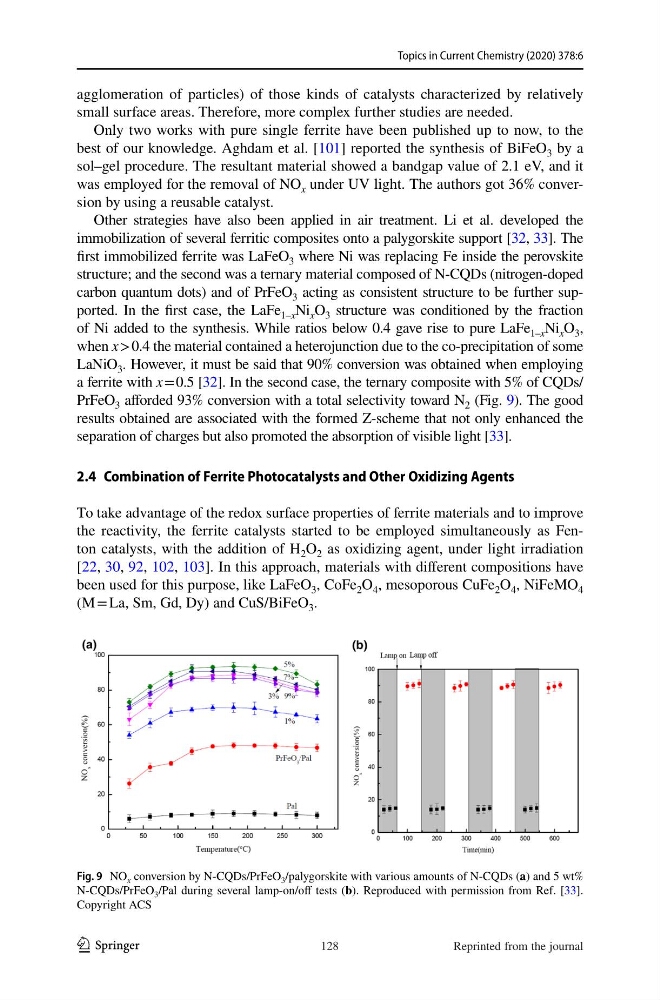
a ferrite with x = 0.5 [32]. In the second case, the ternary composite with 5% of CQDs/
PrFeO 3 afforded 93% conversion with a total selectivity toward N 2 (Fig. 9). The good
results obtained are associated with the formed Z-scheme that not only enhanced the
separation of charges but also promoted the absorption of visible light [33].
2.4 Combination of Ferrite Photocatalysts and Other Oxidizing Agents
To take advantage of the redox surface properties of ferrite materials and to improve
the reactivity, the ferrite catalysts started to be employed simultaneously as Fenton catalysts, with the addition of H 2 O 2 as oxidizing agent, under light irradiation
[22, 30, 92, 102, 103]. In this approach, materials with different compositions have
been used for this purpose, like LaFeO 3 , CoFe 2 O 4 , mesoporous CuFe 2 O 4 , NiFeMO 4
(M = La, Sm, Gd, Dy) and CuS/BiFeO 3 .
Fig. 9 NO x conversion by N-CQDs/PrFeO 3 /palygorskite with various amounts of N-CQDs (a) and 5 wt%
N-CQDs/PrFeO 3 /Pal during several lamp-on/off tests (b). Reproduced with permission from Ref. [33].
Copyright ACS
128
Reprinted from the journal
1 3
agglomeration of particles) of those kinds of catalysts characterized by relatively
small surface areas. Therefore, more complex further studies are needed.
Only two works with pure single ferrite have been published up to now, to the
best of our knowledge. Aghdam et al. [101] reported the synthesis of BiFeO 3 by a
sol–gel procedure. The resultant material showed a bandgap value of 2.1 eV, and it
was employed for the removal of NO x under UV light. The authors got 36% conversion by using a reusable catalyst.
Other strategies have also been applied in air treatment. Li et al. developed the
immobilization of several ferritic composites onto a palygorskite support [32, 33]. The
first immobilized ferrite was LaFeO 3 where Ni was replacing Fe inside the perovskite
structure; and the second was a ternary material composed of N-CQDs (nitrogen-doped
carbon quantum dots) and of PrFeO 3 acting as consistent structure to be further supported. In the first case, the LaFe 1–x Ni x O 3 structure was conditioned by the fraction
of Ni added to the synthesis. While ratios below 0.4 gave rise to pure LaFe 1–x Ni x O 3 ,
when x > 0.4 the material contained a heterojunction due to the co-precipitation of some
LaNiO 3 . However, it must be said that 90% conversion was obtained when employing
a ferrite with x = 0.5 [32]. In the second case, the ternary composite with 5% of CQDs/
PrFeO 3 afforded 93% conversion with a total selectivity toward N 2 (Fig. 9). The good
results obtained are associated with the formed Z-scheme that not only enhanced the
separation of charges but also promoted the absorption of visible light [33].
2.4 Combination of Ferrite Photocatalysts and Other Oxidizing Agents
To take advantage of the redox surface properties of ferrite materials and to improve
the reactivity, the ferrite catalysts started to be employed simultaneously as Fenton catalysts, with the addition of H 2 O 2 as oxidizing agent, under light irradiation
[22, 30, 92, 102, 103]. In this approach, materials with different compositions have
been used for this purpose, like LaFeO 3 , CoFe 2 O 4 , mesoporous CuFe 2 O 4 , NiFeMO 4
(M = La, Sm, Gd, Dy) and CuS/BiFeO 3 .
Fig. 9 NO x conversion by N-CQDs/PrFeO 3 /palygorskite with various amounts of N-CQDs (a) and 5 wt%
N-CQDs/PrFeO 3 /Pal during several lamp-on/off tests (b). Reproduced with permission from Ref. [33].
Copyright ACS
128
Reprinted from the journal