

Topics in Current Chemistry (2020) 378:6
1 3
ZnSm x Fe 2–x O 4 [21] and recently Garcia-Muñoz et al. obtained a La 1–x Ti x FeO 3 ferrite
by sol–gel method [37].
A Pechini synthesis of BaFe 1–x Cu x O 3–δ catalyst led to a material rich in oxygen
vacancies that was successfully employed for the degradation of atrazine in aqueous solution. The best photoactive catalysts comprising BaFe 0.95 Cu 0.05 O 3–δ provoked
90% atrazine removal (in 180 min of reaction) that resulted not only from the vacancies created during synthesis but also from the higher surface area [38]. In contrast,
ZnSm x Fe 2–x O 4 nanoparticles were synthesised by co-precipitation method. In this case,
the insertion of Sm
3+
ions in the ZnFe 2 O 4 spinel matrix increased the lattice parameter
and crystallite size leading to an extension of the light absorption spectrum toward the
visible range as Sm content increased up to x = 1.5 with narrow bandgap (1.42 eV).
This fact reduced the recombination of electron and holes, thereby improving the degradation of methyl orange [21]. A modified Pechini method was used for the synthesis
of Ti-modified LaFeO 3 catalysts [37]. The best performance was achieved by adding
10% of nominal TiO 2 to the synthesis. However, low activity was seen for 4-chlorophenol depletion, whether solar light or visible light was used as activation source,
which led to the implementation of other strategies that will be discussed below.
2.3 Ferrite Photocatalysts for Air Depollution
In contrast to water treatment, in the scope of air depollution, only a few works
have been recently detailed, all of them treating NO x (Table 3). The requirement for immobilizing ferrites onto supports improves the dispersion (avoiding
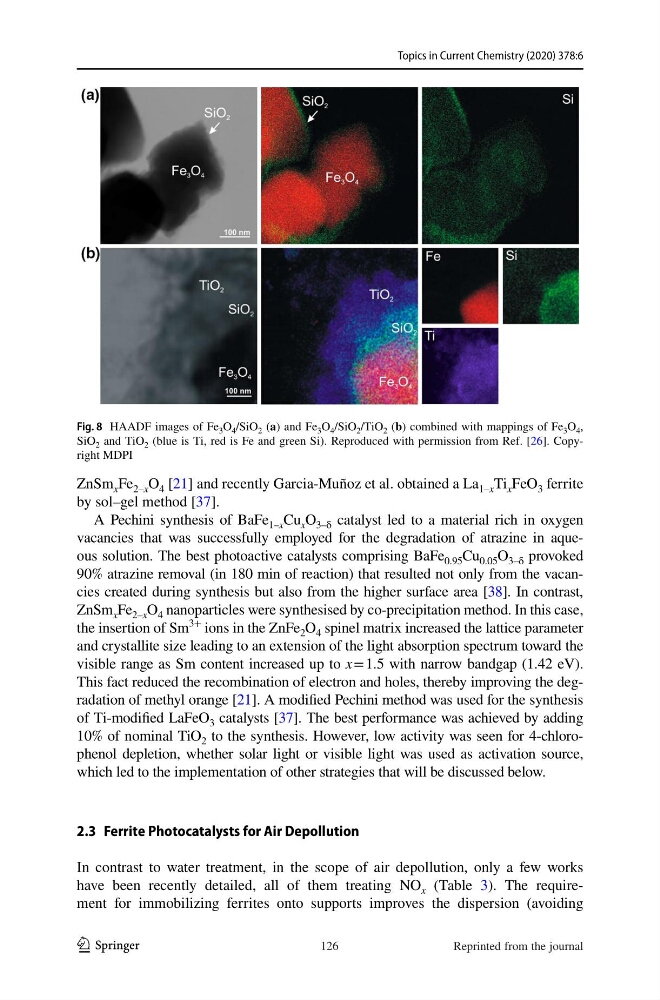
Fig. 8 HAADF images of Fe 3 O 4 /SiO 2 (a) and Fe 3 O 4 /SiO 2 /TiO 2 (b) combined with mappings of Fe 3 O 4 ,
SiO 2 and TiO 2 (blue is Ti, red is Fe and green Si). Reproduced with permission from Ref. [26]. Copyright MDPI
126
Reprinted from the journal
1 3
ZnSm x Fe 2–x O 4 [21] and recently Garcia-Muñoz et al. obtained a La 1–x Ti x FeO 3 ferrite
by sol–gel method [37].
A Pechini synthesis of BaFe 1–x Cu x O 3–δ catalyst led to a material rich in oxygen
vacancies that was successfully employed for the degradation of atrazine in aqueous solution. The best photoactive catalysts comprising BaFe 0.95 Cu 0.05 O 3–δ provoked
90% atrazine removal (in 180 min of reaction) that resulted not only from the vacancies created during synthesis but also from the higher surface area [38]. In contrast,
ZnSm x Fe 2–x O 4 nanoparticles were synthesised by co-precipitation method. In this case,
the insertion of Sm
3+
ions in the ZnFe 2 O 4 spinel matrix increased the lattice parameter
and crystallite size leading to an extension of the light absorption spectrum toward the
visible range as Sm content increased up to x = 1.5 with narrow bandgap (1.42 eV).
This fact reduced the recombination of electron and holes, thereby improving the degradation of methyl orange [21]. A modified Pechini method was used for the synthesis
of Ti-modified LaFeO 3 catalysts [37]. The best performance was achieved by adding
10% of nominal TiO 2 to the synthesis. However, low activity was seen for 4-chlorophenol depletion, whether solar light or visible light was used as activation source,
which led to the implementation of other strategies that will be discussed below.
2.3 Ferrite Photocatalysts for Air Depollution
In contrast to water treatment, in the scope of air depollution, only a few works
have been recently detailed, all of them treating NO x (Table 3). The requirement for immobilizing ferrites onto supports improves the dispersion (avoiding
Fig. 8 HAADF images of Fe 3 O 4 /SiO 2 (a) and Fe 3 O 4 /SiO 2 /TiO 2 (b) combined with mappings of Fe 3 O 4 ,
SiO 2 and TiO 2 (blue is Ti, red is Fe and green Si). Reproduced with permission from Ref. [26]. Copyright MDPI
126
Reprinted from the journal