

1 3
Topics in Current Chemistry (2020) 378:6
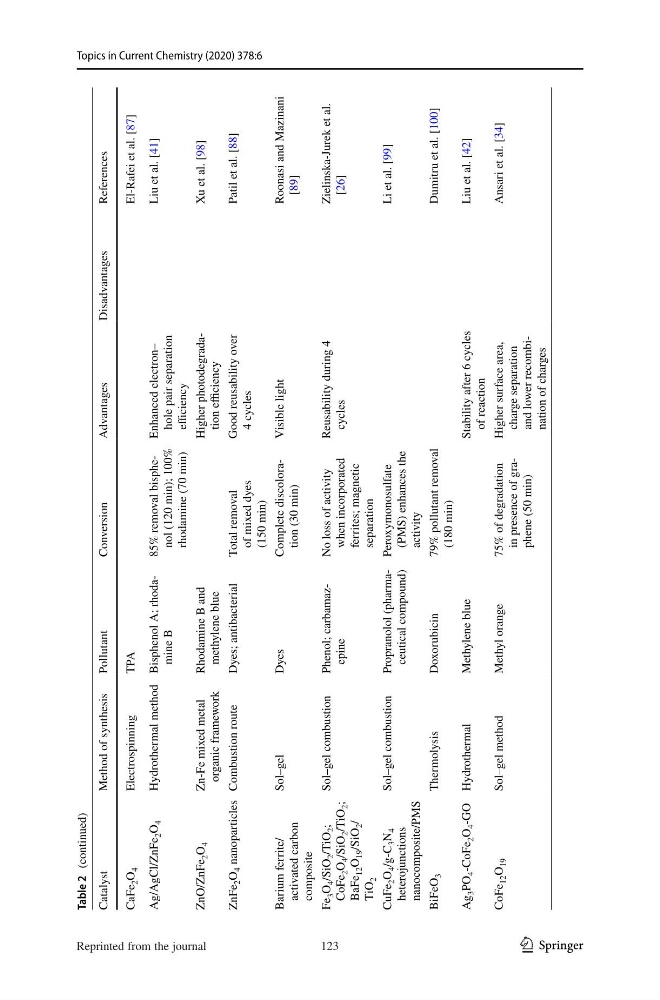
Table 2
(continued)
Catalyst
Method of synthesis
Pollutant
Conversion
Advantages
Disadvantages
References
CaFe
2 O
4
Electrospinning
TPA
El-Rafei et al. [87]
Ag/AgCl/ZnFe
2 O
4
Hydrothermal method Bisphenol A; rhodamine B
85% removal bisphenol (120 min); 100%
rhodamine (70 min)
Enhanced electron–
hole pair separation
efficiency
Liu et al. [41]
ZnO/ZnFe
2 O
4
Zn-Fe mixed metal
organic framework
Rhodamine B and
methylene blue
Higher photodegradation efficiency
Xu et al. [98]
ZnFe
2 O
4 nanoparticles Combustion route
Dyes; antibacterial
Total removal
of mixed dyes
(150 min)
Good reusability over
4 cycles
Patil et al. [88]
Barium ferrite/
activated carbon
composite
Sol–gel
Dyes
Complete discoloration (30 min)
Visible light
Roonasi and Mazinani
[89]
Fe
3 O
4 /SiO
2 /TiO
2 ;
CoFe
2 O
4 /SiO
2 /TiO
2 ;
BaFe
12 O
19 /SiO
2 /
TiO
2
Sol–gel combustion
Phenol; carbamazepine
No loss of activity
when incorporated
ferrites; magnetic
separation
Reusability during 4
cycles
Zielinska-Jurek et al.
[26]
CuFe
2 O
4 /g-C
3 N
4
heterojunctions
nanocomposite/PMS
Sol–gel combustion
Propranolol (pharmaceutical compound)
Peroxymonosulfate
(PMS) enhances the
activity
Li et al. [99]
BiFeO
3
Thermolysis
Doxorubicin
79% pollutant removal
(180 min)
Dumitru et al. [100]
Ag
3 PO
4 -CoFe
2 O
4 -GO Hydrothermal
Methylene blue
Stability after 6 cycles
of reaction
Liu et al. [42]
CoFe
12 O
19
Sol–gel method
Methyl orange
75% of degradation
in presence of graphene (50 min)
Higher surface area,
charge separation
and lower recombination of charges
Ansari et al. [34]
123
Reprinted from the journal
Topics in Current Chemistry (2020) 378:6
Table 2
(continued)
Catalyst
Method of synthesis
Pollutant
Conversion
Advantages
Disadvantages
References
CaFe
2 O
4
Electrospinning
TPA
El-Rafei et al. [87]
Ag/AgCl/ZnFe
2 O
4
Hydrothermal method Bisphenol A; rhodamine B
85% removal bisphenol (120 min); 100%
rhodamine (70 min)
Enhanced electron–
hole pair separation
efficiency
Liu et al. [41]
ZnO/ZnFe
2 O
4
Zn-Fe mixed metal
organic framework
Rhodamine B and
methylene blue
Higher photodegradation efficiency
Xu et al. [98]
ZnFe
2 O
4 nanoparticles Combustion route
Dyes; antibacterial
Total removal
of mixed dyes
(150 min)
Good reusability over
4 cycles
Patil et al. [88]
Barium ferrite/
activated carbon
composite
Sol–gel
Dyes
Complete discoloration (30 min)
Visible light
Roonasi and Mazinani
[89]
Fe
3 O
4 /SiO
2 /TiO
2 ;
CoFe
2 O
4 /SiO
2 /TiO
2 ;
BaFe
12 O
19 /SiO
2 /
TiO
2
Sol–gel combustion
Phenol; carbamazepine
No loss of activity
when incorporated
ferrites; magnetic
separation
Reusability during 4
cycles
Zielinska-Jurek et al.
[26]
CuFe
2 O
4 /g-C
3 N
4
heterojunctions
nanocomposite/PMS
Sol–gel combustion
Propranolol (pharmaceutical compound)
Peroxymonosulfate
(PMS) enhances the
activity
Li et al. [99]
BiFeO
3
Thermolysis
Doxorubicin
79% pollutant removal
(180 min)
Dumitru et al. [100]
Ag
3 PO
4 -CoFe
2 O
4 -GO Hydrothermal
Methylene blue
Stability after 6 cycles
of reaction
Liu et al. [42]
CoFe
12 O
19
Sol–gel method
Methyl orange
75% of degradation
in presence of graphene (50 min)
Higher surface area,
charge separation
and lower recombination of charges
Ansari et al. [34]
123
Reprinted from the journal