

Topics in Current Chemistry (2020) 378:6
1 3
it may result in materials with low crystallinity and therefore with a low photoactivity due to a high recombination rate.
Most of the ferrite materials are semiconductors and take advantage of being
able to absorb visible light owing to a bandgap of about 2 eV (corresponding to
wavelengths lower than 621 nm). This contrasts with the very popular anatase
TiO 2 reference material, whose bandgap of 3.2 eV allows only the absorption of
UV light, corresponding to wavelengths lower than 388 nm. Most of ferrites display energy positions of both valence and conduction bands suitable for either
the oxidation of water, the reduction of protons and/or the generation of active
hydroxyl radicals from water and the reduction of dioxygen into the superoxide
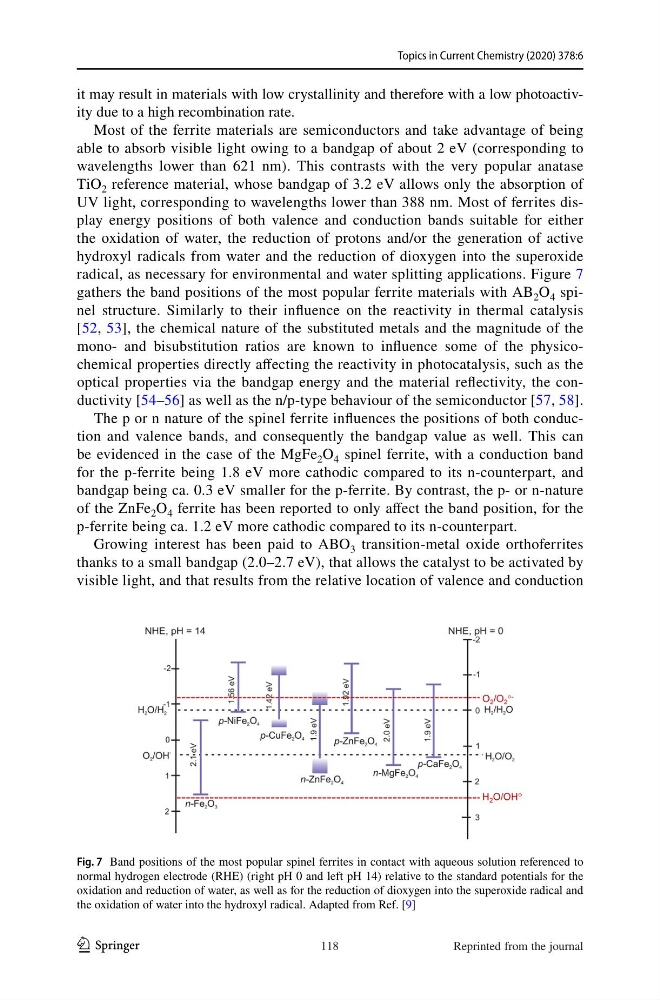
radical, as necessary for environmental and water splitting applications. Figure 7
gathers the band positions of the most popular ferrite materials with AB 2 O 4 spinel structure. Similarly to their influence on the reactivity in thermal catalysis
[52, 53], the chemical nature of the substituted metals and the magnitude of the
mono- and bisubstitution ratios are known to influence some of the physicochemical properties directly affecting the reactivity in photocatalysis, such as the
optical properties via the bandgap energy and the material reflectivity, the conductivity [54–56] as well as the n/p-type behaviour of the semiconductor [57, 58].
The p or n nature of the spinel ferrite influences the positions of both conduction and valence bands, and consequently the bandgap value as well. This can
be evidenced in the case of the MgFe 2 O 4 spinel ferrite, with a conduction band
for the p-ferrite being 1.8 eV more cathodic compared to its n-counterpart, and
bandgap being ca. 0.3 eV smaller for the p-ferrite. By contrast, the p- or n-nature
of the ZnFe 2 O 4 ferrite has been reported to only affect the band position, for the
p-ferrite being ca. 1.2 eV more cathodic compared to its n-counterpart.
Growing interest has been paid to ABO 3 transition-metal oxide orthoferrites
thanks to a small bandgap (2.0–2.7 eV), that allows the catalyst to be activated by
visible light, and that results from the relative location of valence and conduction
Fig. 7 Band positions of the most popular spinel ferrites in contact with aqueous solution referenced to
normal hydrogen electrode (RHE) (right pH 0 and left pH 14) relative to the standard potentials for the
oxidation and reduction of water, as well as for the reduction of dioxygen into the superoxide radical and
the oxidation of water into the hydroxyl radical. Adapted from Ref. [9]
118
Reprinted from the journal
1 3
it may result in materials with low crystallinity and therefore with a low photoactivity due to a high recombination rate.
Most of the ferrite materials are semiconductors and take advantage of being
able to absorb visible light owing to a bandgap of about 2 eV (corresponding to
wavelengths lower than 621 nm). This contrasts with the very popular anatase
TiO 2 reference material, whose bandgap of 3.2 eV allows only the absorption of
UV light, corresponding to wavelengths lower than 388 nm. Most of ferrites display energy positions of both valence and conduction bands suitable for either
the oxidation of water, the reduction of protons and/or the generation of active
hydroxyl radicals from water and the reduction of dioxygen into the superoxide
radical, as necessary for environmental and water splitting applications. Figure 7
gathers the band positions of the most popular ferrite materials with AB 2 O 4 spinel structure. Similarly to their influence on the reactivity in thermal catalysis
[52, 53], the chemical nature of the substituted metals and the magnitude of the
mono- and bisubstitution ratios are known to influence some of the physicochemical properties directly affecting the reactivity in photocatalysis, such as the
optical properties via the bandgap energy and the material reflectivity, the conductivity [54–56] as well as the n/p-type behaviour of the semiconductor [57, 58].
The p or n nature of the spinel ferrite influences the positions of both conduction and valence bands, and consequently the bandgap value as well. This can
be evidenced in the case of the MgFe 2 O 4 spinel ferrite, with a conduction band
for the p-ferrite being 1.8 eV more cathodic compared to its n-counterpart, and
bandgap being ca. 0.3 eV smaller for the p-ferrite. By contrast, the p- or n-nature
of the ZnFe 2 O 4 ferrite has been reported to only affect the band position, for the
p-ferrite being ca. 1.2 eV more cathodic compared to its n-counterpart.
Growing interest has been paid to ABO 3 transition-metal oxide orthoferrites
thanks to a small bandgap (2.0–2.7 eV), that allows the catalyst to be activated by
visible light, and that results from the relative location of valence and conduction
Fig. 7 Band positions of the most popular spinel ferrites in contact with aqueous solution referenced to
normal hydrogen electrode (RHE) (right pH 0 and left pH 14) relative to the standard potentials for the
oxidation and reduction of water, as well as for the reduction of dioxygen into the superoxide radical and
the oxidation of water into the hydroxyl radical. Adapted from Ref. [9]
118
Reprinted from the journal