

1 3
Topics in Current Chemistry (2020) 378:6
hedral B-sites, e.g. NiZnFe 2 O 4 , MgZnFe 2 O 4 , ZnMnFe 2 O 4 , MnNiFe 2 O 4 ,
CuZnFe 2 O 4 or NiCuZnFe 2 O 4 .
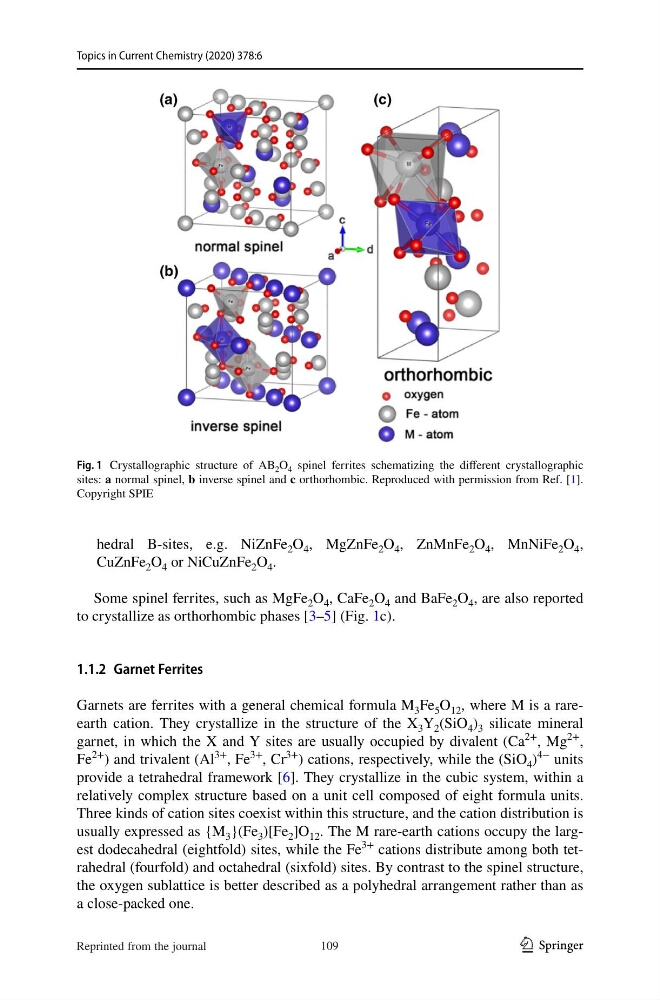
Some spinel ferrites, such as MgFe 2 O 4 , CaFe 2 O 4 and BaFe 2 O 4 , are also reported
to crystallize as orthorhombic phases [3–5] (Fig. 1c).
1.1.2 Garnet Ferrites
Garnets are ferrites with a general chemical formula M 3 Fe 5 O 12 , where M is a rareearth cation. They crystallize in the structure of the X 3 Y 2 (SiO 4 ) 3 silicate mineral
garnet, in which the X and Y sites are usually occupied by divalent (Ca
2+
, Mg
2+
,
Fe
2+
) and trivalent (Al
3+
, Fe
3+
, Cr
3+
) cations, respectively, while the (SiO 4 )
4−
units
provide a tetrahedral framework [6]. They crystallize in the cubic system, within a
relatively complex structure based on a unit cell composed of eight formula units.
Three kinds of cation sites coexist within this structure, and the cation distribution is
usually expressed as {M 3 }(Fe 3 )[Fe 2 ]O 12 . The M rare-earth cations occupy the largest dodecahedral (eightfold) sites, while the Fe
3+
cations distribute among both tetrahedral (fourfold) and octahedral (sixfold) sites. By contrast to the spinel structure,
the oxygen sublattice is better described as a polyhedral arrangement rather than as
a close-packed one.
Fig. 1 Crystallographic structure of AB 2 O 4 spinel ferrites schematizing the different crystallographic
sites: a normal spinel, b inverse spinel and c orthorhombic. Reproduced with permission from Ref. [1].
Copyright SPIE
109
Reprinted from the journal
Topics in Current Chemistry (2020) 378:6
hedral B-sites, e.g. NiZnFe 2 O 4 , MgZnFe 2 O 4 , ZnMnFe 2 O 4 , MnNiFe 2 O 4 ,
CuZnFe 2 O 4 or NiCuZnFe 2 O 4 .
Some spinel ferrites, such as MgFe 2 O 4 , CaFe 2 O 4 and BaFe 2 O 4 , are also reported
to crystallize as orthorhombic phases [3–5] (Fig. 1c).
1.1.2 Garnet Ferrites
Garnets are ferrites with a general chemical formula M 3 Fe 5 O 12 , where M is a rareearth cation. They crystallize in the structure of the X 3 Y 2 (SiO 4 ) 3 silicate mineral
garnet, in which the X and Y sites are usually occupied by divalent (Ca
2+
, Mg
2+
,
Fe
2+
) and trivalent (Al
3+
, Fe
3+
, Cr
3+
) cations, respectively, while the (SiO 4 )
4−
units
provide a tetrahedral framework [6]. They crystallize in the cubic system, within a
relatively complex structure based on a unit cell composed of eight formula units.
Three kinds of cation sites coexist within this structure, and the cation distribution is
usually expressed as {M 3 }(Fe 3 )[Fe 2 ]O 12 . The M rare-earth cations occupy the largest dodecahedral (eightfold) sites, while the Fe
3+
cations distribute among both tetrahedral (fourfold) and octahedral (sixfold) sites. By contrast to the spinel structure,
the oxygen sublattice is better described as a polyhedral arrangement rather than as
a close-packed one.
Fig. 1 Crystallographic structure of AB 2 O 4 spinel ferrites schematizing the different crystallographic
sites: a normal spinel, b inverse spinel and c orthorhombic. Reproduced with permission from Ref. [1].
Copyright SPIE
109
Reprinted from the journal