

1 3
Topics in Current Chemistry (2019) 377:5
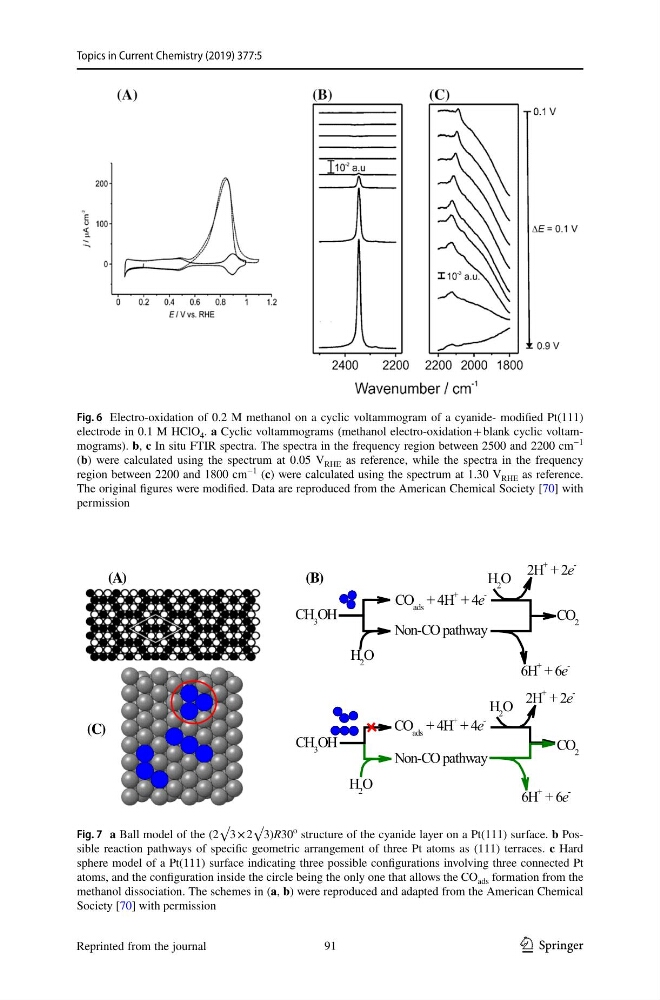
Fig. 6 Electro-oxidation of 0.2 M methanol on a cyclic voltammogram of a cyanide- modified Pt(111)
electrode in 0.1 M HClO 4 . a Cyclic voltammograms (methanol electro-oxidation + blank cyclic voltammograms). b, c In situ FTIR spectra. The spectra in the frequency region between 2500 and 2200 cm
−1
(b) were calculated using the spectrum at 0.05 V RHE as reference, while the spectra in the frequency
region between 2200 and 1800 cm
−1 (c) were calculated using the spectrum at 1.30 V RHE as reference.
The original figures were modified. Data are reproduced from the American Chemical Society [70] with
permission
CO 2
CO 2
6H
+
+ 6e
-
6H
+
+ 6e
-
H 2 O
2H
+
+ 2e
-
2H
+
+ 2e
-
H 2 O
H 2 O
H 2 O
Non-CO pathway
CO ads + 4H
+
+ 4e
-
Non-CO pathway
CO ads + 4H
+
+ 4e
-
CH 3 OH
(C)
(A)
(B)
CH 3 OH
Fig. 7 a Ball model of the (2√3 × 2√3)R30
o structure of the cyanide layer on a Pt(111) surface. b Possible reaction pathways of specific geometric arrangement of three Pt atoms as (111) terraces. c Hard
sphere model of a Pt(111) surface indicating three possible configurations involving three connected Pt
atoms, and the configuration inside the circle being the only one that allows the CO ads formation from the
methanol dissociation. The schemes in (a, b) were reproduced and adapted from the American Chemical
Society [70] with permission
Reprinted from the journal
91
Topics in Current Chemistry (2019) 377:5
Fig. 6 Electro-oxidation of 0.2 M methanol on a cyclic voltammogram of a cyanide- modified Pt(111)
electrode in 0.1 M HClO 4 . a Cyclic voltammograms (methanol electro-oxidation + blank cyclic voltammograms). b, c In situ FTIR spectra. The spectra in the frequency region between 2500 and 2200 cm
−1
(b) were calculated using the spectrum at 0.05 V RHE as reference, while the spectra in the frequency
region between 2200 and 1800 cm
−1 (c) were calculated using the spectrum at 1.30 V RHE as reference.
The original figures were modified. Data are reproduced from the American Chemical Society [70] with
permission
CO 2
CO 2
6H
+
+ 6e
-
6H
+
+ 6e
-
H 2 O
2H
+
+ 2e
-
2H
+
+ 2e
-
H 2 O
H 2 O
H 2 O
Non-CO pathway
CO ads + 4H
+
+ 4e
-
Non-CO pathway
CO ads + 4H
+
+ 4e
-
CH 3 OH
(C)
(A)
(B)
CH 3 OH
Fig. 7 a Ball model of the (2√3 × 2√3)R30
o structure of the cyanide layer on a Pt(111) surface. b Possible reaction pathways of specific geometric arrangement of three Pt atoms as (111) terraces. c Hard
sphere model of a Pt(111) surface indicating three possible configurations involving three connected Pt
atoms, and the configuration inside the circle being the only one that allows the CO ads formation from the
methanol dissociation. The schemes in (a, b) were reproduced and adapted from the American Chemical
Society [70] with permission
Reprinted from the journal
91