

Topics in Current Chemistry (2019) 377:5
1 3
structure stays stable during the reaction, which could not be the case. Also, the
uncontrolled crystallographic features such as holes, ad-atoms or ad-islands are
not considered. In practice, unevenly distributed sites or the atom arrangement
on surfaces are reflected in the variation of the local physical properties intrinsic
to the surfaces, as the work function [19, 20], and imperfections, such as steps,
create electronic perturbation on the terraces [21]. These modifications at the
catalyst surface originate deep consequences in the catalytic properties and open
the possibility of tuning the properties of the catalyst, in a controlled way. In
fact, there are surface-catalyzed reactions which preferentially take place at the
low coordination sites, typically at step or kink sites, while there are others reactions which occur preferentially at terraces [22].
Attempts to classify the electrocatalytic reactions as to their dependence
on the surface structure (and size scale) of the electrocatalytic materials have
appeared in literature [9]. However, beyond the structure of the topmost layer of
atoms at the surface, combining the effects of electronic and geometric nature
[23], the electrocatalytic properties very often depend on factors external to the
structure of the catalyst surface, i.e., the electrochemical environments where
the “active sites” exists at the catalyst surfaces. In this regard, the nature of an
electrolyte’s anions, cations and its pH also exert influence on the performance
of the catalyst. In fact, at different potentials, the nature of anions and their ability (and strength) to attach on the catalyst surface can induce preferential reaction pathways [24]. In the case of solution pH, the mechanisms by which this
parameter affects the catalytic activity are much more complex than previously
thought. In this sense, at the surface of a similar catalyst (consisting of nonequivalent sites), the change of solution pH passing from acidic toward alkalinity catalytically favored some kinds of sites [as highly coordinated Pt atoms, of
(111) terrace sites], while the catalytic activity of the sites consisting of lowcoordination atoms was inhibited [25]. Then, recognition of active sites in electrocatalysis involves at least two environmental aspects: one intrinsic to the catalyst surface, involving geometric and electronic factors (which include scale or
size factors) and the possible influence of the local electrochemical environment
(extrinsic to the catalyst surface). In the following, some of these aspects, such
as surface structure, are considered constant unless otherwise stated, under the
whole experiment, but others vary with applied potential.
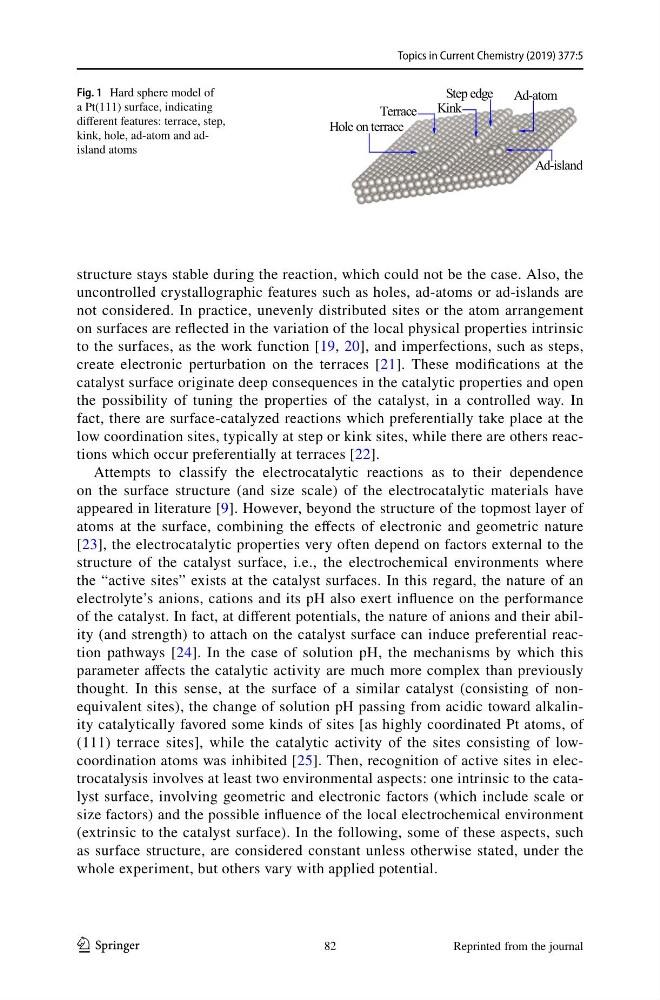
Fig. 1 Hard sphere model of
a Pt(111) surface, indicating
different features: terrace, step,
kink, hole, ad-atom and adisland atoms
Ad-atom
Step edge
Hole on terrace
Terrace Kink
Ad-island
Reprinted from the journal
82
1 3
structure stays stable during the reaction, which could not be the case. Also, the
uncontrolled crystallographic features such as holes, ad-atoms or ad-islands are
not considered. In practice, unevenly distributed sites or the atom arrangement
on surfaces are reflected in the variation of the local physical properties intrinsic
to the surfaces, as the work function [19, 20], and imperfections, such as steps,
create electronic perturbation on the terraces [21]. These modifications at the
catalyst surface originate deep consequences in the catalytic properties and open
the possibility of tuning the properties of the catalyst, in a controlled way. In
fact, there are surface-catalyzed reactions which preferentially take place at the
low coordination sites, typically at step or kink sites, while there are others reactions which occur preferentially at terraces [22].
Attempts to classify the electrocatalytic reactions as to their dependence
on the surface structure (and size scale) of the electrocatalytic materials have
appeared in literature [9]. However, beyond the structure of the topmost layer of
atoms at the surface, combining the effects of electronic and geometric nature
[23], the electrocatalytic properties very often depend on factors external to the
structure of the catalyst surface, i.e., the electrochemical environments where
the “active sites” exists at the catalyst surfaces. In this regard, the nature of an
electrolyte’s anions, cations and its pH also exert influence on the performance
of the catalyst. In fact, at different potentials, the nature of anions and their ability (and strength) to attach on the catalyst surface can induce preferential reaction pathways [24]. In the case of solution pH, the mechanisms by which this
parameter affects the catalytic activity are much more complex than previously
thought. In this sense, at the surface of a similar catalyst (consisting of nonequivalent sites), the change of solution pH passing from acidic toward alkalinity catalytically favored some kinds of sites [as highly coordinated Pt atoms, of
(111) terrace sites], while the catalytic activity of the sites consisting of lowcoordination atoms was inhibited [25]. Then, recognition of active sites in electrocatalysis involves at least two environmental aspects: one intrinsic to the catalyst surface, involving geometric and electronic factors (which include scale or
size factors) and the possible influence of the local electrochemical environment
(extrinsic to the catalyst surface). In the following, some of these aspects, such
as surface structure, are considered constant unless otherwise stated, under the
whole experiment, but others vary with applied potential.
Fig. 1 Hard sphere model of
a Pt(111) surface, indicating
different features: terrace, step,
kink, hole, ad-atom and adisland atoms
Ad-atom
Step edge
Hole on terrace
Terrace Kink
Ad-island
Reprinted from the journal
82