

1 3
Topics in Current Chemistry (2018) 376:42
account of the premise of equal mass for each catalyst, the absolute content of the
main active component Ni changed to be lacked with gradually increasing the Co
content. To sum up, although the Co-doping reduces the reaction over-potential, the
current density decreased on the contrary. To overcome this drawback, Zn was further co-deposited with Ni and Ni–Co for fabricating multivariate nickel-based alloy
catalysts by Botte et al. [83]. More interestingly, the electrochemical performance
of Ni–Zn catalysts was three times that of Ni, while OOP was reduced by ~ 0.04 V.
Otherwise, Ni–Zn–Co catalyst further decreased OOP by 0.08 V without dropping
the current density.
Except for Co element, the doping of other transition metal elements has achieved
preliminary results in the field of urea electro-oxidation more recently. Wu et al. [84]
fabricated carbon-coated nickel–iron alloy nanoparticles with further adhered to the
macroporous Ni foam (noted as C@Ni–Fe/NF) as unique catalysts with core–shell
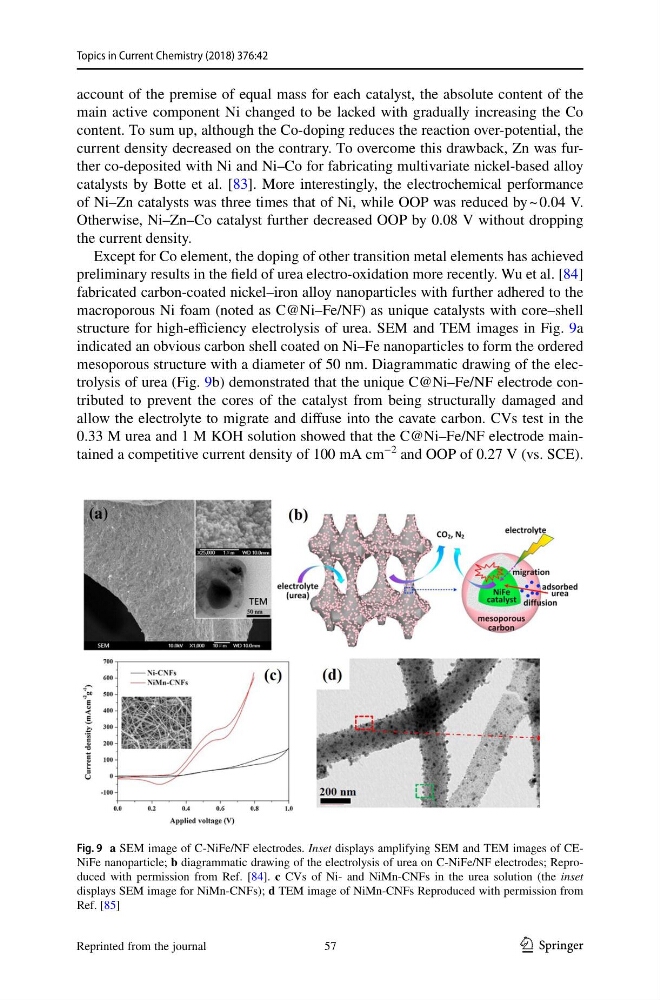
structure for high-efficiency electrolysis of urea. SEM and TEM images in Fig. 9a
indicated an obvious carbon shell coated on Ni–Fe nanoparticles to form the ordered
mesoporous structure with a diameter of 50 nm. Diagrammatic drawing of the electrolysis of urea (Fig. 9b) demonstrated that the unique C@Ni–Fe/NF electrode contributed to prevent the cores of the catalyst from being structurally damaged and
allow the electrolyte to migrate and diffuse into the cavate carbon. CVs test in the
0.33 M urea and 1 M KOH solution showed that the C@Ni–Fe/NF electrode maintained a competitive current density of 100 mA cm
−2
and OOP of 0.27 V (vs. SCE).
Fig. 9 a SEM image of C-NiFe/NF electrodes. Inset displays amplifying SEM and TEM images of CENiFe nanoparticle; b diagrammatic drawing of the electrolysis of urea on C-NiFe/NF electrodes; Reproduced with permission from Ref. [84]. c CVs of Ni- and NiMn-CNFs in the urea solution (the inset
displays SEM image for NiMn-CNFs); d TEM image of NiMn-CNFs Reproduced with permission from
Ref. [85]
Reprinted from the journal
57
Topics in Current Chemistry (2018) 376:42
account of the premise of equal mass for each catalyst, the absolute content of the
main active component Ni changed to be lacked with gradually increasing the Co
content. To sum up, although the Co-doping reduces the reaction over-potential, the
current density decreased on the contrary. To overcome this drawback, Zn was further co-deposited with Ni and Ni–Co for fabricating multivariate nickel-based alloy
catalysts by Botte et al. [83]. More interestingly, the electrochemical performance
of Ni–Zn catalysts was three times that of Ni, while OOP was reduced by ~ 0.04 V.
Otherwise, Ni–Zn–Co catalyst further decreased OOP by 0.08 V without dropping
the current density.
Except for Co element, the doping of other transition metal elements has achieved
preliminary results in the field of urea electro-oxidation more recently. Wu et al. [84]
fabricated carbon-coated nickel–iron alloy nanoparticles with further adhered to the
macroporous Ni foam (noted as C@Ni–Fe/NF) as unique catalysts with core–shell
structure for high-efficiency electrolysis of urea. SEM and TEM images in Fig. 9a
indicated an obvious carbon shell coated on Ni–Fe nanoparticles to form the ordered
mesoporous structure with a diameter of 50 nm. Diagrammatic drawing of the electrolysis of urea (Fig. 9b) demonstrated that the unique C@Ni–Fe/NF electrode contributed to prevent the cores of the catalyst from being structurally damaged and
allow the electrolyte to migrate and diffuse into the cavate carbon. CVs test in the
0.33 M urea and 1 M KOH solution showed that the C@Ni–Fe/NF electrode maintained a competitive current density of 100 mA cm
−2
and OOP of 0.27 V (vs. SCE).
Fig. 9 a SEM image of C-NiFe/NF electrodes. Inset displays amplifying SEM and TEM images of CENiFe nanoparticle; b diagrammatic drawing of the electrolysis of urea on C-NiFe/NF electrodes; Reproduced with permission from Ref. [84]. c CVs of Ni- and NiMn-CNFs in the urea solution (the inset
displays SEM image for NiMn-CNFs); d TEM image of NiMn-CNFs Reproduced with permission from
Ref. [85]
Reprinted from the journal
57