

Topics in Current Chemistry (2018) 376:42
1 3
reaction mechanism, the activation energy can be minimized to 1227 kJ mol
−1
through a certain reaction profile, as described in Table 4.
Similarly, it can be concluded from the rate constants in each intermediate elementary reaction that the desorption of CO 2 from NiOOH catalyst in ‘step 9’ is the
rate-determining step, because its rate constant value (4.3 × 10
−65
l mol
−1
s
−1
) is the
smallest among all the steps. The thermodynamic calculation can also explain this
phenomenon because the final step (∆G = 1242.2 kJ mol
−1
) tends to make the greatest contribution to the change of free energy during the entire reaction. By summarizing the experimental results, it is known that when CO 2 is generated on the
catalyst surface, the reaction of urea molecules will be blocked due to the aggregation of CO 2 molecules. Cao et al. [75, 76] further made an electrochemical study
on the mechanism for alkaline urea electro-oxidation by cyclic voltammograms
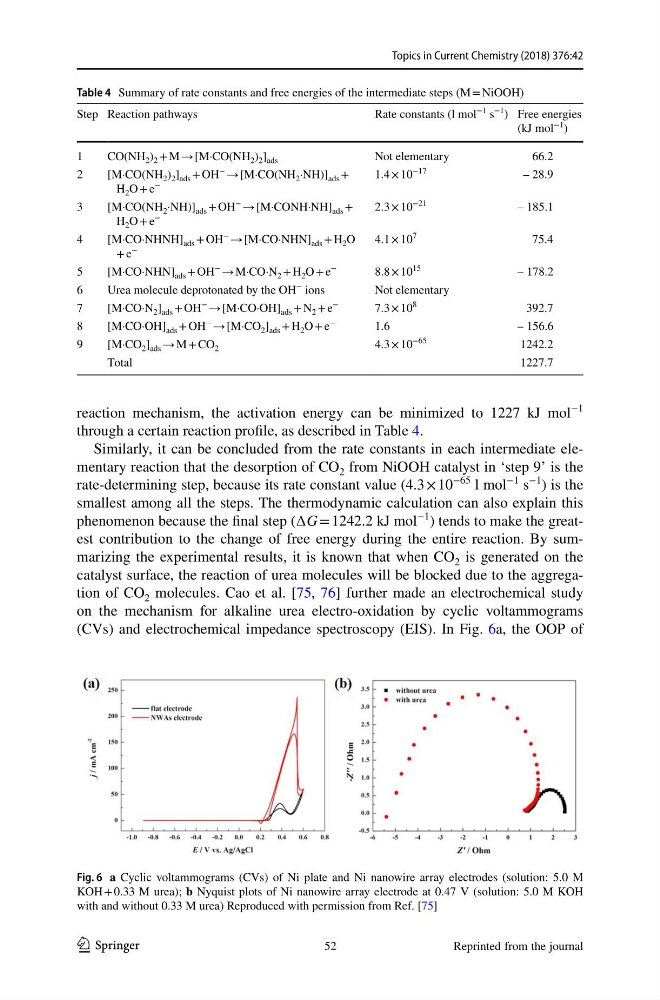
(CVs) and electrochemical impedance spectroscopy (EIS). In Fig. 6a, the OOP of
Table 4 Summary of rate constants and free energies of the intermediate steps (M = NiOOH)
Step Reaction pathways
Rate constants (l mol
−1 s
−1 ) Free energies
(kJ mol
−1
)
1
CO(NH 2 ) 2 + M → [M·CO(NH 2 ) 2 ] ads
Not elementary
66.2
2
[M·CO(NH 2 ) 2 ] ads + OH
− → [M·CO(NH 2 ·NH)] ads +
H 2 O + e
−
1.4 × 10
−17
– 28.9
3
[M·CO(NH 2 ·NH)] ads + OH
− → [M·CONH·NH] ads +
H 2 O + e
−
2.3 × 10
−21
– 185.1
4
[M·CO·NHNH] ads + OH
− → [M·CO·NHN] ads + H 2 O
+ e
−
4.1 × 10
7
75.4
5
[M·CO·NHN] ads + OH
− → M·CO·N 2 + H 2 O + e
−
8.8 × 10
15
– 178.2
6
Urea molecule deprotonated by the OH
− ions
Not elementary
7
[M·CO·N 2 ] ads + OH
− → [M·CO·OH] ads + N 2 + e
−
7.3 × 10
8
392.7
8
[M·CO·OH] ads + OH
− → [M·CO 2 ] ads + H 2 O + e
−
1.6
– 156.6
9
[M·CO 2 ] ads → M + CO 2
4.3 × 10
−65
1242.2
Total
1227.7
Fig. 6 a Cyclic voltammograms (CVs) of Ni plate and Ni nanowire array electrodes (solution: 5.0 M
KOH + 0.33 M urea); b Nyquist plots of Ni nanowire array electrode at 0.47 V (solution: 5.0 M KOH
with and without 0.33 M urea) Reproduced with permission from Ref. [75]
Reprinted from the journal
52
1 3
reaction mechanism, the activation energy can be minimized to 1227 kJ mol
−1
through a certain reaction profile, as described in Table 4.
Similarly, it can be concluded from the rate constants in each intermediate elementary reaction that the desorption of CO 2 from NiOOH catalyst in ‘step 9’ is the
rate-determining step, because its rate constant value (4.3 × 10
−65
l mol
−1
s
−1
) is the
smallest among all the steps. The thermodynamic calculation can also explain this
phenomenon because the final step (∆G = 1242.2 kJ mol
−1
) tends to make the greatest contribution to the change of free energy during the entire reaction. By summarizing the experimental results, it is known that when CO 2 is generated on the
catalyst surface, the reaction of urea molecules will be blocked due to the aggregation of CO 2 molecules. Cao et al. [75, 76] further made an electrochemical study
on the mechanism for alkaline urea electro-oxidation by cyclic voltammograms
(CVs) and electrochemical impedance spectroscopy (EIS). In Fig. 6a, the OOP of
Table 4 Summary of rate constants and free energies of the intermediate steps (M = NiOOH)
Step Reaction pathways
Rate constants (l mol
−1 s
−1 ) Free energies
(kJ mol
−1
)
1
CO(NH 2 ) 2 + M → [M·CO(NH 2 ) 2 ] ads
Not elementary
66.2
2
[M·CO(NH 2 ) 2 ] ads + OH
− → [M·CO(NH 2 ·NH)] ads +
H 2 O + e
−
1.4 × 10
−17
– 28.9
3
[M·CO(NH 2 ·NH)] ads + OH
− → [M·CONH·NH] ads +
H 2 O + e
−
2.3 × 10
−21
– 185.1
4
[M·CO·NHNH] ads + OH
− → [M·CO·NHN] ads + H 2 O
+ e
−
4.1 × 10
7
75.4
5
[M·CO·NHN] ads + OH
− → M·CO·N 2 + H 2 O + e
−
8.8 × 10
15
– 178.2
6
Urea molecule deprotonated by the OH
− ions
Not elementary
7
[M·CO·N 2 ] ads + OH
− → [M·CO·OH] ads + N 2 + e
−
7.3 × 10
8
392.7
8
[M·CO·OH] ads + OH
− → [M·CO 2 ] ads + H 2 O + e
−
1.6
– 156.6
9
[M·CO 2 ] ads → M + CO 2
4.3 × 10
−65
1242.2
Total
1227.7
Fig. 6 a Cyclic voltammograms (CVs) of Ni plate and Ni nanowire array electrodes (solution: 5.0 M
KOH + 0.33 M urea); b Nyquist plots of Ni nanowire array electrode at 0.47 V (solution: 5.0 M KOH
with and without 0.33 M urea) Reproduced with permission from Ref. [75]
Reprinted from the journal
52