

1 3
Topics in Current Chemistry (2019) 377:11
pathway that generates acetic acid and acetaldehyde. The complete oxidation of
ethanol requires full dehydrogenation and C–C bond splitting, which might not be
favored on a stretched Pt ML .
DFT calculations were carried out to gain a better understanding of the
methanol electrooxidation on the surfaces of Pt ML supported on different substrates. The onset potential for methanol electrooxidation on the Pt ML /metal
surfaces was estimated by calculating the binding energies and free energies
of CO and OH (Fig. 20). The DFT-predicted trend in reactivity, viz.: Pt ML /
Au(111) > Pt(111) > Pt ML /Pd(111) > Pt ML /Ir(111) > Pt ML /Rh(111) > Pt ML /
Ru(0001), agrees well with the experimental data shown in Fig. 19. The activity
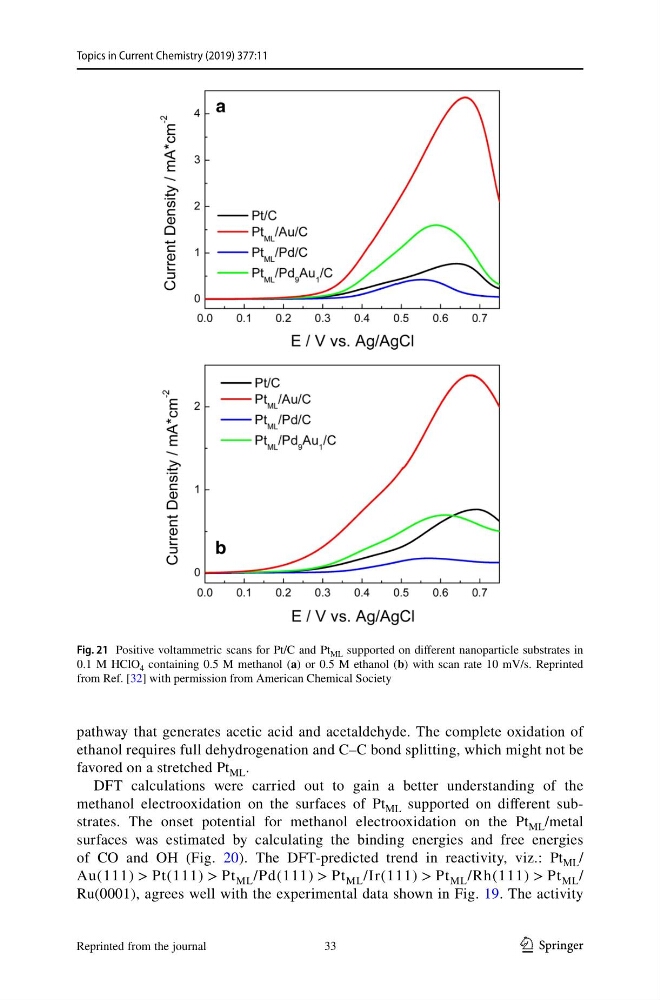
Fig. 21 Positive voltammetric scans for Pt/C and Pt ML supported on different nanoparticle substrates in
0.1 M HClO 4 containing 0.5 M methanol (a) or 0.5 M ethanol (b) with scan rate 10 mV/s. Reprinted
from Ref. [32] with permission from American Chemical Society
Reprinted from the journal
33
Topics in Current Chemistry (2019) 377:11
pathway that generates acetic acid and acetaldehyde. The complete oxidation of
ethanol requires full dehydrogenation and C–C bond splitting, which might not be
favored on a stretched Pt ML .
DFT calculations were carried out to gain a better understanding of the
methanol electrooxidation on the surfaces of Pt ML supported on different substrates. The onset potential for methanol electrooxidation on the Pt ML /metal
surfaces was estimated by calculating the binding energies and free energies
of CO and OH (Fig. 20). The DFT-predicted trend in reactivity, viz.: Pt ML /
Au(111) > Pt(111) > Pt ML /Pd(111) > Pt ML /Ir(111) > Pt ML /Rh(111) > Pt ML /
Ru(0001), agrees well with the experimental data shown in Fig. 19. The activity
Fig. 21 Positive voltammetric scans for Pt/C and Pt ML supported on different nanoparticle substrates in
0.1 M HClO 4 containing 0.5 M methanol (a) or 0.5 M ethanol (b) with scan rate 10 mV/s. Reprinted
from Ref. [32] with permission from American Chemical Society
Reprinted from the journal
33