

1 3
Topics in Current Chemistry (2019) 377:11
In situ IRRAS spectra recorded on Pt ML /Au(111) during MOR (Fig. 19a)
indicate that methanol oxidation proceeds without formation of adsorbed CO,
as observed by the lack of characteristic bipolar, potential dependent peak at ca.
2100 cm
−1
; namely, the enhanced MOR activity in Pt ML /Au(111) is due to the
formation of COH ads instead of the poisoning CO ads species. On the other hand,
in situ IRRAS spectra obtained during ethanol oxidation (Fig. 19b) show a complete absence of both the CO ads and CO 2 bands, denoting that ethanol dissociative adsorption on Pt ML /Au(111) does not occur, i.e., the EOR follows the partial
oxidation pathway without cleavage of the C–C bond. Therefore, the high EOR
activity on Pt ML /Au(111) is a consequence of faster kinetics of partial oxidation
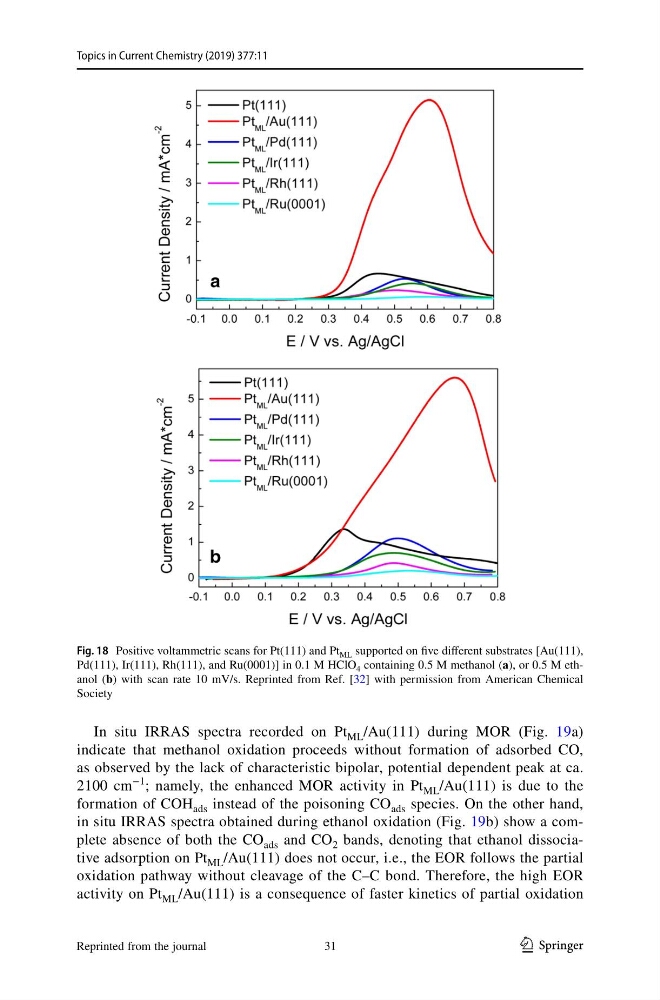
Fig. 18 Positive voltammetric scans for Pt(111) and Pt ML supported on five different substrates [Au(111),
Pd(111), Ir(111), Rh(111), and Ru(0001)] in 0.1 M HClO 4 containing 0.5 M methanol (a), or 0.5 M ethanol (b) with scan rate 10 mV/s. Reprinted from Ref. [32] with permission from American Chemical
Society
Reprinted from the journal
31
Topics in Current Chemistry (2019) 377:11
In situ IRRAS spectra recorded on Pt ML /Au(111) during MOR (Fig. 19a)
indicate that methanol oxidation proceeds without formation of adsorbed CO,
as observed by the lack of characteristic bipolar, potential dependent peak at ca.
2100 cm
−1
; namely, the enhanced MOR activity in Pt ML /Au(111) is due to the
formation of COH ads instead of the poisoning CO ads species. On the other hand,
in situ IRRAS spectra obtained during ethanol oxidation (Fig. 19b) show a complete absence of both the CO ads and CO 2 bands, denoting that ethanol dissociative adsorption on Pt ML /Au(111) does not occur, i.e., the EOR follows the partial
oxidation pathway without cleavage of the C–C bond. Therefore, the high EOR
activity on Pt ML /Au(111) is a consequence of faster kinetics of partial oxidation
Fig. 18 Positive voltammetric scans for Pt(111) and Pt ML supported on five different substrates [Au(111),
Pd(111), Ir(111), Rh(111), and Ru(0001)] in 0.1 M HClO 4 containing 0.5 M methanol (a), or 0.5 M ethanol (b) with scan rate 10 mV/s. Reprinted from Ref. [32] with permission from American Chemical
Society
Reprinted from the journal
31