

Topics in Current Chemistry (2019) 377:11
1 3
4.1.1 EXAFS Fitting of Pt–Rh–SnO 2 Nanocatalyst
The internal structure of Pt/Rh nanoclusters were examined by in situ EXAFS. During the fit, only the amplitude reduction factors were kept constant and equal to the
preceding fit of the Pt and Rh metal foils. The fitting results are shown in Fig. 11.
As shown earlier, the homogeneous solid solution is characterized with partial
coordination numbers of two metals that are related to their mole fractions, equal
total coordination numbers, and interatomic distances that are between their bulk values. Our EXAFS fitting gave the following results: N(Rh–Pt)/N(Pt–Rh) = 2.1 ± 0.3,
whereas independent inductive coupled plasma (ICP) study showed similar value,
x(Pt)/x(Rh) = 1.5 ± 0.2. The total coordination numbers obtained by concurrent fitting of Pt L 3 -edge and Rh K-edge were equal within the error range, i.e.,
N(Pt–M) = 9.5 ± 0.8 and N(Rh–M) = 10.8 ± 0:8, suggesting that Pt and Rh atoms are
homogeneously distributed throughout the PtRh nanoparticles. The bond lengths
of Pt–Pt, Pt–Rh, and Rh–Rh found by the EXAFS analysis viz.: 2.743 ± 0.003,
2.725 ± 0.004, and 2.705 ± 0.005 Å, respectively, further support the above conclusion. It is expected that in the random alloy, the distances between atoms of the
same type should be closer together than in pure nanoparticles (2.775 Å and 2.689
Å for Pt and Rh, respectively) [23]. Lastly, averaging the total coordination numbers
for Pt–metal and Rh–metal to 10.0 ± 0.8, the size of the nanoparticles is estimated
to 2.7 ± 0.9 nm, which is in good agreement with the range found by TEM (1–3 nm)
[104].
4.2 Optimizing Pt–Rh–SnO 2 Nanocatalyst
Catalytic properties of the ternary catalyst were improved by optimizing the
molar fractions of the three constituents in Pt/Rh/SnO 2 . As seen from part 3.1.2
above, in situ IR measurements indicated that the catalyst with the mole ratio of
Pt:Rh = 1:1/3 produced the highest amount of CO 2 and the best selectivity toward
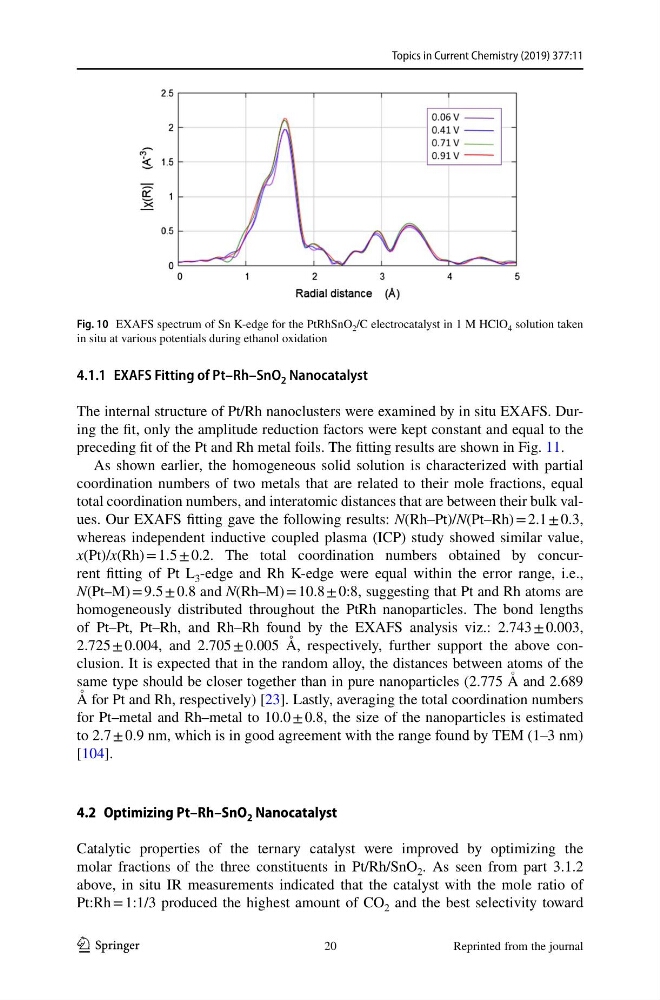
Fig. 10 EXAFS spectrum of Sn K-edge for the PtRhSnO 2 /C electrocatalyst in 1 M HClO 4 solution taken
in situ at various potentials during ethanol oxidation
Reprinted from the journal
20
1 3
4.1.1 EXAFS Fitting of Pt–Rh–SnO 2 Nanocatalyst
The internal structure of Pt/Rh nanoclusters were examined by in situ EXAFS. During the fit, only the amplitude reduction factors were kept constant and equal to the
preceding fit of the Pt and Rh metal foils. The fitting results are shown in Fig. 11.
As shown earlier, the homogeneous solid solution is characterized with partial
coordination numbers of two metals that are related to their mole fractions, equal
total coordination numbers, and interatomic distances that are between their bulk values. Our EXAFS fitting gave the following results: N(Rh–Pt)/N(Pt–Rh) = 2.1 ± 0.3,
whereas independent inductive coupled plasma (ICP) study showed similar value,
x(Pt)/x(Rh) = 1.5 ± 0.2. The total coordination numbers obtained by concurrent fitting of Pt L 3 -edge and Rh K-edge were equal within the error range, i.e.,
N(Pt–M) = 9.5 ± 0.8 and N(Rh–M) = 10.8 ± 0:8, suggesting that Pt and Rh atoms are
homogeneously distributed throughout the PtRh nanoparticles. The bond lengths
of Pt–Pt, Pt–Rh, and Rh–Rh found by the EXAFS analysis viz.: 2.743 ± 0.003,
2.725 ± 0.004, and 2.705 ± 0.005 Å, respectively, further support the above conclusion. It is expected that in the random alloy, the distances between atoms of the
same type should be closer together than in pure nanoparticles (2.775 Å and 2.689
Å for Pt and Rh, respectively) [23]. Lastly, averaging the total coordination numbers
for Pt–metal and Rh–metal to 10.0 ± 0.8, the size of the nanoparticles is estimated
to 2.7 ± 0.9 nm, which is in good agreement with the range found by TEM (1–3 nm)
[104].
4.2 Optimizing Pt–Rh–SnO 2 Nanocatalyst
Catalytic properties of the ternary catalyst were improved by optimizing the
molar fractions of the three constituents in Pt/Rh/SnO 2 . As seen from part 3.1.2
above, in situ IR measurements indicated that the catalyst with the mole ratio of
Pt:Rh = 1:1/3 produced the highest amount of CO 2 and the best selectivity toward
Fig. 10 EXAFS spectrum of Sn K-edge for the PtRhSnO 2 /C electrocatalyst in 1 M HClO 4 solution taken
in situ at various potentials during ethanol oxidation
Reprinted from the journal
20