

Topics in Current Chemistry (2018) 376:43
1 3
native electron acceptor for OxO), thus < 12 electrons per molecule of glycerol
were likely collected.
Use of hybrid catalytic motifs to enhance the overall rate-determining steps in
this cascade was expanded upon in two important ways. The first altered the electrometabolic pathway for glycerol oxidation by replacing oxalate oxidase (which
exhibits only minor activity for the oxidative cleavage of CO 2 from mesoxalate)
with formate dehydrogenase, an NAD
+
-dependent enzyme that can more efficiently oxidize mesoxalate to form glyoxalate. Unlike previously described NAD
+
regeneration systems (that require additional enzymes or coelectrocatalysts), the
FDH/TEMPO hybrid cascade utilizes TEMPO-NH 2 dually to oxidize alcohols/
aldehydes as electrochemically regenerated NAD
+
[28]. A primary benefit from
employing FDH is gained from increased reactivity towards mesoxalic acid. In
addition to increased rate of mesoxalate oxidation, the use of FDH enables collection of electrons from the CO 2 cleavage step(s) indirectly via TEMPO-catalyzed
NAD
+
regeneration.
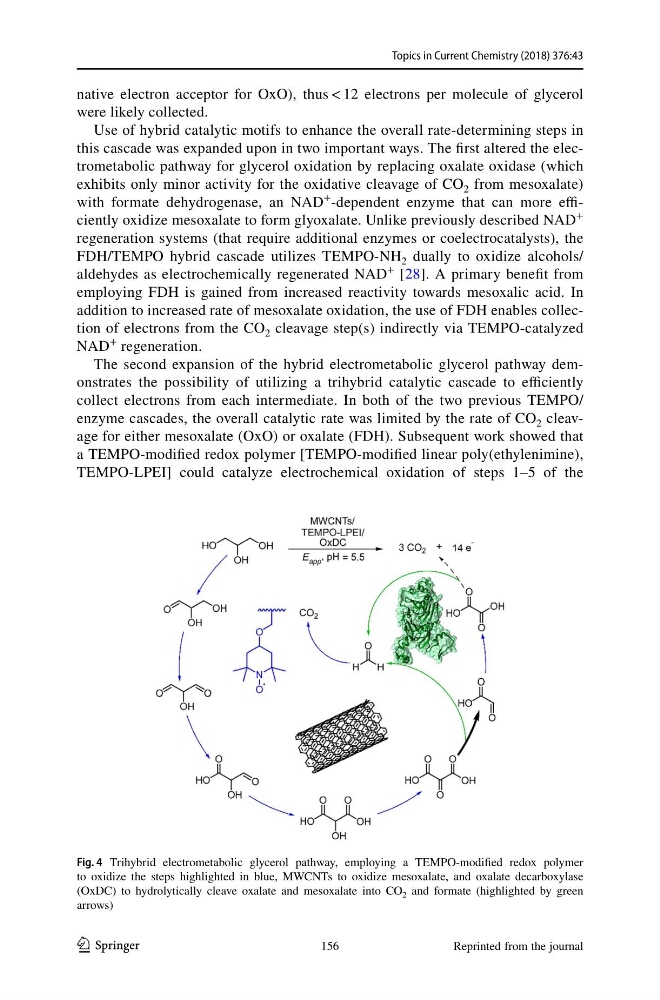
The second expansion of the hybrid electrometabolic glycerol pathway demonstrates the possibility of utilizing a trihybrid catalytic cascade to efficiently
collect electrons from each intermediate. In both of the two previous TEMPO/
enzyme cascades, the overall catalytic rate was limited by the rate of CO 2 cleavage for either mesoxalate (OxO) or oxalate (FDH). Subsequent work showed that
a TEMPO-modified redox polymer [TEMPO-modified linear poly(ethylenimine),
TEMPO-LPEI] could catalyze electrochemical oxidation of steps 1–5 of the
Fig. 4 Trihybrid electrometabolic glycerol pathway, employing a TEMPO-modified redox polymer
to oxidize the steps highlighted in blue, MWCNTs to oxidize mesoxalate, and oxalate decarboxylase
(OxDC) to hydrolytically cleave oxalate and mesoxalate into CO 2 and formate (highlighted by green
arrows)
Reprinted from the journal
156
1 3
native electron acceptor for OxO), thus < 12 electrons per molecule of glycerol
were likely collected.
Use of hybrid catalytic motifs to enhance the overall rate-determining steps in
this cascade was expanded upon in two important ways. The first altered the electrometabolic pathway for glycerol oxidation by replacing oxalate oxidase (which
exhibits only minor activity for the oxidative cleavage of CO 2 from mesoxalate)
with formate dehydrogenase, an NAD
+
-dependent enzyme that can more efficiently oxidize mesoxalate to form glyoxalate. Unlike previously described NAD
+
regeneration systems (that require additional enzymes or coelectrocatalysts), the
FDH/TEMPO hybrid cascade utilizes TEMPO-NH 2 dually to oxidize alcohols/
aldehydes as electrochemically regenerated NAD
+
[28]. A primary benefit from
employing FDH is gained from increased reactivity towards mesoxalic acid. In
addition to increased rate of mesoxalate oxidation, the use of FDH enables collection of electrons from the CO 2 cleavage step(s) indirectly via TEMPO-catalyzed
NAD
+
regeneration.
The second expansion of the hybrid electrometabolic glycerol pathway demonstrates the possibility of utilizing a trihybrid catalytic cascade to efficiently
collect electrons from each intermediate. In both of the two previous TEMPO/
enzyme cascades, the overall catalytic rate was limited by the rate of CO 2 cleavage for either mesoxalate (OxO) or oxalate (FDH). Subsequent work showed that
a TEMPO-modified redox polymer [TEMPO-modified linear poly(ethylenimine),
TEMPO-LPEI] could catalyze electrochemical oxidation of steps 1–5 of the
Fig. 4 Trihybrid electrometabolic glycerol pathway, employing a TEMPO-modified redox polymer
to oxidize the steps highlighted in blue, MWCNTs to oxidize mesoxalate, and oxalate decarboxylase
(OxDC) to hydrolytically cleave oxalate and mesoxalate into CO 2 and formate (highlighted by green
arrows)
Reprinted from the journal
156