

Topics in Current Chemistry (2019) 377:4
1 3
on N-doped carbons indeed show much better ORR activity than commercial nanosized counterparts. However, single Pt atoms supported on S-doped carbons follow
an inefficient two-electron-transfer pathway, beneficial for H 2 O 2 formation. The stability of single-atom metal catalysts is also a significant factor. Most research results
have shown that carbon-based single-atom metal catalysts exhibit good stability at
room temperature in liquid cells, but it is not clear whether they can meet the durability requirements in full electrochemical cells under harsher operating conditions.
Based on the above discussions, we believe that strategies for the future development of carbon-based single-atom metal catalysts for highly efficient electrocatalysis should focus mainly on (1) understanding the correlation between electronic
properties and catalytic activity, and (2) increasing atomic metal loading in catalysts. The total catalytic performance of a catalyst is directly proportional to turnover frequency (TOF, evaluating the catalytic activity per active site) and concentration of active sites. The TOF of single-atom metal sites is dependent on the types of
metal atoms as well as their surrounding coordination environments. The addition
or removal of any heteroatoms surrounding single metal atoms can greatly alter the
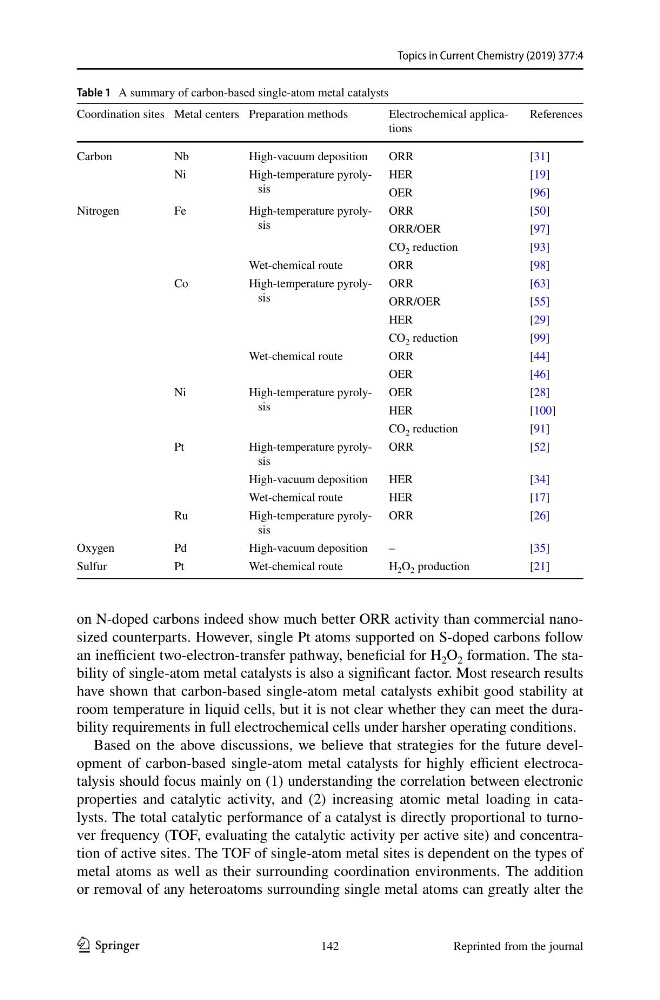
Table 1 A summary of carbon-based single-atom metal catalysts
Coordination sites Metal centers Preparation methods
Electrochemical applications
References
Carbon
Nb
High-vacuum deposition
ORR
[31]
Ni
High-temperature pyrolysis
HER
[19]
OER
[96]
Nitrogen
Fe
High-temperature pyrolysis
ORR
[50]
ORR/OER
[97]
CO 2 reduction
[93]
Wet-chemical route
ORR
[98]
Co
High-temperature pyrolysis
ORR
[63]
ORR/OER
[55]
HER
[29]
CO 2 reduction
[99]
Wet-chemical route
ORR
[44]
OER
[46]
Ni
High-temperature pyrolysis
OER
[28]
HER
[100]
CO 2 reduction
[91]
Pt
High-temperature pyrolysis
ORR
[52]
High-vacuum deposition
HER
[34]
Wet-chemical route
HER
[17]
Ru
High-temperature pyrolysis
ORR
[26]
Oxygen
Pd
High-vacuum deposition
–
[35]
Sulfur
Pt
Wet-chemical route
H 2 O 2 production
[21]
Reprinted from the journal
142
1 3
on N-doped carbons indeed show much better ORR activity than commercial nanosized counterparts. However, single Pt atoms supported on S-doped carbons follow
an inefficient two-electron-transfer pathway, beneficial for H 2 O 2 formation. The stability of single-atom metal catalysts is also a significant factor. Most research results
have shown that carbon-based single-atom metal catalysts exhibit good stability at
room temperature in liquid cells, but it is not clear whether they can meet the durability requirements in full electrochemical cells under harsher operating conditions.
Based on the above discussions, we believe that strategies for the future development of carbon-based single-atom metal catalysts for highly efficient electrocatalysis should focus mainly on (1) understanding the correlation between electronic
properties and catalytic activity, and (2) increasing atomic metal loading in catalysts. The total catalytic performance of a catalyst is directly proportional to turnover frequency (TOF, evaluating the catalytic activity per active site) and concentration of active sites. The TOF of single-atom metal sites is dependent on the types of
metal atoms as well as their surrounding coordination environments. The addition
or removal of any heteroatoms surrounding single metal atoms can greatly alter the
Table 1 A summary of carbon-based single-atom metal catalysts
Coordination sites Metal centers Preparation methods
Electrochemical applications
References
Carbon
Nb
High-vacuum deposition
ORR
[31]
Ni
High-temperature pyrolysis
HER
[19]
OER
[96]
Nitrogen
Fe
High-temperature pyrolysis
ORR
[50]
ORR/OER
[97]
CO 2 reduction
[93]
Wet-chemical route
ORR
[98]
Co
High-temperature pyrolysis
ORR
[63]
ORR/OER
[55]
HER
[29]
CO 2 reduction
[99]
Wet-chemical route
ORR
[44]
OER
[46]
Ni
High-temperature pyrolysis
OER
[28]
HER
[100]
CO 2 reduction
[91]
Pt
High-temperature pyrolysis
ORR
[52]
High-vacuum deposition
HER
[34]
Wet-chemical route
HER
[17]
Ru
High-temperature pyrolysis
ORR
[26]
Oxygen
Pd
High-vacuum deposition
–
[35]
Sulfur
Pt
Wet-chemical route
H 2 O 2 production
[21]
Reprinted from the journal
142