

1 3
Topics in Current Chemistry (2019) 377:4
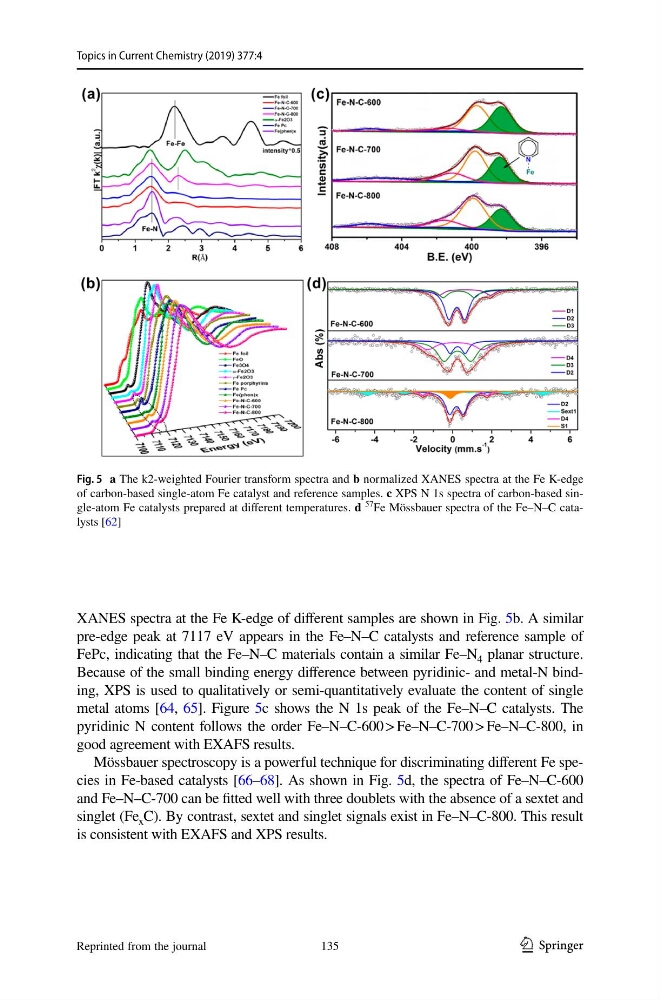
XANES spectra at the Fe K-edge of different samples are shown in Fig. 5b. A similar
pre-edge peak at 7117 eV appears in the Fe–N–C catalysts and reference sample of
FePc, indicating that the Fe–N–C materials contain a similar Fe–N 4 planar structure.
Because of the small binding energy difference between pyridinic- and metal-N binding, XPS is used to qualitatively or semi-quantitatively evaluate the content of single
metal atoms [64, 65]. Figure 5c shows the N 1s peak of the Fe–N–C catalysts. The
pyridinic N content follows the order Fe–N–C-600 > Fe–N–C-700 > Fe–N–C-800, in
good agreement with EXAFS results.
Mössbauer spectroscopy is a powerful technique for discriminating different Fe species in Fe-based catalysts [66–68]. As shown in Fig. 5d, the spectra of Fe–N–C-600
and Fe–N–C-700 can be fitted well with three doublets with the absence of a sextet and
singlet (Fe x C). By contrast, sextet and singlet signals exist in Fe–N–C-800. This result
is consistent with EXAFS and XPS results.
Fig. 5 a The k2-weighted Fourier transform spectra and b normalized XANES spectra at the Fe K-edge
of carbon-based single-atom Fe catalyst and reference samples. c XPS N 1s spectra of carbon-based single-atom Fe catalysts prepared at different temperatures. d
57
Fe Mössbauer spectra of the Fe–N–C catalysts [62]
Reprinted from the journal
135
Topics in Current Chemistry (2019) 377:4
XANES spectra at the Fe K-edge of different samples are shown in Fig. 5b. A similar
pre-edge peak at 7117 eV appears in the Fe–N–C catalysts and reference sample of
FePc, indicating that the Fe–N–C materials contain a similar Fe–N 4 planar structure.
Because of the small binding energy difference between pyridinic- and metal-N binding, XPS is used to qualitatively or semi-quantitatively evaluate the content of single
metal atoms [64, 65]. Figure 5c shows the N 1s peak of the Fe–N–C catalysts. The
pyridinic N content follows the order Fe–N–C-600 > Fe–N–C-700 > Fe–N–C-800, in
good agreement with EXAFS results.
Mössbauer spectroscopy is a powerful technique for discriminating different Fe species in Fe-based catalysts [66–68]. As shown in Fig. 5d, the spectra of Fe–N–C-600
and Fe–N–C-700 can be fitted well with three doublets with the absence of a sextet and
singlet (Fe x C). By contrast, sextet and singlet signals exist in Fe–N–C-800. This result
is consistent with EXAFS and XPS results.
Fig. 5 a The k2-weighted Fourier transform spectra and b normalized XANES spectra at the Fe K-edge
of carbon-based single-atom Fe catalyst and reference samples. c XPS N 1s spectra of carbon-based single-atom Fe catalysts prepared at different temperatures. d
57
Fe Mössbauer spectra of the Fe–N–C catalysts [62]
Reprinted from the journal
135