

1 3
Topics in Current Chemistry (2019) 377:4
is usually used as the precursor, which undergoes arc-discharge evaporation, reaction with the decomposed carbon, and deposition on the cool walls of the chamber to produce carbon-supported single-atom metal catalysts. A typical example is a
single-atom niobium in graphitic layer reported by Zhang et al. [31]. ALD is a more
widely adopted strategy for the fabrication of carbon-based single-atom metal catalysts owing to its high level of controllability. Organic molecules containing metal
atoms are used as the precursors. The Sun group first reported single Pt atoms on
graphene nanosheets using (methylcyclopentadienyl)-trimethylplatinum as the precursor [32]. Subsequently, a series of carbon-based single-atom metal catalysts were
synthesized by ALD [33–35].
To date, high-vacuum deposition has been the most common method used to prepare carbon-based single-atom noble metal catalysts. Owing to its good controllability, this technique may be a desirable strategy for fundamental studies in terms of
metal–support interactions and size effect. However, this deposition method may not
be suitable for large-scale industrial applications due to low catalyst yield and high
cost. Thus there is an urgent need for the development of alternatives for the synthesis of carbon-based single-atom metal catalysts.
2.2 Wet‑Chemical Route
Compared to the high-vacuum deposition technique, the wet-chemical route
has been more widely used for the synthesis of carbon-based single-atom metal
catalysts, as it does not involve specialized equipment [18, 36, 37]. Typically,
single-atom metal species are anchored in the carbon supports by wet-chemical
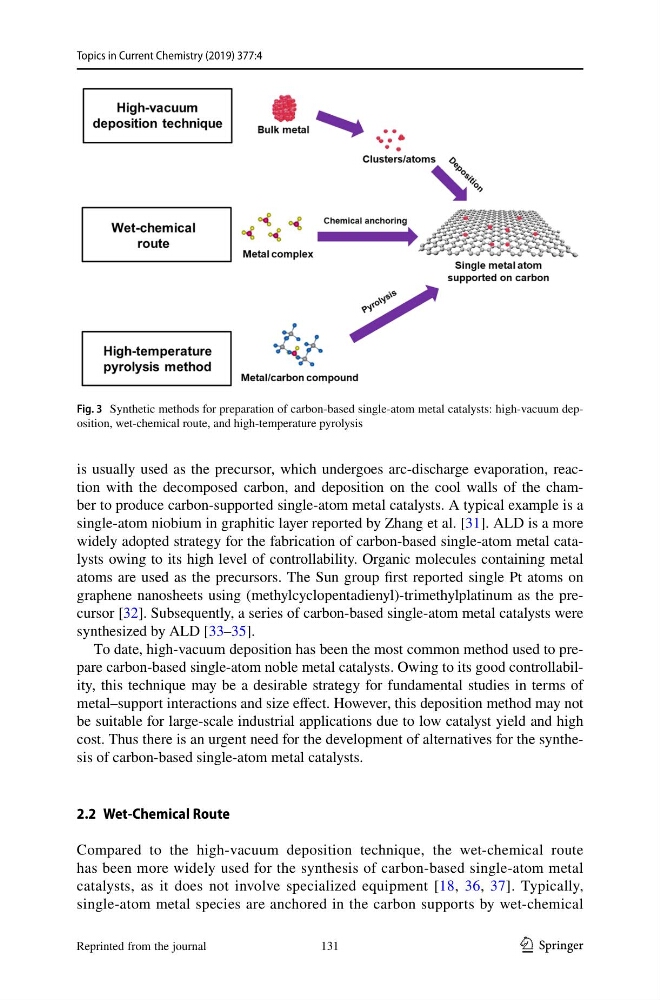
Fig. 3 Synthetic methods for preparation of carbon-based single-atom metal catalysts: high-vacuum deposition, wet-chemical route, and high-temperature pyrolysis
Reprinted from the journal
131
Topics in Current Chemistry (2019) 377:4
is usually used as the precursor, which undergoes arc-discharge evaporation, reaction with the decomposed carbon, and deposition on the cool walls of the chamber to produce carbon-supported single-atom metal catalysts. A typical example is a
single-atom niobium in graphitic layer reported by Zhang et al. [31]. ALD is a more
widely adopted strategy for the fabrication of carbon-based single-atom metal catalysts owing to its high level of controllability. Organic molecules containing metal
atoms are used as the precursors. The Sun group first reported single Pt atoms on
graphene nanosheets using (methylcyclopentadienyl)-trimethylplatinum as the precursor [32]. Subsequently, a series of carbon-based single-atom metal catalysts were
synthesized by ALD [33–35].
To date, high-vacuum deposition has been the most common method used to prepare carbon-based single-atom noble metal catalysts. Owing to its good controllability, this technique may be a desirable strategy for fundamental studies in terms of
metal–support interactions and size effect. However, this deposition method may not
be suitable for large-scale industrial applications due to low catalyst yield and high
cost. Thus there is an urgent need for the development of alternatives for the synthesis of carbon-based single-atom metal catalysts.
2.2 Wet‑Chemical Route
Compared to the high-vacuum deposition technique, the wet-chemical route
has been more widely used for the synthesis of carbon-based single-atom metal
catalysts, as it does not involve specialized equipment [18, 36, 37]. Typically,
single-atom metal species are anchored in the carbon supports by wet-chemical
Fig. 3 Synthetic methods for preparation of carbon-based single-atom metal catalysts: high-vacuum deposition, wet-chemical route, and high-temperature pyrolysis
Reprinted from the journal
131