

Topics in Current Chemistry (2018) 376:41
1 3
nineteen times higher than that on Cu, although no clear explanation of the origin
of this enhancement was provided [80].
DFT calculations predicted that titania-modified Ag electrocatalysts could be suitable for CO 2 reduction to produce CH 3 OH as well as CH 4 [81], where Ag acts as an
electron donor, reducing the supported (TiO 2 ) 3 partially. Thus, the surface became
more reactive with CO 2 . Further reduction produces HCOO*, H 2 COO*, H 2 COOH*,
CH 3 OH sequentially. Also, by calculating the intermediate surface free energies, Zhao
et al. estimated that Ni/Ti, Cu/Ni, and strained Cu/Ni near-surface-alloys could lead to
highly selective and efficient production of formic acid [24]. Even though there were
several experimental and computational data for better multi-carbon species production, the detailed mechanism after CO adsorption were still under debate. The open
questions include, for example, when and where the C–C coupling happens, and what
helps the formation of C 2+ products.
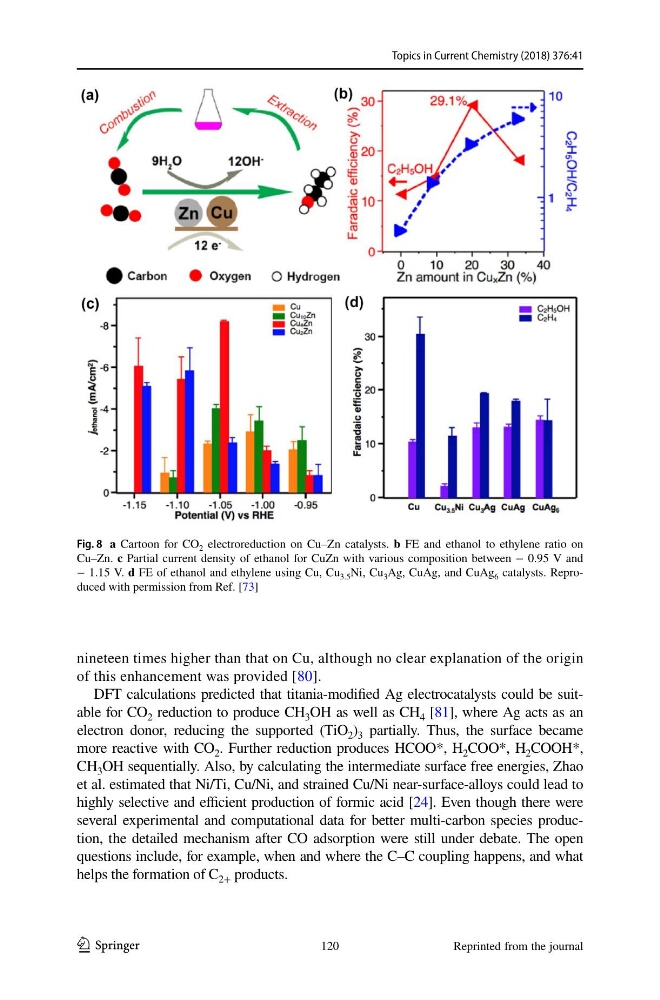
Fig. 8 a Cartoon for CO 2 electroreduction on Cu–Zn catalysts. b FE and ethanol to ethylene ratio on
Cu–Zn. c Partial current density of ethanol for CuZn with various composition between − 0.95 V and
− 1.15 V. d FE of ethanol and ethylene using Cu, Cu 3.5 Ni, Cu 3 Ag, CuAg, and CuAg 6 catalysts. Reproduced with permission from Ref. [73]
Reprinted from the journal
120
1 3
nineteen times higher than that on Cu, although no clear explanation of the origin
of this enhancement was provided [80].
DFT calculations predicted that titania-modified Ag electrocatalysts could be suitable for CO 2 reduction to produce CH 3 OH as well as CH 4 [81], where Ag acts as an
electron donor, reducing the supported (TiO 2 ) 3 partially. Thus, the surface became
more reactive with CO 2 . Further reduction produces HCOO*, H 2 COO*, H 2 COOH*,
CH 3 OH sequentially. Also, by calculating the intermediate surface free energies, Zhao
et al. estimated that Ni/Ti, Cu/Ni, and strained Cu/Ni near-surface-alloys could lead to
highly selective and efficient production of formic acid [24]. Even though there were
several experimental and computational data for better multi-carbon species production, the detailed mechanism after CO adsorption were still under debate. The open
questions include, for example, when and where the C–C coupling happens, and what
helps the formation of C 2+ products.
Fig. 8 a Cartoon for CO 2 electroreduction on Cu–Zn catalysts. b FE and ethanol to ethylene ratio on
Cu–Zn. c Partial current density of ethanol for CuZn with various composition between − 0.95 V and
− 1.15 V. d FE of ethanol and ethylene using Cu, Cu 3.5 Ni, Cu 3 Ag, CuAg, and CuAg 6 catalysts. Reproduced with permission from Ref. [73]
Reprinted from the journal
120