

1 3
Topics in Current Chemistry (2018) 376:41
58]. Graza et al. showed that the C–C coupling first happened between CO and
CHO [59]. The formed HOCCO could then go to either the ethylene or ethanol
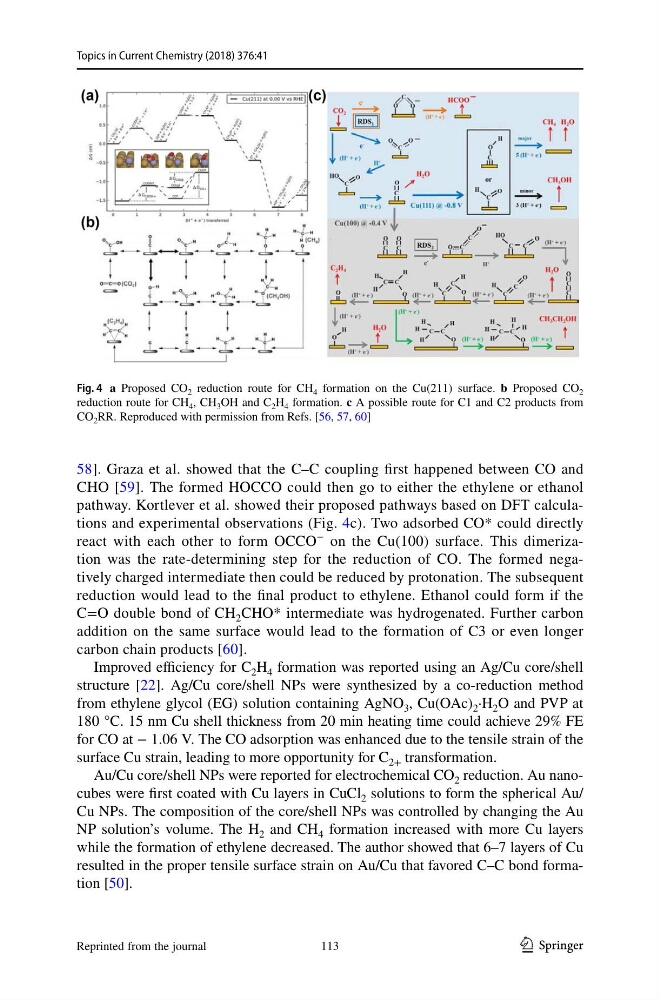
pathway. Kortlever et al. showed their proposed pathways based on DFT calculations and experimental observations (Fig. 4c). Two adsorbed CO* could directly
react with each other to form OCCO
−
on the Cu(100) surface. This dimerization was the rate-determining step for the reduction of CO. The formed negatively charged intermediate then could be reduced by protonation. The subsequent
reduction would lead to the final product to ethylene. Ethanol could form if the
C=O double bond of CH 2 CHO* intermediate was hydrogenated. Further carbon
addition on the same surface would lead to the formation of C3 or even longer
carbon chain products [60].
Improved efficiency for C 2 H 4 formation was reported using an Ag/Cu core/shell
structure [22]. Ag/Cu core/shell NPs were synthesized by a co-reduction method
from ethylene glycol (EG) solution containing AgNO 3 , Cu(OAc) 2 ·H 2 O and PVP at
180 °C. 15 nm Cu shell thickness from 20 min heating time could achieve 29% FE
for CO at − 1.06 V. The CO adsorption was enhanced due to the tensile strain of the
surface Cu strain, leading to more opportunity for C 2+ transformation.
Au/Cu core/shell NPs were reported for electrochemical CO 2 reduction. Au nanocubes were first coated with Cu layers in CuCl 2 solutions to form the spherical Au/
Cu NPs. The composition of the core/shell NPs was controlled by changing the Au
NP solution’s volume. The H 2 and CH 4 formation increased with more Cu layers
while the formation of ethylene decreased. The author showed that 6–7 layers of Cu
resulted in the proper tensile surface strain on Au/Cu that favored C–C bond formation [50].
Fig. 4 a Proposed CO 2 reduction route for CH 4 formation on the Cu(211) surface. b Proposed CO 2
reduction route for CH 4 , CH 3 OH and C 2 H 4 formation. c A possible route for C1 and C2 products from
CO 2 RR. Reproduced with permission from Refs. [56, 57, 60]
Reprinted from the journal
113
Topics in Current Chemistry (2018) 376:41
58]. Graza et al. showed that the C–C coupling first happened between CO and
CHO [59]. The formed HOCCO could then go to either the ethylene or ethanol
pathway. Kortlever et al. showed their proposed pathways based on DFT calculations and experimental observations (Fig. 4c). Two adsorbed CO* could directly
react with each other to form OCCO
−
on the Cu(100) surface. This dimerization was the rate-determining step for the reduction of CO. The formed negatively charged intermediate then could be reduced by protonation. The subsequent
reduction would lead to the final product to ethylene. Ethanol could form if the
C=O double bond of CH 2 CHO* intermediate was hydrogenated. Further carbon
addition on the same surface would lead to the formation of C3 or even longer
carbon chain products [60].
Improved efficiency for C 2 H 4 formation was reported using an Ag/Cu core/shell
structure [22]. Ag/Cu core/shell NPs were synthesized by a co-reduction method
from ethylene glycol (EG) solution containing AgNO 3 , Cu(OAc) 2 ·H 2 O and PVP at
180 °C. 15 nm Cu shell thickness from 20 min heating time could achieve 29% FE
for CO at − 1.06 V. The CO adsorption was enhanced due to the tensile strain of the
surface Cu strain, leading to more opportunity for C 2+ transformation.
Au/Cu core/shell NPs were reported for electrochemical CO 2 reduction. Au nanocubes were first coated with Cu layers in CuCl 2 solutions to form the spherical Au/
Cu NPs. The composition of the core/shell NPs was controlled by changing the Au
NP solution’s volume. The H 2 and CH 4 formation increased with more Cu layers
while the formation of ethylene decreased. The author showed that 6–7 layers of Cu
resulted in the proper tensile surface strain on Au/Cu that favored C–C bond formation [50].
Fig. 4 a Proposed CO 2 reduction route for CH 4 formation on the Cu(211) surface. b Proposed CO 2
reduction route for CH 4 , CH 3 OH and C 2 H 4 formation. c A possible route for C1 and C2 products from
CO 2 RR. Reproduced with permission from Refs. [56, 57, 60]
Reprinted from the journal
113