

nickel(II) chloride with lithium powder and a catalytic amount of DTBB (5 mol%) in
THF, which yielded NPs with an average diameter of 2.5 nm.
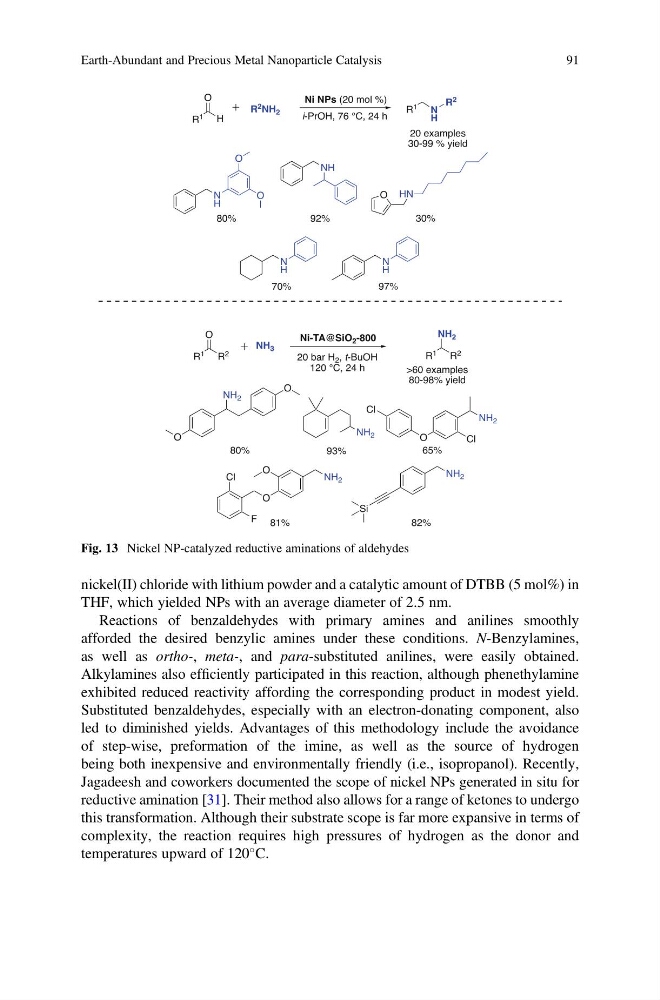
Reactions of benzaldehydes with primary amines and anilines smoothly
afforded the desired benzylic amines under these conditions. N-Benzylamines,
as well as ortho-, meta-, and para-substituted anilines, were easily obtained.
Alkylamines also efficiently participated in this reaction, although phenethylamine
exhibited reduced reactivity affording the corresponding product in modest yield.
Substituted benzaldehydes, especially with an electron-donating component, also
led to diminished yields. Advantages of this methodology include the avoidance
of step-wise, preformation of the imine, as well as the source of hydrogen
being both inexpensive and environmentally friendly (i.e., isopropanol). Recently,
Jagadeesh and coworkers documented the scope of nickel NPs generated in situ for
reductive amination [31]. Their method also allows for a range of ketones to undergo
this transformation. Although their substrate scope is far more expansive in terms of
complexity, the reaction requires high pressures of hydrogen as the donor and
temperatures upward of 120
C.
Fig. 13 Nickel NP-catalyzed reductive aminations of aldehydes
Earth-Abundant and Precious Metal Nanoparticle Catalysis
91
THF, which yielded NPs with an average diameter of 2.5 nm.
Reactions of benzaldehydes with primary amines and anilines smoothly
afforded the desired benzylic amines under these conditions. N-Benzylamines,
as well as ortho-, meta-, and para-substituted anilines, were easily obtained.
Alkylamines also efficiently participated in this reaction, although phenethylamine
exhibited reduced reactivity affording the corresponding product in modest yield.
Substituted benzaldehydes, especially with an electron-donating component, also
led to diminished yields. Advantages of this methodology include the avoidance
of step-wise, preformation of the imine, as well as the source of hydrogen
being both inexpensive and environmentally friendly (i.e., isopropanol). Recently,
Jagadeesh and coworkers documented the scope of nickel NPs generated in situ for
reductive amination [31]. Their method also allows for a range of ketones to undergo
this transformation. Although their substrate scope is far more expansive in terms of
complexity, the reaction requires high pressures of hydrogen as the donor and
temperatures upward of 120
C.
Fig. 13 Nickel NP-catalyzed reductive aminations of aldehydes
Earth-Abundant and Precious Metal Nanoparticle Catalysis
91