

Pd doped into these ligandless Fe/ppm Pd NPs. An extensive array of highly
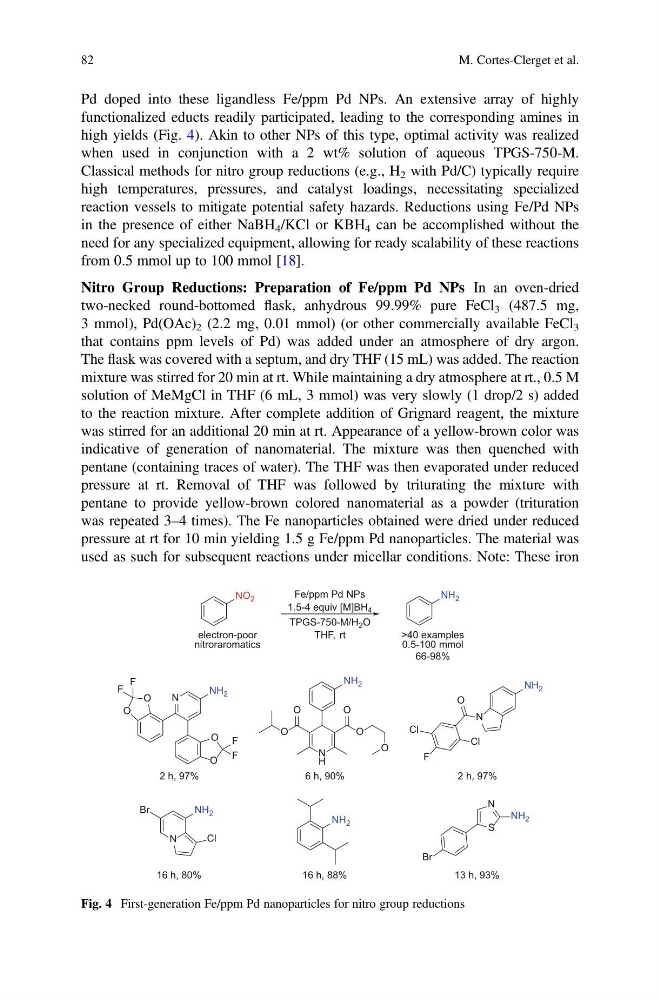
functionalized educts readily participated, leading to the corresponding amines in
high yields (Fig. 4). Akin to other NPs of this type, optimal activity was realized
when used in conjunction with a 2 wt% solution of aqueous TPGS-750-M.
Classical methods for nitro group reductions (e.g., H 2 with Pd/C) typically require
high temperatures, pressures, and catalyst loadings, necessitating specialized
reaction vessels to mitigate potential safety hazards. Reductions using Fe/Pd NPs
in the presence of either NaBH 4 /KCl or KBH 4 can be accomplished without the
need for any specialized equipment, allowing for ready scalability of these reactions
from 0.5 mmol up to 100 mmol [18].
Nitro Group Reductions: Preparation of Fe/ppm Pd NPs In an oven-dried
two-necked round-bottomed flask, anhydrous 99.99% pure FeCl 3 (487.5 mg,
3 mmol), Pd(OAc) 2 (2.2 mg, 0.01 mmol) (or other commercially available FeCl 3
that contains ppm levels of Pd) was added under an atmosphere of dry argon.
The flask was covered with a septum, and dry THF (15 mL) was added. The reaction
mixture was stirred for 20 min at rt. While maintaining a dry atmosphere at rt., 0.5 M
solution of MeMgCl in THF (6 mL, 3 mmol) was very slowly (1 drop/2 s) added
to the reaction mixture. After complete addition of Grignard reagent, the mixture
was stirred for an additional 20 min at rt. Appearance of a yellow-brown color was
indicative of generation of nanomaterial. The mixture was then quenched with
pentane (containing traces of water). The THF was then evaporated under reduced
pressure at rt. Removal of THF was followed by triturating the mixture with
pentane to provide yellow-brown colored nanomaterial as a powder (trituration
was repeated 3–4 times). The Fe nanoparticles obtained were dried under reduced
pressure at rt for 10 min yielding 1.5 g Fe/ppm Pd nanoparticles. The material was
used as such for subsequent reactions under micellar conditions. Note: These iron
NO 2
Fe/ppm Pd NPs
1.5-4 equiv [M]BH 4
TPGS-750-M/H 2 O
THF, rt
NH 2
electron-poor
nitroraromatics
>40 examples
0.5-100 mmol
66-98%
N
NH 2
O
O
O
O
F
F
F
F
2 h, 97%
NH 2
N
H
O
O
O
O
O
6 h, 90%
NH 2
16 h, 88%
N
NH 2
Cl
Br
16 h, 80%
NH 2
N
O
Cl
F
Cl
2 h, 97%
S
N
NH 2
Br
13 h, 93%
Fig. 4 First-generation Fe/ppm Pd nanoparticles for nitro group reductions
82
M. Cortes-Clerget et al.
functionalized educts readily participated, leading to the corresponding amines in
high yields (Fig. 4). Akin to other NPs of this type, optimal activity was realized
when used in conjunction with a 2 wt% solution of aqueous TPGS-750-M.
Classical methods for nitro group reductions (e.g., H 2 with Pd/C) typically require
high temperatures, pressures, and catalyst loadings, necessitating specialized
reaction vessels to mitigate potential safety hazards. Reductions using Fe/Pd NPs
in the presence of either NaBH 4 /KCl or KBH 4 can be accomplished without the
need for any specialized equipment, allowing for ready scalability of these reactions
from 0.5 mmol up to 100 mmol [18].
Nitro Group Reductions: Preparation of Fe/ppm Pd NPs In an oven-dried
two-necked round-bottomed flask, anhydrous 99.99% pure FeCl 3 (487.5 mg,
3 mmol), Pd(OAc) 2 (2.2 mg, 0.01 mmol) (or other commercially available FeCl 3
that contains ppm levels of Pd) was added under an atmosphere of dry argon.
The flask was covered with a septum, and dry THF (15 mL) was added. The reaction
mixture was stirred for 20 min at rt. While maintaining a dry atmosphere at rt., 0.5 M
solution of MeMgCl in THF (6 mL, 3 mmol) was very slowly (1 drop/2 s) added
to the reaction mixture. After complete addition of Grignard reagent, the mixture
was stirred for an additional 20 min at rt. Appearance of a yellow-brown color was
indicative of generation of nanomaterial. The mixture was then quenched with
pentane (containing traces of water). The THF was then evaporated under reduced
pressure at rt. Removal of THF was followed by triturating the mixture with
pentane to provide yellow-brown colored nanomaterial as a powder (trituration
was repeated 3–4 times). The Fe nanoparticles obtained were dried under reduced
pressure at rt for 10 min yielding 1.5 g Fe/ppm Pd nanoparticles. The material was
used as such for subsequent reactions under micellar conditions. Note: These iron
NO 2
Fe/ppm Pd NPs
1.5-4 equiv [M]BH 4
TPGS-750-M/H 2 O
THF, rt
NH 2
electron-poor
nitroraromatics
>40 examples
0.5-100 mmol
66-98%
N
NH 2
O
O
O
O
F
F
F
F
2 h, 97%
NH 2
N
H
O
O
O
O
O
6 h, 90%
NH 2
16 h, 88%
N
NH 2
Cl
Br
16 h, 80%
NH 2
N
O
Cl
F
Cl
2 h, 97%
S
N
NH 2
Br
13 h, 93%
Fig. 4 First-generation Fe/ppm Pd nanoparticles for nitro group reductions
82
M. Cortes-Clerget et al.