

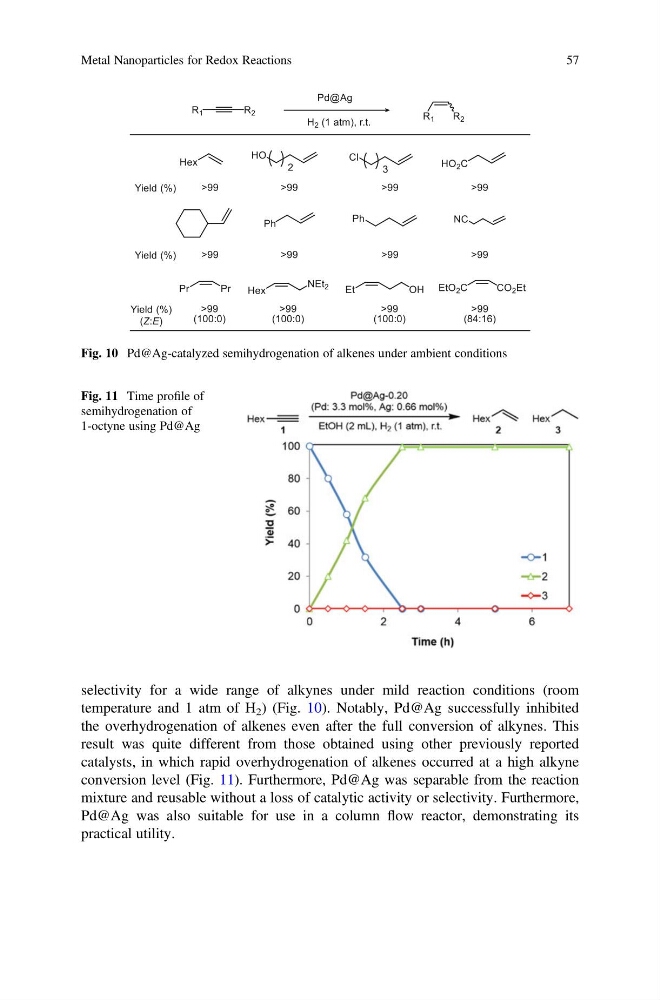
selectivity for a wide range of alkynes under mild reaction conditions (room
temperature and 1 atm of H 2 ) (Fig. 10). Notably, Pd@Ag successfully inhibited
the overhydrogenation of alkenes even after the full conversion of alkynes. This
result was quite different from those obtained using other previously reported
catalysts, in which rapid overhydrogenation of alkenes occurred at a high alkyne
conversion level (Fig. 11). Furthermore, Pd@Ag was separable from the reaction
mixture and reusable without a loss of catalytic activity or selectivity. Furthermore,
Pd@Ag was also suitable for use in a column flow reactor, demonstrating its
practical utility.
Fig. 10 Pd@Ag-catalyzed semihydrogenation of alkenes under ambient conditions
Fig. 11 Time profile of
semihydrogenation of
1-octyne using Pd@Ag
Metal Nanoparticles for Redox Reactions
57
temperature and 1 atm of H 2 ) (Fig. 10). Notably, Pd@Ag successfully inhibited
the overhydrogenation of alkenes even after the full conversion of alkynes. This
result was quite different from those obtained using other previously reported
catalysts, in which rapid overhydrogenation of alkenes occurred at a high alkyne
conversion level (Fig. 11). Furthermore, Pd@Ag was separable from the reaction
mixture and reusable without a loss of catalytic activity or selectivity. Furthermore,
Pd@Ag was also suitable for use in a column flow reactor, demonstrating its
practical utility.
Fig. 10 Pd@Ag-catalyzed semihydrogenation of alkenes under ambient conditions
Fig. 11 Time profile of
semihydrogenation of
1-octyne using Pd@Ag
Metal Nanoparticles for Redox Reactions
57