

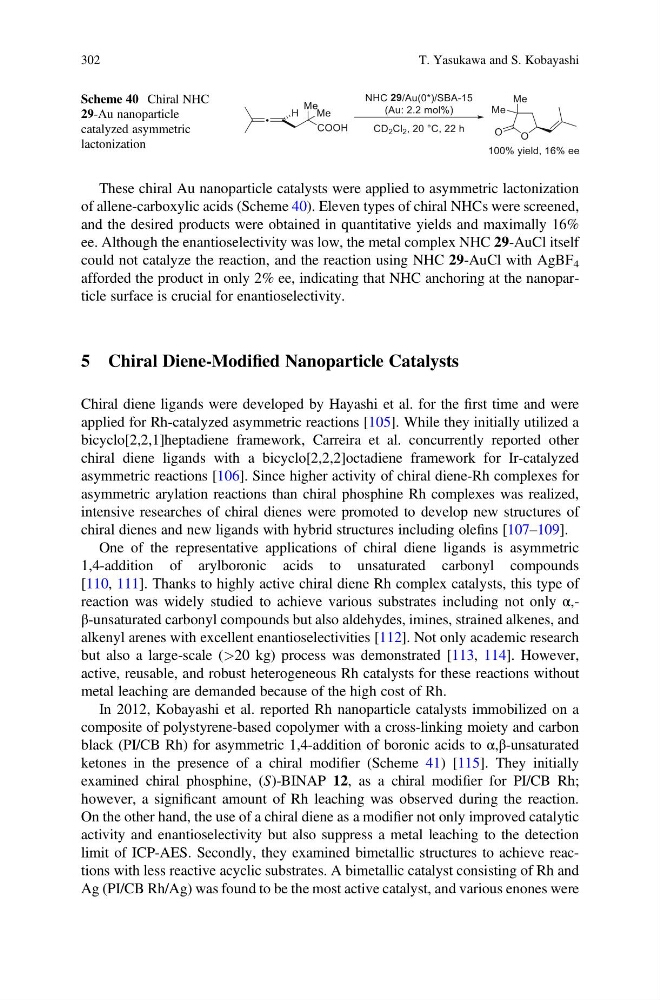
These chiral Au nanoparticle catalysts were applied to asymmetric lactonization
of allene-carboxylic acids (Scheme 40). Eleven types of chiral NHCs were screened,
and the desired products were obtained in quantitative yields and maximally 16%
ee. Although the enantioselectivity was low, the metal complex NHC 29-AuCl itself
could not catalyze the reaction, and the reaction using NHC 29-AuCl with AgBF 4
afforded the product in only 2% ee, indicating that NHC anchoring at the nanoparticle surface is crucial for enantioselectivity.
5 Chiral Diene-Modified Nanoparticle Catalysts
Chiral diene ligands were developed by Hayashi et al. for the first time and were
applied for Rh-catalyzed asymmetric reactions [105]. While they initially utilized a
bicyclo[2,2,1]heptadiene framework, Carreira et al. concurrently reported other
chiral diene ligands with a bicyclo[2,2,2]octadiene framework for Ir-catalyzed
asymmetric reactions [106]. Since higher activity of chiral diene-Rh complexes for
asymmetric arylation reactions than chiral phosphine Rh complexes was realized,
intensive researches of chiral dienes were promoted to develop new structures of
chiral dienes and new ligands with hybrid structures including olefins [107–109].
One of the representative applications of chiral diene ligands is asymmetric
1,4-addition of arylboronic acids to unsaturated carbonyl compounds
[110, 111]. Thanks to highly active chiral diene Rh complex catalysts, this type of
reaction was widely studied to achieve various substrates including not only α,β-unsaturated carbonyl compounds but also aldehydes, imines, strained alkenes, and
alkenyl arenes with excellent enantioselectivities [112]. Not only academic research
but also a large-scale (>20 kg) process was demonstrated [113, 114]. However,
active, reusable, and robust heterogeneous Rh catalysts for these reactions without
metal leaching are demanded because of the high cost of Rh.
In 2012, Kobayashi et al. reported Rh nanoparticle catalysts immobilized on a
composite of polystyrene-based copolymer with a cross-linking moiety and carbon
black (PI/CB Rh) for asymmetric 1,4-addition of boronic acids to α,β-unsaturated
ketones in the presence of a chiral modifier (Scheme 41) [115]. They initially
examined chiral phosphine, (S)-BINAP 12, as a chiral modifier for PI/CB Rh;
however, a significant amount of Rh leaching was observed during the reaction.
On the other hand, the use of a chiral diene as a modifier not only improved catalytic
activity and enantioselectivity but also suppress a metal leaching to the detection
limit of ICP-AES. Secondly, they examined bimetallic structures to achieve reactions with less reactive acyclic substrates. A bimetallic catalyst consisting of Rh and
Ag (PI/CB Rh/Ag) was found to be the most active catalyst, and various enones were
Scheme 40 Chiral NHC
29-Au nanoparticle
catalyzed asymmetric
lactonization
302
T. Yasukawa and S. Kobayashi
of allene-carboxylic acids (Scheme 40). Eleven types of chiral NHCs were screened,
and the desired products were obtained in quantitative yields and maximally 16%
ee. Although the enantioselectivity was low, the metal complex NHC 29-AuCl itself
could not catalyze the reaction, and the reaction using NHC 29-AuCl with AgBF 4
afforded the product in only 2% ee, indicating that NHC anchoring at the nanoparticle surface is crucial for enantioselectivity.
5 Chiral Diene-Modified Nanoparticle Catalysts
Chiral diene ligands were developed by Hayashi et al. for the first time and were
applied for Rh-catalyzed asymmetric reactions [105]. While they initially utilized a
bicyclo[2,2,1]heptadiene framework, Carreira et al. concurrently reported other
chiral diene ligands with a bicyclo[2,2,2]octadiene framework for Ir-catalyzed
asymmetric reactions [106]. Since higher activity of chiral diene-Rh complexes for
asymmetric arylation reactions than chiral phosphine Rh complexes was realized,
intensive researches of chiral dienes were promoted to develop new structures of
chiral dienes and new ligands with hybrid structures including olefins [107–109].
One of the representative applications of chiral diene ligands is asymmetric
1,4-addition of arylboronic acids to unsaturated carbonyl compounds
[110, 111]. Thanks to highly active chiral diene Rh complex catalysts, this type of
reaction was widely studied to achieve various substrates including not only α,β-unsaturated carbonyl compounds but also aldehydes, imines, strained alkenes, and
alkenyl arenes with excellent enantioselectivities [112]. Not only academic research
but also a large-scale (>20 kg) process was demonstrated [113, 114]. However,
active, reusable, and robust heterogeneous Rh catalysts for these reactions without
metal leaching are demanded because of the high cost of Rh.
In 2012, Kobayashi et al. reported Rh nanoparticle catalysts immobilized on a
composite of polystyrene-based copolymer with a cross-linking moiety and carbon
black (PI/CB Rh) for asymmetric 1,4-addition of boronic acids to α,β-unsaturated
ketones in the presence of a chiral modifier (Scheme 41) [115]. They initially
examined chiral phosphine, (S)-BINAP 12, as a chiral modifier for PI/CB Rh;
however, a significant amount of Rh leaching was observed during the reaction.
On the other hand, the use of a chiral diene as a modifier not only improved catalytic
activity and enantioselectivity but also suppress a metal leaching to the detection
limit of ICP-AES. Secondly, they examined bimetallic structures to achieve reactions with less reactive acyclic substrates. A bimetallic catalyst consisting of Rh and
Ag (PI/CB Rh/Ag) was found to be the most active catalyst, and various enones were
Scheme 40 Chiral NHC
29-Au nanoparticle
catalyzed asymmetric
lactonization
302
T. Yasukawa and S. Kobayashi