

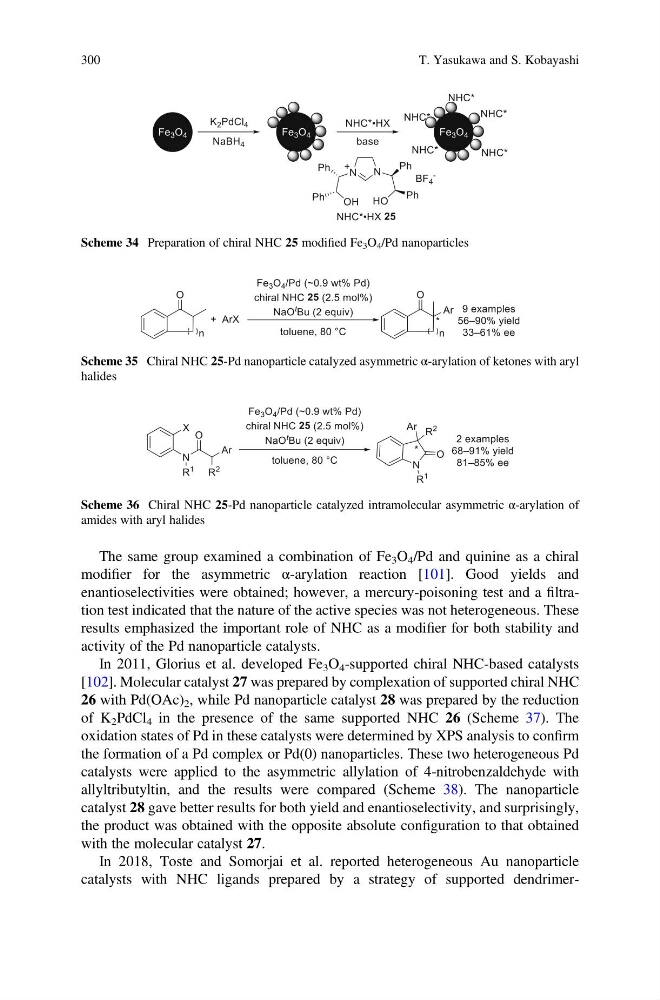
The same group examined a combination of Fe 3 O 4 /Pd and quinine as a chiral
modifier for the asymmetric α-arylation reaction [101]. Good yields and
enantioselectivities were obtained; however, a mercury-poisoning test and a filtration test indicated that the nature of the active species was not heterogeneous. These
results emphasized the important role of NHC as a modifier for both stability and
activity of the Pd nanoparticle catalysts.
In 2011, Glorius et al. developed Fe 3 O 4 -supported chiral NHC-based catalysts
[102]. Molecular catalyst 27 was prepared by complexation of supported chiral NHC
26 with Pd(OAc) 2 , while Pd nanoparticle catalyst 28 was prepared by the reduction
of K 2 PdCl 4 in the presence of the same supported NHC 26 (Scheme 37). The
oxidation states of Pd in these catalysts were determined by XPS analysis to confirm
the formation of a Pd complex or Pd(0) nanoparticles. These two heterogeneous Pd
catalysts were applied to the asymmetric allylation of 4-nitrobenzaldehyde with
allyltributyltin, and the results were compared (Scheme 38). The nanoparticle
catalyst 28 gave better results for both yield and enantioselectivity, and surprisingly,
the product was obtained with the opposite absolute configuration to that obtained
with the molecular catalyst 27.
In 2018, Toste and Somorjai et al. reported heterogeneous Au nanoparticle
catalysts with NHC ligands prepared by a strategy of supported dendrimerScheme 34 Preparation of chiral NHC 25 modified Fe 3 O 4 /Pd nanoparticles
Scheme 35 Chiral NHC 25-Pd nanoparticle catalyzed asymmetric α-arylation of ketones with aryl
halides
Scheme 36 Chiral NHC 25-Pd nanoparticle catalyzed intramolecular asymmetric α-arylation of
amides with aryl halides
300
T. Yasukawa and S. Kobayashi
modifier for the asymmetric α-arylation reaction [101]. Good yields and
enantioselectivities were obtained; however, a mercury-poisoning test and a filtration test indicated that the nature of the active species was not heterogeneous. These
results emphasized the important role of NHC as a modifier for both stability and
activity of the Pd nanoparticle catalysts.
In 2011, Glorius et al. developed Fe 3 O 4 -supported chiral NHC-based catalysts
[102]. Molecular catalyst 27 was prepared by complexation of supported chiral NHC
26 with Pd(OAc) 2 , while Pd nanoparticle catalyst 28 was prepared by the reduction
of K 2 PdCl 4 in the presence of the same supported NHC 26 (Scheme 37). The
oxidation states of Pd in these catalysts were determined by XPS analysis to confirm
the formation of a Pd complex or Pd(0) nanoparticles. These two heterogeneous Pd
catalysts were applied to the asymmetric allylation of 4-nitrobenzaldehyde with
allyltributyltin, and the results were compared (Scheme 38). The nanoparticle
catalyst 28 gave better results for both yield and enantioselectivity, and surprisingly,
the product was obtained with the opposite absolute configuration to that obtained
with the molecular catalyst 27.
In 2018, Toste and Somorjai et al. reported heterogeneous Au nanoparticle
catalysts with NHC ligands prepared by a strategy of supported dendrimerScheme 34 Preparation of chiral NHC 25 modified Fe 3 O 4 /Pd nanoparticles
Scheme 35 Chiral NHC 25-Pd nanoparticle catalyzed asymmetric α-arylation of ketones with aryl
halides
Scheme 36 Chiral NHC 25-Pd nanoparticle catalyzed intramolecular asymmetric α-arylation of
amides with aryl halides
300
T. Yasukawa and S. Kobayashi