

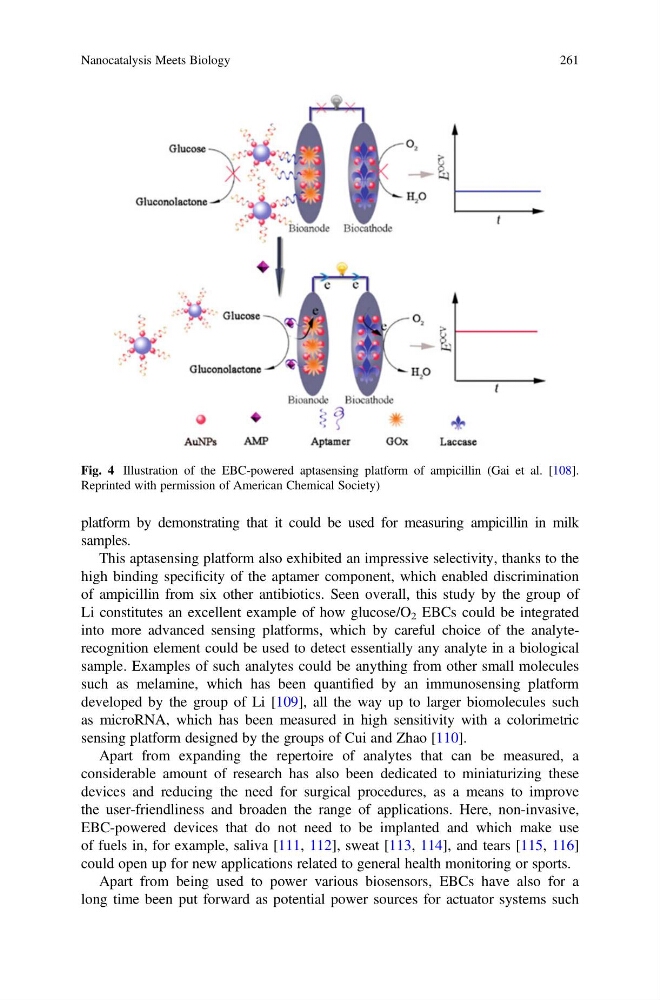
platform by demonstrating that it could be used for measuring ampicillin in milk
samples.
This aptasensing platform also exhibited an impressive selectivity, thanks to the
high binding specificity of the aptamer component, which enabled discrimination
of ampicillin from six other antibiotics. Seen overall, this study by the group of
Li constitutes an excellent example of how glucose/O 2 EBCs could be integrated
into more advanced sensing platforms, which by careful choice of the analyterecognition element could be used to detect essentially any analyte in a biological
sample. Examples of such analytes could be anything from other small molecules
such as melamine, which has been quantified by an immunosensing platform
developed by the group of Li [109], all the way up to larger biomolecules such
as microRNA, which has been measured in high sensitivity with a colorimetric
sensing platform designed by the groups of Cui and Zhao [110].
Apart from expanding the repertoire of analytes that can be measured, a
considerable amount of research has also been dedicated to miniaturizing these
devices and reducing the need for surgical procedures, as a means to improve
the user-friendliness and broaden the range of applications. Here, non-invasive,
EBC-powered devices that do not need to be implanted and which make use
of fuels in, for example, saliva [111, 112], sweat [113, 114], and tears [115, 116]
could open up for new applications related to general health monitoring or sports.
Apart from being used to power various biosensors, EBCs have also for a
long time been put forward as potential power sources for actuator systems such
Fig. 4 Illustration of the EBC-powered aptasensing platform of ampicillin (Gai et al. [108].
Reprinted with permission of American Chemical Society)
Nanocatalysis Meets Biology
261
samples.
This aptasensing platform also exhibited an impressive selectivity, thanks to the
high binding specificity of the aptamer component, which enabled discrimination
of ampicillin from six other antibiotics. Seen overall, this study by the group of
Li constitutes an excellent example of how glucose/O 2 EBCs could be integrated
into more advanced sensing platforms, which by careful choice of the analyterecognition element could be used to detect essentially any analyte in a biological
sample. Examples of such analytes could be anything from other small molecules
such as melamine, which has been quantified by an immunosensing platform
developed by the group of Li [109], all the way up to larger biomolecules such
as microRNA, which has been measured in high sensitivity with a colorimetric
sensing platform designed by the groups of Cui and Zhao [110].
Apart from expanding the repertoire of analytes that can be measured, a
considerable amount of research has also been dedicated to miniaturizing these
devices and reducing the need for surgical procedures, as a means to improve
the user-friendliness and broaden the range of applications. Here, non-invasive,
EBC-powered devices that do not need to be implanted and which make use
of fuels in, for example, saliva [111, 112], sweat [113, 114], and tears [115, 116]
could open up for new applications related to general health monitoring or sports.
Apart from being used to power various biosensors, EBCs have also for a
long time been put forward as potential power sources for actuator systems such
Fig. 4 Illustration of the EBC-powered aptasensing platform of ampicillin (Gai et al. [108].
Reprinted with permission of American Chemical Society)
Nanocatalysis Meets Biology
261