

2.3 Future Outlook on the Applications
of Nanometal-Enzyme Hybrids in Organic Synthesis
During the past decade, there has been an emerging interest in the organic
chemistry community of novel nanometal-enzyme hybrids because of their
potential as multifunctional catalysts in complex cascade sequences. Although
some very impressive contributions have already been made in this area, as,
for example, the many bifunctional Pd/CalB hybrids developed for the DKR of
amines [36, 45, 48, 49], there is still significant room for further developments
in terms of both hybrid design and the cascades they are used in. So far, only
very few enzymes have been used to construct nanometal-enzyme hybrids, and
simply expanding the portfolio of enzymes used would open up new opportunities
to broaden the potential catalytic applications of these hybrids. Some enzymes
that would be exciting to study in interfaces with different transition metal
NPs would, for example, be different aldolases, decarboxylases, dehydrogenases,
oxidases, proteases, pyrophosphatases, and transferases. In terms of the transition
metals to be integrated into future hybrids, it would be interesting to study the
performance of NPs based on the first row transition metals Fe, Mn, Co, and Ni,
as they are attractive from both an economical and environmental point of view.
Moreover, it would be exciting to see how far this hybrid catalyst concept could
be pushed in terms of the maximum number of catalytic species that could be
co-immobilized on the same support. So far, most examples have involved the
pairing of only one nanometal species and one enzyme, but in principle there is
nothing that prevents three or more different catalytic species to be co-immobilized
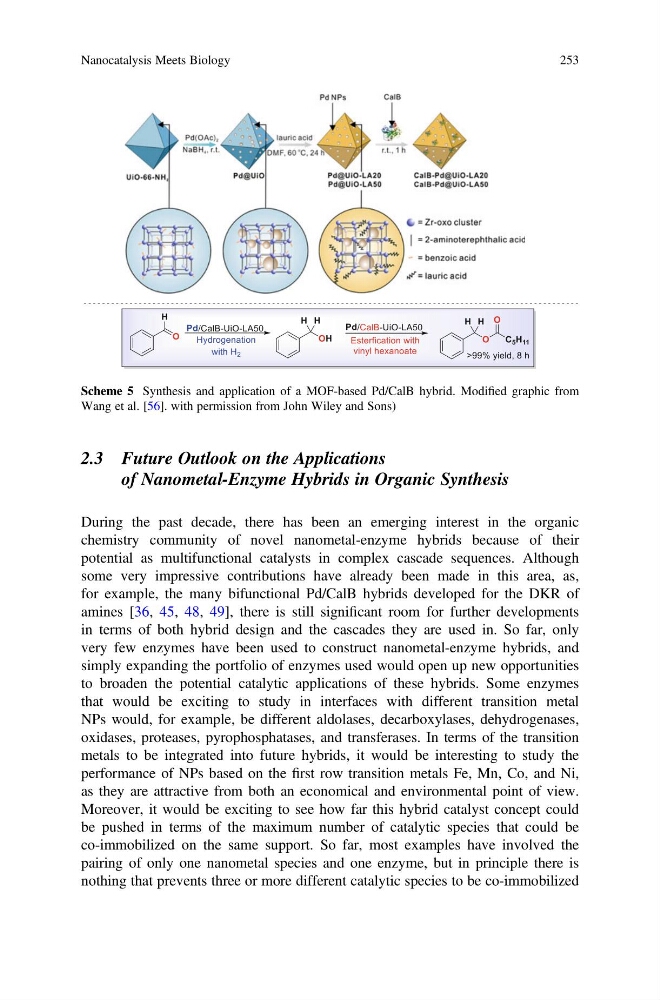
Scheme 5 Synthesis and application of a MOF-based Pd/CalB hybrid. Modified graphic from
Wang et al. [56]. with permission from John Wiley and Sons)
Nanocatalysis Meets Biology
253
of Nanometal-Enzyme Hybrids in Organic Synthesis
During the past decade, there has been an emerging interest in the organic
chemistry community of novel nanometal-enzyme hybrids because of their
potential as multifunctional catalysts in complex cascade sequences. Although
some very impressive contributions have already been made in this area, as,
for example, the many bifunctional Pd/CalB hybrids developed for the DKR of
amines [36, 45, 48, 49], there is still significant room for further developments
in terms of both hybrid design and the cascades they are used in. So far, only
very few enzymes have been used to construct nanometal-enzyme hybrids, and
simply expanding the portfolio of enzymes used would open up new opportunities
to broaden the potential catalytic applications of these hybrids. Some enzymes
that would be exciting to study in interfaces with different transition metal
NPs would, for example, be different aldolases, decarboxylases, dehydrogenases,
oxidases, proteases, pyrophosphatases, and transferases. In terms of the transition
metals to be integrated into future hybrids, it would be interesting to study the
performance of NPs based on the first row transition metals Fe, Mn, Co, and Ni,
as they are attractive from both an economical and environmental point of view.
Moreover, it would be exciting to see how far this hybrid catalyst concept could
be pushed in terms of the maximum number of catalytic species that could be
co-immobilized on the same support. So far, most examples have involved the
pairing of only one nanometal species and one enzyme, but in principle there is
nothing that prevents three or more different catalytic species to be co-immobilized
Scheme 5 Synthesis and application of a MOF-based Pd/CalB hybrid. Modified graphic from
Wang et al. [56]. with permission from John Wiley and Sons)
Nanocatalysis Meets Biology
253