

well. For example, one of the earlier examples was developed for the use in SuzukiMiyaura reactions by the group of Cacchi [52]. This hybrid, which had been
constructed via the conjugation approach, consisted of Pd NPs that had
been immobilized in the protein Dps, isolated from the thermophilic bacterium
Thermosynechococcus elongatus. Although this hybrid catalyst did not make use
of any catalytic activity from the protein component, it was still important for
controlling the size of the NPs and enabling the cross-coupling reaction to be
performed in water. Furthermore, because of the possibility to run the Suzuki
reactions in water, the authors were also able to design chemoenzymatic one-pot
cascades for the synthesis of chiral biraryl alcohols, by pairing this hybrid with
an alcohol dehydrogenase from Lactobacillus brevis.
Another elegant example of a nanometal-enzyme assembly prepared via
the conjugation approach was the Pt/aminopeptidase hybrid reported by Kim et al.
[53]. Unlike the hybrid previously developed by the group of Cacchi, this
Pt/aminopeptidase hybrid made use of both the nanometal and the enzyme
components for coupled tandem catalysis. For the synthesis of their hybrid, the
authors deliberately chose an aminopeptidase from Streptococcus pneumonia that
is known to self-assemble into well-defined tetrahedral dodecameric superstructures.
On the inside of these aminopeptidase superstructures, there is a cavity with
a diameter of ca 6 nm that can be exploited for the entrapping of metal NPs.
To incorporate the Pt NPs into the interior of these aminopeptidase superstructures,
the authors simply exposed them to an aqueous solution of K 2 PtCl 4 and then
slowly reduced the Pt(II) with NaBH 4 . The Pt NPs that formed on the inside of
aminopeptidase superstructures were found to be crystalline and have an average
diameter of ca 2 nm, as determined by TEM analysis. To demonstrate the dual
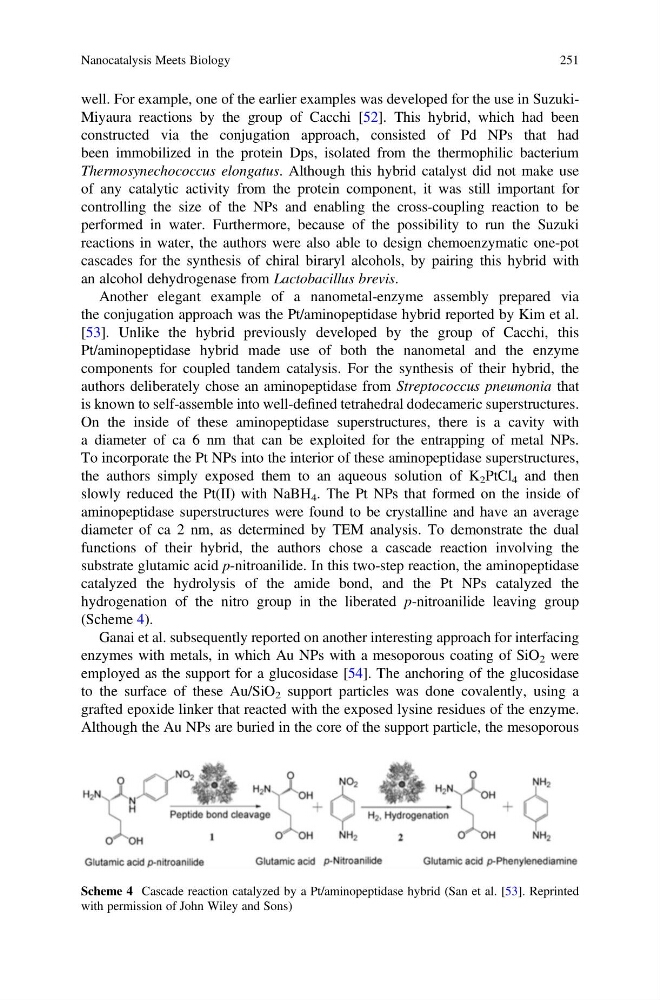
functions of their hybrid, the authors chose a cascade reaction involving the
substrate glutamic acid p-nitroanilide. In this two-step reaction, the aminopeptidase
catalyzed the hydrolysis of the amide bond, and the Pt NPs catalyzed the
hydrogenation of the nitro group in the liberated p-nitroanilide leaving group
(Scheme 4).
Ganai et al. subsequently reported on another interesting approach for interfacing
enzymes with metals, in which Au NPs with a mesoporous coating of SiO 2 were
employed as the support for a glucosidase [54]. The anchoring of the glucosidase
to the surface of these Au/SiO 2 support particles was done covalently, using a
grafted epoxide linker that reacted with the exposed lysine residues of the enzyme.
Although the Au NPs are buried in the core of the support particle, the mesoporous
Scheme 4 Cascade reaction catalyzed by a Pt/aminopeptidase hybrid (San et al. [53]. Reprinted
with permission of John Wiley and Sons)
Nanocatalysis Meets Biology
251
constructed via the conjugation approach, consisted of Pd NPs that had
been immobilized in the protein Dps, isolated from the thermophilic bacterium
Thermosynechococcus elongatus. Although this hybrid catalyst did not make use
of any catalytic activity from the protein component, it was still important for
controlling the size of the NPs and enabling the cross-coupling reaction to be
performed in water. Furthermore, because of the possibility to run the Suzuki
reactions in water, the authors were also able to design chemoenzymatic one-pot
cascades for the synthesis of chiral biraryl alcohols, by pairing this hybrid with
an alcohol dehydrogenase from Lactobacillus brevis.
Another elegant example of a nanometal-enzyme assembly prepared via
the conjugation approach was the Pt/aminopeptidase hybrid reported by Kim et al.
[53]. Unlike the hybrid previously developed by the group of Cacchi, this
Pt/aminopeptidase hybrid made use of both the nanometal and the enzyme
components for coupled tandem catalysis. For the synthesis of their hybrid, the
authors deliberately chose an aminopeptidase from Streptococcus pneumonia that
is known to self-assemble into well-defined tetrahedral dodecameric superstructures.
On the inside of these aminopeptidase superstructures, there is a cavity with
a diameter of ca 6 nm that can be exploited for the entrapping of metal NPs.
To incorporate the Pt NPs into the interior of these aminopeptidase superstructures,
the authors simply exposed them to an aqueous solution of K 2 PtCl 4 and then
slowly reduced the Pt(II) with NaBH 4 . The Pt NPs that formed on the inside of
aminopeptidase superstructures were found to be crystalline and have an average
diameter of ca 2 nm, as determined by TEM analysis. To demonstrate the dual
functions of their hybrid, the authors chose a cascade reaction involving the
substrate glutamic acid p-nitroanilide. In this two-step reaction, the aminopeptidase
catalyzed the hydrolysis of the amide bond, and the Pt NPs catalyzed the
hydrogenation of the nitro group in the liberated p-nitroanilide leaving group
(Scheme 4).
Ganai et al. subsequently reported on another interesting approach for interfacing
enzymes with metals, in which Au NPs with a mesoporous coating of SiO 2 were
employed as the support for a glucosidase [54]. The anchoring of the glucosidase
to the surface of these Au/SiO 2 support particles was done covalently, using a
grafted epoxide linker that reacted with the exposed lysine residues of the enzyme.
Although the Au NPs are buried in the core of the support particle, the mesoporous
Scheme 4 Cascade reaction catalyzed by a Pt/aminopeptidase hybrid (San et al. [53]. Reprinted
with permission of John Wiley and Sons)
Nanocatalysis Meets Biology
251