

fall within two main categories, which is either the so-called co-immobilization
approach where the nanocatalyst and the enzyme are attached next to one another
on a support material or the more challenging bioconjugation approach where
the two catalytic species are directly merged together. The overall goal of this
part is not only to review the applications of such hybrid systems but also to shine
light on their respective advantages and shortcomings. By doing so, we aim to
outline future research directions that would be helpful for the development of
even more efficient and intricate coupled catalytic systems for organic chemistry
applications.
2.1 Dynamic Kinetic Resolution: A Major Driver
for the Development of Nanometal-Enzyme Hybrids
In organic synthesis, the transformation that has perhaps benefitted the most
from coupled catalytic systems involving both transition metals and enzymes is
the dynamic kinetic resolution (DKR) of alcohols and amines [14, 15]. In these
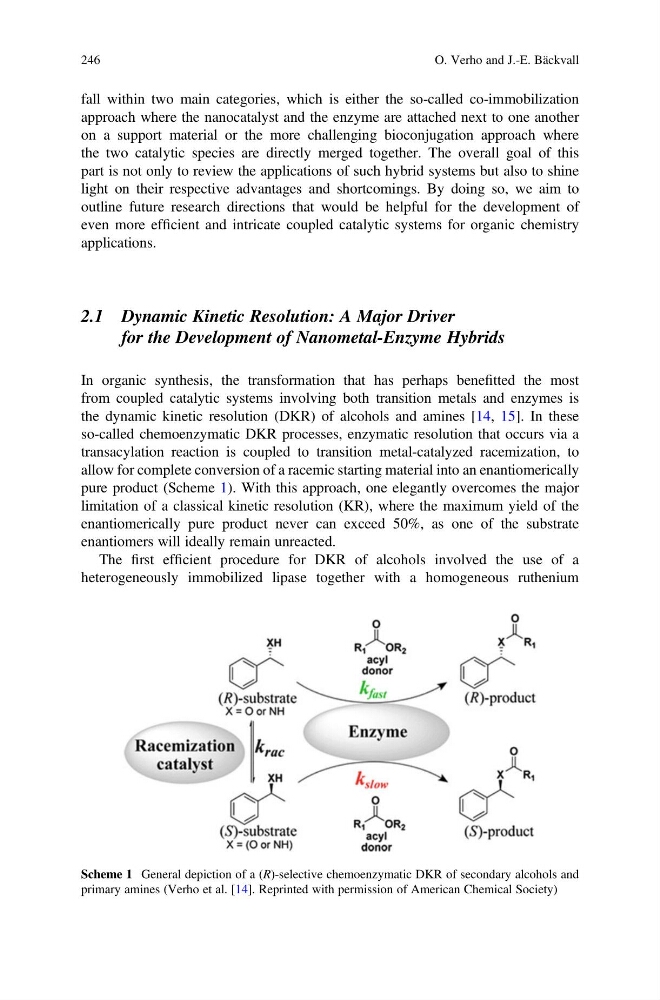
so-called chemoenzymatic DKR processes, enzymatic resolution that occurs via a
transacylation reaction is coupled to transition metal-catalyzed racemization, to
allow for complete conversion of a racemic starting material into an enantiomerically
pure product (Scheme 1). With this approach, one elegantly overcomes the major
limitation of a classical kinetic resolution (KR), where the maximum yield of the
enantiomerically pure product never can exceed 50%, as one of the substrate
enantiomers will ideally remain unreacted.
The first efficient procedure for DKR of alcohols involved the use of a
heterogeneously immobilized lipase together with a homogeneous ruthenium
Scheme 1 General depiction of a (R)-selective chemoenzymatic DKR of secondary alcohols and
primary amines (Verho et al. [14]. Reprinted with permission of American Chemical Society)
246
O. Verho and J.-E. Bäckvall
approach where the nanocatalyst and the enzyme are attached next to one another
on a support material or the more challenging bioconjugation approach where
the two catalytic species are directly merged together. The overall goal of this
part is not only to review the applications of such hybrid systems but also to shine
light on their respective advantages and shortcomings. By doing so, we aim to
outline future research directions that would be helpful for the development of
even more efficient and intricate coupled catalytic systems for organic chemistry
applications.
2.1 Dynamic Kinetic Resolution: A Major Driver
for the Development of Nanometal-Enzyme Hybrids
In organic synthesis, the transformation that has perhaps benefitted the most
from coupled catalytic systems involving both transition metals and enzymes is
the dynamic kinetic resolution (DKR) of alcohols and amines [14, 15]. In these
so-called chemoenzymatic DKR processes, enzymatic resolution that occurs via a
transacylation reaction is coupled to transition metal-catalyzed racemization, to
allow for complete conversion of a racemic starting material into an enantiomerically
pure product (Scheme 1). With this approach, one elegantly overcomes the major
limitation of a classical kinetic resolution (KR), where the maximum yield of the
enantiomerically pure product never can exceed 50%, as one of the substrate
enantiomers will ideally remain unreacted.
The first efficient procedure for DKR of alcohols involved the use of a
heterogeneously immobilized lipase together with a homogeneous ruthenium
Scheme 1 General depiction of a (R)-selective chemoenzymatic DKR of secondary alcohols and
primary amines (Verho et al. [14]. Reprinted with permission of American Chemical Society)
246
O. Verho and J.-E. Bäckvall