

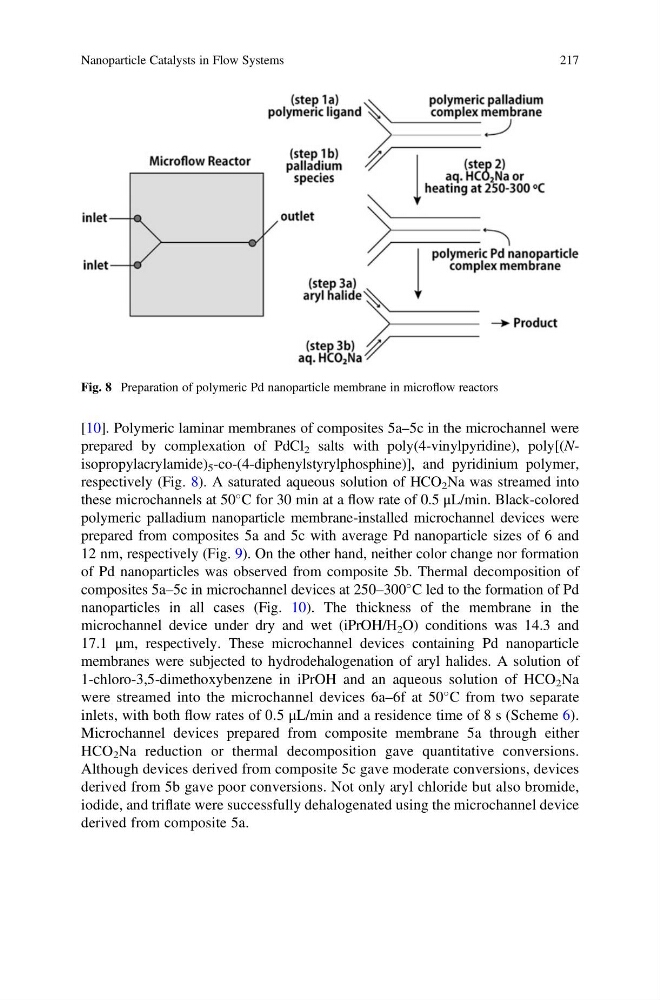
[10]. Polymeric laminar membranes of composites 5a–5c in the microchannel were
prepared by complexation of PdCl 2 salts with poly(4-vinylpyridine), poly[(Nisopropylacrylamide) 5 -co-(4-diphenylstyrylphosphine)], and pyridinium polymer,
respectively (Fig. 8). A saturated aqueous solution of HCO 2 Na was streamed into
these microchannels at 50
C for 30 min at a flow rate of 0.5 μL/min. Black-colored
polymeric palladium nanoparticle membrane-installed microchannel devices were
prepared from composites 5a and 5c with average Pd nanoparticle sizes of 6 and
12 nm, respectively (Fig. 9). On the other hand, neither color change nor formation
of Pd nanoparticles was observed from composite 5b. Thermal decomposition of
composites 5a–5c in microchannel devices at 250–300
C led to the formation of Pd
nanoparticles in all cases (Fig. 10). The thickness of the membrane in the
microchannel device under dry and wet (iPrOH/H 2 O) conditions was 14.3 and
17.1 μm, respectively. These microchannel devices containing Pd nanoparticle
membranes were subjected to hydrodehalogenation of aryl halides. A solution of
1-chloro-3,5-dimethoxybenzene in iPrOH and an aqueous solution of HCO 2 Na
were streamed into the microchannel devices 6a–6f at 50
C from two separate
inlets, with both flow rates of 0.5 μL/min and a residence time of 8 s (Scheme 6).
Microchannel devices prepared from composite membrane 5a through either
HCO 2 Na reduction or thermal decomposition gave quantitative conversions.
Although devices derived from composite 5c gave moderate conversions, devices
derived from 5b gave poor conversions. Not only aryl chloride but also bromide,
iodide, and triflate were successfully dehalogenated using the microchannel device
derived from composite 5a.
Fig. 8 Preparation of polymeric Pd nanoparticle membrane in microflow reactors
Nanoparticle Catalysts in Flow Systems
217
prepared by complexation of PdCl 2 salts with poly(4-vinylpyridine), poly[(Nisopropylacrylamide) 5 -co-(4-diphenylstyrylphosphine)], and pyridinium polymer,
respectively (Fig. 8). A saturated aqueous solution of HCO 2 Na was streamed into
these microchannels at 50
C for 30 min at a flow rate of 0.5 μL/min. Black-colored
polymeric palladium nanoparticle membrane-installed microchannel devices were
prepared from composites 5a and 5c with average Pd nanoparticle sizes of 6 and
12 nm, respectively (Fig. 9). On the other hand, neither color change nor formation
of Pd nanoparticles was observed from composite 5b. Thermal decomposition of
composites 5a–5c in microchannel devices at 250–300
C led to the formation of Pd
nanoparticles in all cases (Fig. 10). The thickness of the membrane in the
microchannel device under dry and wet (iPrOH/H 2 O) conditions was 14.3 and
17.1 μm, respectively. These microchannel devices containing Pd nanoparticle
membranes were subjected to hydrodehalogenation of aryl halides. A solution of
1-chloro-3,5-dimethoxybenzene in iPrOH and an aqueous solution of HCO 2 Na
were streamed into the microchannel devices 6a–6f at 50
C from two separate
inlets, with both flow rates of 0.5 μL/min and a residence time of 8 s (Scheme 6).
Microchannel devices prepared from composite membrane 5a through either
HCO 2 Na reduction or thermal decomposition gave quantitative conversions.
Although devices derived from composite 5c gave moderate conversions, devices
derived from 5b gave poor conversions. Not only aryl chloride but also bromide,
iodide, and triflate were successfully dehalogenated using the microchannel device
derived from composite 5a.
Fig. 8 Preparation of polymeric Pd nanoparticle membrane in microflow reactors
Nanoparticle Catalysts in Flow Systems
217