

experimentalist can perform to gain insights on whether a reaction is heterogeneously or homogeneously catalysed is given, along with their respective caveats.
Six detailed case studies are presented, aimed at introducing the reader to the breadth
and variety of recent developments of both synthetic utility and mechanistic understanding of nanoparticles applied to the field of C—H activation/functionalisation
chemistry.
Keywords C–H bond activation · Catalysis · Cross-coupling catalysis ·
Heterogeneous C–H functionalisation catalysis · Mechanism · Nanoparticles ·
Palladium · Pd nanoparticles · Pd speciation · Quasi-heterogeneous catalysis
1 Introduction: Background to Cross-Coupling and C–H
Bond Activation and Functionalisation Chemistry
The activation of C–H bonds by transition metals has been of interest to organometallic chemists for many years [1]. Indeed, the intimate involvement of various
transition metals with C–H bonds, with carbon centres of varying hybridisation,
has been well studied over the past 30 years or so [2–3]. The advantage of this
approach is that a functional group is not necessarily required for functionalisation
through successive reaction(s). Indeed, over the last 10–15 years, the field of
transition metal-catalysed C–H bond functionalisation has emerged with great vigour and application [4–7]. Researchers in catalysis and chemical synthesis have gone
on to explore well beyond proof-of-concept transformations, seemingly making the
impossible quite possible [8–10]. It is clear that a true paradigm shift in chemical
synthesis, through explicit use of C–H bond functionalisation reactions, has been
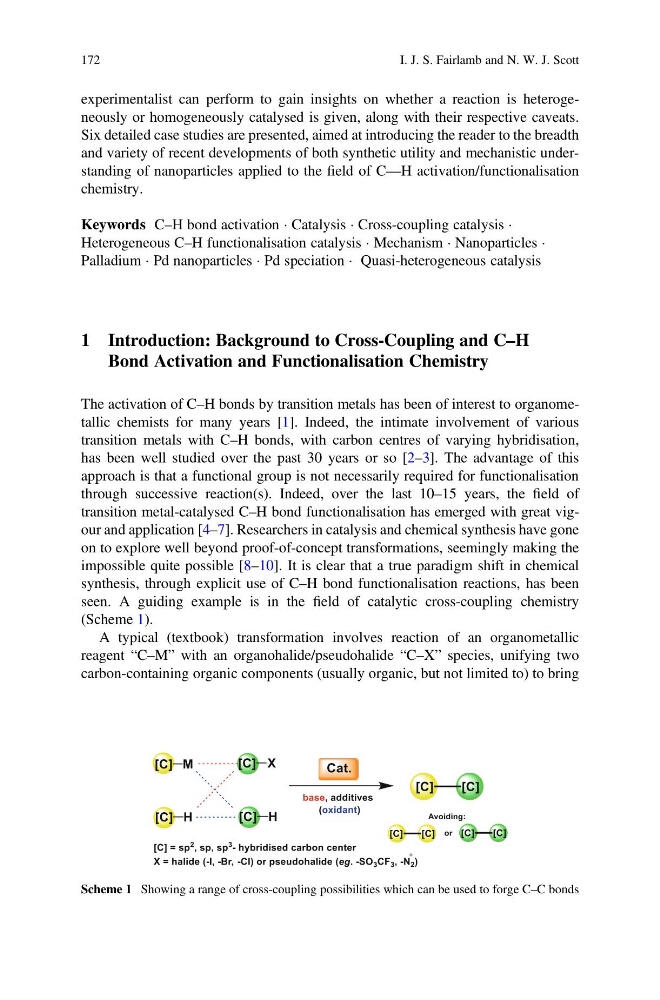
seen. A guiding example is in the field of catalytic cross-coupling chemistry
(Scheme 1).
A typical (textbook) transformation involves reaction of an organometallic
reagent “C–M” with an organohalide/pseudohalide “C–X” species, unifying two
carbon-containing organic components (usually organic, but not limited to) to bring
Scheme 1 Showing a range of cross-coupling possibilities which can be used to forge C–C bonds
172
I. J. S. Fairlamb and N. W. J. Scott
Six detailed case studies are presented, aimed at introducing the reader to the breadth
and variety of recent developments of both synthetic utility and mechanistic understanding of nanoparticles applied to the field of C—H activation/functionalisation
chemistry.
Keywords C–H bond activation · Catalysis · Cross-coupling catalysis ·
Heterogeneous C–H functionalisation catalysis · Mechanism · Nanoparticles ·
Palladium · Pd nanoparticles · Pd speciation · Quasi-heterogeneous catalysis
1 Introduction: Background to Cross-Coupling and C–H
Bond Activation and Functionalisation Chemistry
The activation of C–H bonds by transition metals has been of interest to organometallic chemists for many years [1]. Indeed, the intimate involvement of various
transition metals with C–H bonds, with carbon centres of varying hybridisation,
has been well studied over the past 30 years or so [2–3]. The advantage of this
approach is that a functional group is not necessarily required for functionalisation
through successive reaction(s). Indeed, over the last 10–15 years, the field of
transition metal-catalysed C–H bond functionalisation has emerged with great vigour and application [4–7]. Researchers in catalysis and chemical synthesis have gone
on to explore well beyond proof-of-concept transformations, seemingly making the
impossible quite possible [8–10]. It is clear that a true paradigm shift in chemical
synthesis, through explicit use of C–H bond functionalisation reactions, has been
seen. A guiding example is in the field of catalytic cross-coupling chemistry
(Scheme 1).
A typical (textbook) transformation involves reaction of an organometallic
reagent “C–M” with an organohalide/pseudohalide “C–X” species, unifying two
carbon-containing organic components (usually organic, but not limited to) to bring
Scheme 1 Showing a range of cross-coupling possibilities which can be used to forge C–C bonds
172
I. J. S. Fairlamb and N. W. J. Scott