

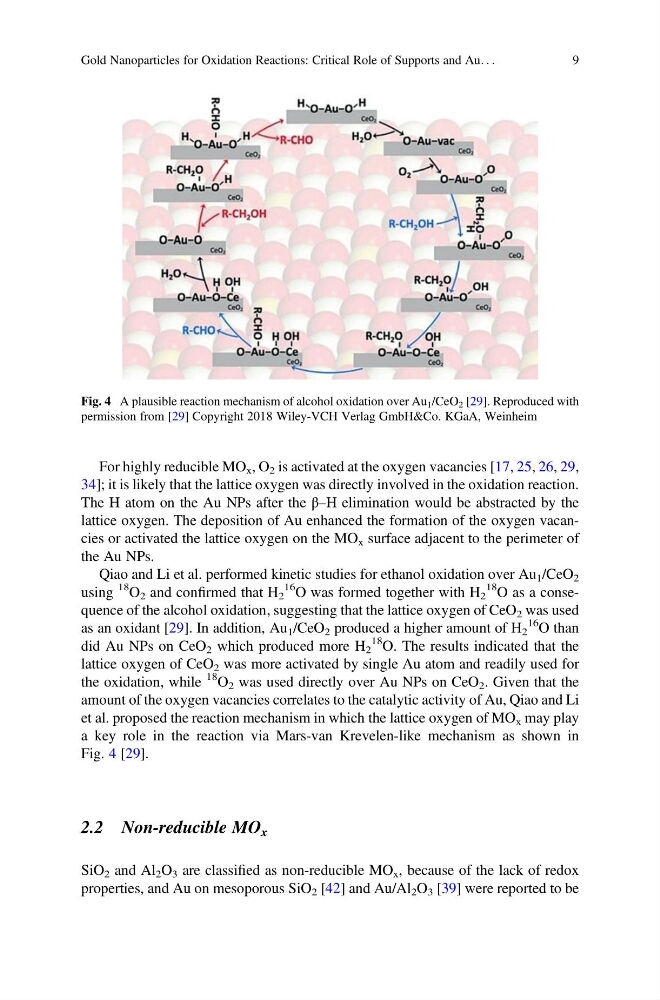
For highly reducible MO x , O 2 is activated at the oxygen vacancies [17, 25, 26, 29,
34]; it is likely that the lattice oxygen was directly involved in the oxidation reaction.
The H atom on the Au NPs after the β–H elimination would be abstracted by the
lattice oxygen. The deposition of Au enhanced the formation of the oxygen vacancies or activated the lattice oxygen on the MO x surface adjacent to the perimeter of
the Au NPs.
Qiao and Li et al. performed kinetic studies for ethanol oxidation over Au 1 /CeO 2
using
18 O 2 and confirmed that H 2
16 O was formed together with H 2
18 O as a consequence of the alcohol oxidation, suggesting that the lattice oxygen of CeO 2 was used
as an oxidant [29]. In addition, Au 1 /CeO 2 produced a higher amount of H 2
16 O than
did Au NPs on CeO 2 which produced more H 2
18 O. The results indicated that the
lattice oxygen of CeO 2 was more activated by single Au atom and readily used for
the oxidation, while
18 O 2 was used directly over Au NPs on CeO 2 . Given that the
amount of the oxygen vacancies correlates to the catalytic activity of Au, Qiao and Li
et al. proposed the reaction mechanism in which the lattice oxygen of MO x may play
a key role in the reaction via Mars-van Krevelen-like mechanism as shown in
Fig. 4 [29].
2.2 Non-reducible MO x
SiO 2 and Al 2 O 3 are classified as non-reducible MO x , because of the lack of redox
properties, and Au on mesoporous SiO 2 [42] and Au/Al 2 O 3 [39] were reported to be
Fig. 4 A plausible reaction mechanism of alcohol oxidation over Au 1 /CeO 2 [29]. Reproduced with
permission from [29] Copyright 2018 Wiley-VCH Verlag GmbH&Co. KGaA, Weinheim
Gold Nanoparticles for Oxidation Reactions: Critical Role of Supports and Au. . .
9
34]; it is likely that the lattice oxygen was directly involved in the oxidation reaction.
The H atom on the Au NPs after the β–H elimination would be abstracted by the
lattice oxygen. The deposition of Au enhanced the formation of the oxygen vacancies or activated the lattice oxygen on the MO x surface adjacent to the perimeter of
the Au NPs.
Qiao and Li et al. performed kinetic studies for ethanol oxidation over Au 1 /CeO 2
using
18 O 2 and confirmed that H 2
16 O was formed together with H 2
18 O as a consequence of the alcohol oxidation, suggesting that the lattice oxygen of CeO 2 was used
as an oxidant [29]. In addition, Au 1 /CeO 2 produced a higher amount of H 2
16 O than
did Au NPs on CeO 2 which produced more H 2
18 O. The results indicated that the
lattice oxygen of CeO 2 was more activated by single Au atom and readily used for
the oxidation, while
18 O 2 was used directly over Au NPs on CeO 2 . Given that the
amount of the oxygen vacancies correlates to the catalytic activity of Au, Qiao and Li
et al. proposed the reaction mechanism in which the lattice oxygen of MO x may play
a key role in the reaction via Mars-van Krevelen-like mechanism as shown in
Fig. 4 [29].
2.2 Non-reducible MO x
SiO 2 and Al 2 O 3 are classified as non-reducible MO x , because of the lack of redox
properties, and Au on mesoporous SiO 2 [42] and Au/Al 2 O 3 [39] were reported to be
Fig. 4 A plausible reaction mechanism of alcohol oxidation over Au 1 /CeO 2 [29]. Reproduced with
permission from [29] Copyright 2018 Wiley-VCH Verlag GmbH&Co. KGaA, Weinheim
Gold Nanoparticles for Oxidation Reactions: Critical Role of Supports and Au. . .
9