

order were produced from the inner imines to the outer imines of the dendrimer,
which was dominated by the Lewis acidity of the metal halide and the gradient Lewis
basicity of the imine sites on each layer. The trimetallic CuPtAu cluster supported on
carbon materials, obtained after chemical reduction, possessed greater catalytic
activity than those of the single or bimetallic catalysts for the solvent-free aerobic
oxidation of aromatic hydrocarbons [146]. Hybridization of copper atoms into the
multimetallic clusters resulted in enhancement of the catalytic performance, which
was 24 greater times than that for a commercially available Pt/C catalyst (Fig. 42).
Multimetallic sub-nanoclusters were successfully synthesized using a
DPA-PyTPM template [147]. Precisely controlled multimetallic accumulation of
five metal salts with different Lewis acidities: GaCl 3 > InBr 3 > AuCl 3 > BiCl 3 > SnBr 2 ,
provided the location to coordinate five metal halides with a narrow distribution
(Fig. 43). The multimetallic clusters, formed by chemical reduction of the complex,
were confirmed using scanning transmission electron microscopy (STEM) and EDS,
which revealed the spectral peaks of the five elements. This synthesis technique for
multimetallic sub-nanoclusters could also be utilized for other metal species such as
Fe, Pd, Rh, Sb, Cu, and Pt and is referred to as “atom hybridization.”
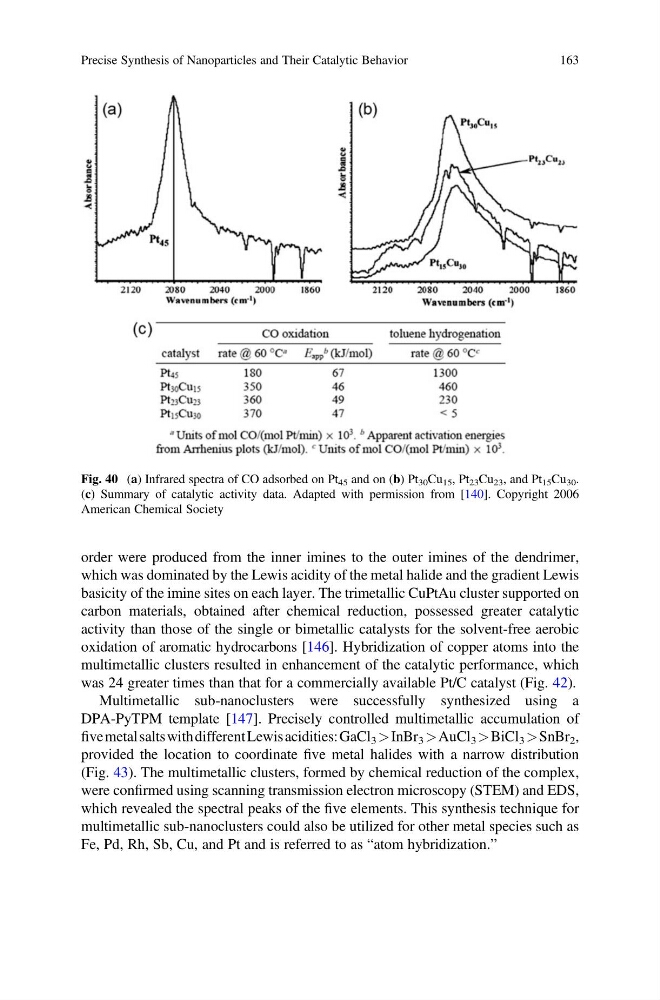
Fig. 40 (a) Infrared spectra of CO adsorbed on Pt 45 and on (b) Pt 30 Cu 15 , Pt 23 Cu 23 , and Pt 15 Cu 30 .
(c) Summary of catalytic activity data. Adapted with permission from [140]. Copyright 2006
American Chemical Society
Precise Synthesis of Nanoparticles and Their Catalytic Behavior
163
which was dominated by the Lewis acidity of the metal halide and the gradient Lewis
basicity of the imine sites on each layer. The trimetallic CuPtAu cluster supported on
carbon materials, obtained after chemical reduction, possessed greater catalytic
activity than those of the single or bimetallic catalysts for the solvent-free aerobic
oxidation of aromatic hydrocarbons [146]. Hybridization of copper atoms into the
multimetallic clusters resulted in enhancement of the catalytic performance, which
was 24 greater times than that for a commercially available Pt/C catalyst (Fig. 42).
Multimetallic sub-nanoclusters were successfully synthesized using a
DPA-PyTPM template [147]. Precisely controlled multimetallic accumulation of
five metal salts with different Lewis acidities: GaCl 3 > InBr 3 > AuCl 3 > BiCl 3 > SnBr 2 ,
provided the location to coordinate five metal halides with a narrow distribution
(Fig. 43). The multimetallic clusters, formed by chemical reduction of the complex,
were confirmed using scanning transmission electron microscopy (STEM) and EDS,
which revealed the spectral peaks of the five elements. This synthesis technique for
multimetallic sub-nanoclusters could also be utilized for other metal species such as
Fe, Pd, Rh, Sb, Cu, and Pt and is referred to as “atom hybridization.”
Fig. 40 (a) Infrared spectra of CO adsorbed on Pt 45 and on (b) Pt 30 Cu 15 , Pt 23 Cu 23 , and Pt 15 Cu 30 .
(c) Summary of catalytic activity data. Adapted with permission from [140]. Copyright 2006
American Chemical Society
Precise Synthesis of Nanoparticles and Their Catalytic Behavior
163