

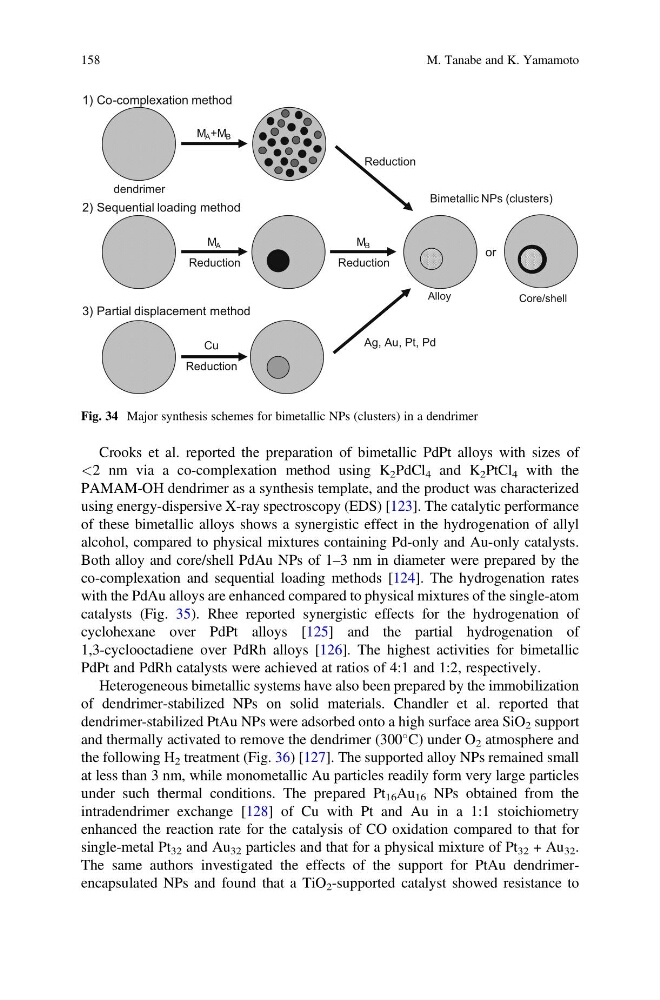
Crooks et al. reported the preparation of bimetallic PdPt alloys with sizes of
<2 nm via a co-complexation method using K 2 PdCl 4 and K 2 PtCl 4 with the
PAMAM-OH dendrimer as a synthesis template, and the product was characterized
using energy-dispersive X-ray spectroscopy (EDS) [123]. The catalytic performance
of these bimetallic alloys shows a synergistic effect in the hydrogenation of allyl
alcohol, compared to physical mixtures containing Pd-only and Au-only catalysts.
Both alloy and core/shell PdAu NPs of 1–3 nm in diameter were prepared by the
co-complexation and sequential loading methods [124]. The hydrogenation rates
with the PdAu alloys are enhanced compared to physical mixtures of the single-atom
catalysts (Fig. 35). Rhee reported synergistic effects for the hydrogenation of
cyclohexane over PdPt alloys [125] and the partial hydrogenation of
1,3-cyclooctadiene over PdRh alloys [126]. The highest activities for bimetallic
PdPt and PdRh catalysts were achieved at ratios of 4:1 and 1:2, respectively.
Heterogeneous bimetallic systems have also been prepared by the immobilization
of dendrimer-stabilized NPs on solid materials. Chandler et al. reported that
dendrimer-stabilized PtAu NPs were adsorbed onto a high surface area SiO 2 support
and thermally activated to remove the dendrimer (300
C) under O 2 atmosphere and
the following H 2 treatment (Fig. 36) [127]. The supported alloy NPs remained small
at less than 3 nm, while monometallic Au particles readily form very large particles
under such thermal conditions. The prepared Pt 16 Au 16 NPs obtained from the
intradendrimer exchange [128] of Cu with Pt and Au in a 1:1 stoichiometry
enhanced the reaction rate for the catalysis of CO oxidation compared to that for
single-metal Pt 32 and Au 32 particles and that for a physical mixture of Pt 32 + Au 32 .
The same authors investigated the effects of the support for PtAu dendrimerencapsulated NPs and found that a TiO 2 -supported catalyst showed resistance to
M A +M B
dendrimer
Reduction
Bimetallic NPs (clusters)
1) Co-complexation method
2) Sequential loading method
M A
Reduction
M B
Reduction
or
3) Partial displacement method
Cu
Reduction
Ag, Au, Pt, Pd
Alloy
Core/shell
Fig. 34 Major synthesis schemes for bimetallic NPs (clusters) in a dendrimer
158
M. Tanabe and K. Yamamoto
<2 nm via a co-complexation method using K 2 PdCl 4 and K 2 PtCl 4 with the
PAMAM-OH dendrimer as a synthesis template, and the product was characterized
using energy-dispersive X-ray spectroscopy (EDS) [123]. The catalytic performance
of these bimetallic alloys shows a synergistic effect in the hydrogenation of allyl
alcohol, compared to physical mixtures containing Pd-only and Au-only catalysts.
Both alloy and core/shell PdAu NPs of 1–3 nm in diameter were prepared by the
co-complexation and sequential loading methods [124]. The hydrogenation rates
with the PdAu alloys are enhanced compared to physical mixtures of the single-atom
catalysts (Fig. 35). Rhee reported synergistic effects for the hydrogenation of
cyclohexane over PdPt alloys [125] and the partial hydrogenation of
1,3-cyclooctadiene over PdRh alloys [126]. The highest activities for bimetallic
PdPt and PdRh catalysts were achieved at ratios of 4:1 and 1:2, respectively.
Heterogeneous bimetallic systems have also been prepared by the immobilization
of dendrimer-stabilized NPs on solid materials. Chandler et al. reported that
dendrimer-stabilized PtAu NPs were adsorbed onto a high surface area SiO 2 support
and thermally activated to remove the dendrimer (300
C) under O 2 atmosphere and
the following H 2 treatment (Fig. 36) [127]. The supported alloy NPs remained small
at less than 3 nm, while monometallic Au particles readily form very large particles
under such thermal conditions. The prepared Pt 16 Au 16 NPs obtained from the
intradendrimer exchange [128] of Cu with Pt and Au in a 1:1 stoichiometry
enhanced the reaction rate for the catalysis of CO oxidation compared to that for
single-metal Pt 32 and Au 32 particles and that for a physical mixture of Pt 32 + Au 32 .
The same authors investigated the effects of the support for PtAu dendrimerencapsulated NPs and found that a TiO 2 -supported catalyst showed resistance to
M A +M B
dendrimer
Reduction
Bimetallic NPs (clusters)
1) Co-complexation method
2) Sequential loading method
M A
Reduction
M B
Reduction
or
3) Partial displacement method
Cu
Reduction
Ag, Au, Pt, Pd
Alloy
Core/shell
Fig. 34 Major synthesis schemes for bimetallic NPs (clusters) in a dendrimer
158
M. Tanabe and K. Yamamoto