

In order to investigate the ORR catalytic performance dependent on the atomicity
of the Pt n (n ¼ 12–28) cluster, a special dendrimer, DPAG4-PyTPM [118], was
prepared by incorporation of a pyridoxine(triphenylene)methane core (Fig. 31).
Unsymmetrical structure of the dendrimer increases the magic numbers of 1, 2,
5, 7, 13, 17, 29, 37, and 61 to coordinate the metal ion with narrow distribution. One
incorporated pyridine changed the basicity of the imines on one dendron and
increased coordinating sites having different basicities.
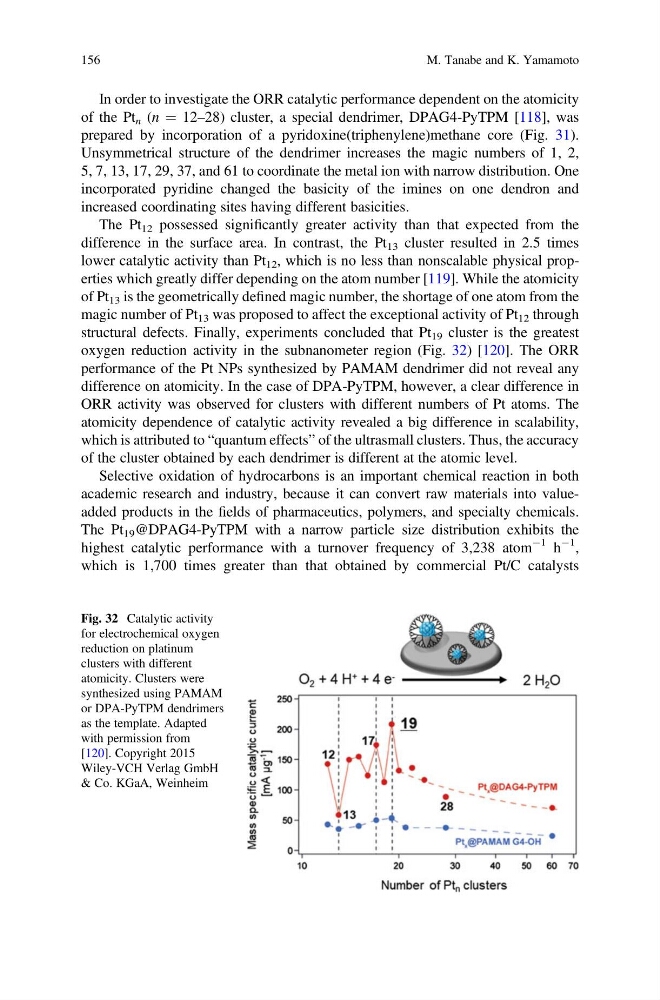
The Pt 12 possessed significantly greater activity than that expected from the
difference in the surface area. In contrast, the Pt 13 cluster resulted in 2.5 times
lower catalytic activity than Pt 12 , which is no less than nonscalable physical properties which greatly differ depending on the atom number [119]. While the atomicity
of Pt 13 is the geometrically defined magic number, the shortage of one atom from the
magic number of Pt 13 was proposed to affect the exceptional activity of Pt 12 through
structural defects. Finally, experiments concluded that Pt 19 cluster is the greatest
oxygen reduction activity in the subnanometer region (Fig. 32) [120]. The ORR
performance of the Pt NPs synthesized by PAMAM dendrimer did not reveal any
difference on atomicity. In the case of DPA-PyTPM, however, a clear difference in
ORR activity was observed for clusters with different numbers of Pt atoms. The
atomicity dependence of catalytic activity revealed a big difference in scalability,
which is attributed to “quantum effects” of the ultrasmall clusters. Thus, the accuracy
of the cluster obtained by each dendrimer is different at the atomic level.
Selective oxidation of hydrocarbons is an important chemical reaction in both
academic research and industry, because it can convert raw materials into valueadded products in the fields of pharmaceutics, polymers, and specialty chemicals.
The Pt 19 @DPAG4-PyTPM with a narrow particle size distribution exhibits the
highest catalytic performance with a turnover frequency of 3,238 atom
À1 h
À1 ,
which is 1,700 times greater than that obtained by commercial Pt/C catalysts
Fig. 32 Catalytic activity
for electrochemical oxygen
reduction on platinum
clusters with different
atomicity. Clusters were
synthesized using PAMAM
or DPA-PyTPM dendrimers
as the template. Adapted
with permission from
[120]. Copyright 2015
Wiley-VCH Verlag GmbH
& Co. KGaA, Weinheim
156
M. Tanabe and K. Yamamoto
of the Pt n (n ¼ 12–28) cluster, a special dendrimer, DPAG4-PyTPM [118], was
prepared by incorporation of a pyridoxine(triphenylene)methane core (Fig. 31).
Unsymmetrical structure of the dendrimer increases the magic numbers of 1, 2,
5, 7, 13, 17, 29, 37, and 61 to coordinate the metal ion with narrow distribution. One
incorporated pyridine changed the basicity of the imines on one dendron and
increased coordinating sites having different basicities.
The Pt 12 possessed significantly greater activity than that expected from the
difference in the surface area. In contrast, the Pt 13 cluster resulted in 2.5 times
lower catalytic activity than Pt 12 , which is no less than nonscalable physical properties which greatly differ depending on the atom number [119]. While the atomicity
of Pt 13 is the geometrically defined magic number, the shortage of one atom from the
magic number of Pt 13 was proposed to affect the exceptional activity of Pt 12 through
structural defects. Finally, experiments concluded that Pt 19 cluster is the greatest
oxygen reduction activity in the subnanometer region (Fig. 32) [120]. The ORR
performance of the Pt NPs synthesized by PAMAM dendrimer did not reveal any
difference on atomicity. In the case of DPA-PyTPM, however, a clear difference in
ORR activity was observed for clusters with different numbers of Pt atoms. The
atomicity dependence of catalytic activity revealed a big difference in scalability,
which is attributed to “quantum effects” of the ultrasmall clusters. Thus, the accuracy
of the cluster obtained by each dendrimer is different at the atomic level.
Selective oxidation of hydrocarbons is an important chemical reaction in both
academic research and industry, because it can convert raw materials into valueadded products in the fields of pharmaceutics, polymers, and specialty chemicals.
The Pt 19 @DPAG4-PyTPM with a narrow particle size distribution exhibits the
highest catalytic performance with a turnover frequency of 3,238 atom
À1 h
À1 ,
which is 1,700 times greater than that obtained by commercial Pt/C catalysts
Fig. 32 Catalytic activity
for electrochemical oxygen
reduction on platinum
clusters with different
atomicity. Clusters were
synthesized using PAMAM
or DPA-PyTPM dendrimers
as the template. Adapted
with permission from
[120]. Copyright 2015
Wiley-VCH Verlag GmbH
& Co. KGaA, Weinheim
156
M. Tanabe and K. Yamamoto