

[109]. After the accumulating metal salt, the following chemical reduction produced
monodisperse metal clusters at the atomic level utilizing this principle [110]. A
similar procedure of obtaining metal NPs was reported by using the PAMAM
dendrimer containing amines and amides to undergo multidentate coordination or
random accumulation of metal ions to the dendrimer. In contrast, the programmed
clusters with the precise number of atoms can be established by stepwise accumulation of metal ions to the π-conjugated DPA dendrimers. This is only one example
of the ability to control the precious number of atoms by changing the number of
equivalents of dendrimer and metal salt. The DPAG4-pPh with 2 dendrons consists
of special magic numbers of 2, 6, 14, and 40 to assemble the metal ion with much
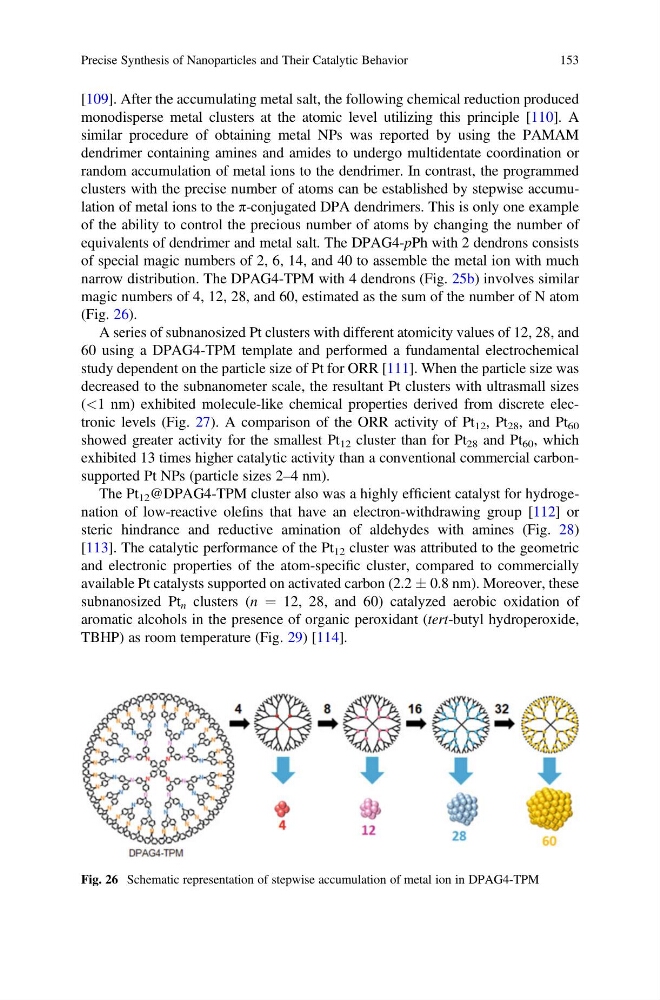
narrow distribution. The DPAG4-TPM with 4 dendrons (Fig. 25b) involves similar
magic numbers of 4, 12, 28, and 60, estimated as the sum of the number of N atom
(Fig. 26).
A series of subnanosized Pt clusters with different atomicity values of 12, 28, and
60 using a DPAG4-TPM template and performed a fundamental electrochemical
study dependent on the particle size of Pt for ORR [111]. When the particle size was
decreased to the subnanometer scale, the resultant Pt clusters with ultrasmall sizes
(<1 nm) exhibited molecule-like chemical properties derived from discrete electronic levels (Fig. 27). A comparison of the ORR activity of Pt 12 , Pt 28 , and Pt 60
showed greater activity for the smallest Pt 12 cluster than for Pt 28 and Pt 60 , which
exhibited 13 times higher catalytic activity than a conventional commercial carbonsupported Pt NPs (particle sizes 2–4 nm).
The Pt 12 @DPAG4-TPM cluster also was a highly efficient catalyst for hydrogenation of low-reactive olefins that have an electron-withdrawing group [112] or
steric hindrance and reductive amination of aldehydes with amines (Fig. 28)
[113]. The catalytic performance of the Pt 12 cluster was attributed to the geometric
and electronic properties of the atom-specific cluster, compared to commercially
available Pt catalysts supported on activated carbon (2.2 Æ 0.8 nm). Moreover, these
subnanosized Pt n clusters (n ¼ 12, 28, and 60) catalyzed aerobic oxidation of
aromatic alcohols in the presence of organic peroxidant (tert-butyl hydroperoxide,
TBHP) as room temperature (Fig. 29) [114].
Fig. 26 Schematic representation of stepwise accumulation of metal ion in DPAG4-TPM
Precise Synthesis of Nanoparticles and Their Catalytic Behavior
153
monodisperse metal clusters at the atomic level utilizing this principle [110]. A
similar procedure of obtaining metal NPs was reported by using the PAMAM
dendrimer containing amines and amides to undergo multidentate coordination or
random accumulation of metal ions to the dendrimer. In contrast, the programmed
clusters with the precise number of atoms can be established by stepwise accumulation of metal ions to the π-conjugated DPA dendrimers. This is only one example
of the ability to control the precious number of atoms by changing the number of
equivalents of dendrimer and metal salt. The DPAG4-pPh with 2 dendrons consists
of special magic numbers of 2, 6, 14, and 40 to assemble the metal ion with much
narrow distribution. The DPAG4-TPM with 4 dendrons (Fig. 25b) involves similar
magic numbers of 4, 12, 28, and 60, estimated as the sum of the number of N atom
(Fig. 26).
A series of subnanosized Pt clusters with different atomicity values of 12, 28, and
60 using a DPAG4-TPM template and performed a fundamental electrochemical
study dependent on the particle size of Pt for ORR [111]. When the particle size was
decreased to the subnanometer scale, the resultant Pt clusters with ultrasmall sizes
(<1 nm) exhibited molecule-like chemical properties derived from discrete electronic levels (Fig. 27). A comparison of the ORR activity of Pt 12 , Pt 28 , and Pt 60
showed greater activity for the smallest Pt 12 cluster than for Pt 28 and Pt 60 , which
exhibited 13 times higher catalytic activity than a conventional commercial carbonsupported Pt NPs (particle sizes 2–4 nm).
The Pt 12 @DPAG4-TPM cluster also was a highly efficient catalyst for hydrogenation of low-reactive olefins that have an electron-withdrawing group [112] or
steric hindrance and reductive amination of aldehydes with amines (Fig. 28)
[113]. The catalytic performance of the Pt 12 cluster was attributed to the geometric
and electronic properties of the atom-specific cluster, compared to commercially
available Pt catalysts supported on activated carbon (2.2 Æ 0.8 nm). Moreover, these
subnanosized Pt n clusters (n ¼ 12, 28, and 60) catalyzed aerobic oxidation of
aromatic alcohols in the presence of organic peroxidant (tert-butyl hydroperoxide,
TBHP) as room temperature (Fig. 29) [114].
Fig. 26 Schematic representation of stepwise accumulation of metal ion in DPAG4-TPM
Precise Synthesis of Nanoparticles and Their Catalytic Behavior
153