

H 2 flow at 300
C was used to remove the organic dendrimer without any significant
aggregation. The Pt NP catalysts on the silica surface were more active for CO
oxidation and toluene hydrogenation than a classic Pt/SiO 2 catalyst.
Amiridis et al. prepared Pt@PAMAM-OH dendrimer on porous silica support
and removed the template for CO oxidation [40]. Later on, the Pt NPs provided the
trans-cis conversion of 2-butene by Zaera group [41]. Size-controlled Ru NPs within
PAMAM dendrimer were impregnated similarly on Al 2 O 3 and maintained average
particle size below 2.5 nm [42]. Li et al. reported preparation of hollow capsulestabilized Au NPs through the encapsulation from the grafted dendrimers on the
surface of the silica microspheres. The capsule-stabilized Au NPs catalyzed the
reduction reaction of 4-nitrophenol to 4-aminophenol [43].
Platinum is considered the most effective catalyst for the oxygen reduction
reaction (ORR), which is the cathode reaction in hydrogen-based fuel cells. However, Pt is not optimal in this application because of its scarcity and its high
overpotential for the ORR. As the particle size is reduced, the efficiency of each
atom in the particle is increased. However, it has been difficult to associate with
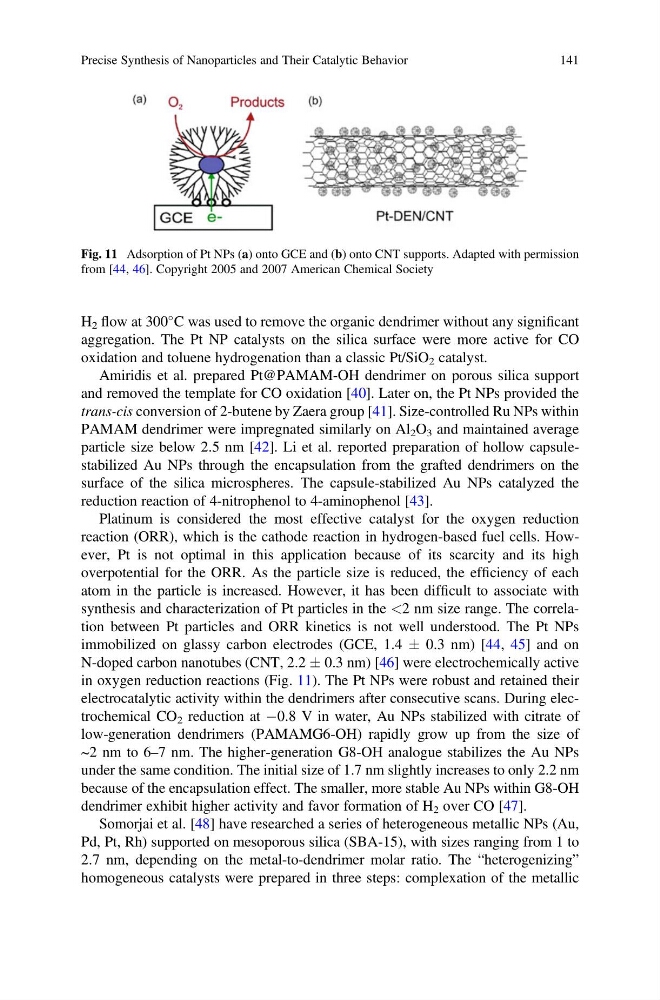
synthesis and characterization of Pt particles in the <2 nm size range. The correlation between Pt particles and ORR kinetics is not well understood. The Pt NPs
immobilized on glassy carbon electrodes (GCE, 1.4 Æ 0.3 nm) [44, 45] and on
N-doped carbon nanotubes (CNT, 2.2 Æ 0.3 nm) [46] were electrochemically active
in oxygen reduction reactions (Fig. 11). The Pt NPs were robust and retained their
electrocatalytic activity within the dendrimers after consecutive scans. During electrochemical CO 2 reduction at À0.8 V in water, Au NPs stabilized with citrate of
low-generation dendrimers (PAMAMG6-OH) rapidly grow up from the size of
~2 nm to 6–7 nm. The higher-generation G8-OH analogue stabilizes the Au NPs
under the same condition. The initial size of 1.7 nm slightly increases to only 2.2 nm
because of the encapsulation effect. The smaller, more stable Au NPs within G8-OH
dendrimer exhibit higher activity and favor formation of H 2 over CO [47].
Somorjai et al. [48] have researched a series of heterogeneous metallic NPs (Au,
Pd, Pt, Rh) supported on mesoporous silica (SBA-15), with sizes ranging from 1 to
2.7 nm, depending on the metal-to-dendrimer molar ratio. The “heterogenizing”
homogeneous catalysts were prepared in three steps: complexation of the metallic
Fig. 11 Adsorption of Pt NPs (a) onto GCE and (b) onto CNT supports. Adapted with permission
from [44, 46]. Copyright 2005 and 2007 American Chemical Society
Precise Synthesis of Nanoparticles and Their Catalytic Behavior
141
C was used to remove the organic dendrimer without any significant
aggregation. The Pt NP catalysts on the silica surface were more active for CO
oxidation and toluene hydrogenation than a classic Pt/SiO 2 catalyst.
Amiridis et al. prepared Pt@PAMAM-OH dendrimer on porous silica support
and removed the template for CO oxidation [40]. Later on, the Pt NPs provided the
trans-cis conversion of 2-butene by Zaera group [41]. Size-controlled Ru NPs within
PAMAM dendrimer were impregnated similarly on Al 2 O 3 and maintained average
particle size below 2.5 nm [42]. Li et al. reported preparation of hollow capsulestabilized Au NPs through the encapsulation from the grafted dendrimers on the
surface of the silica microspheres. The capsule-stabilized Au NPs catalyzed the
reduction reaction of 4-nitrophenol to 4-aminophenol [43].
Platinum is considered the most effective catalyst for the oxygen reduction
reaction (ORR), which is the cathode reaction in hydrogen-based fuel cells. However, Pt is not optimal in this application because of its scarcity and its high
overpotential for the ORR. As the particle size is reduced, the efficiency of each
atom in the particle is increased. However, it has been difficult to associate with
synthesis and characterization of Pt particles in the <2 nm size range. The correlation between Pt particles and ORR kinetics is not well understood. The Pt NPs
immobilized on glassy carbon electrodes (GCE, 1.4 Æ 0.3 nm) [44, 45] and on
N-doped carbon nanotubes (CNT, 2.2 Æ 0.3 nm) [46] were electrochemically active
in oxygen reduction reactions (Fig. 11). The Pt NPs were robust and retained their
electrocatalytic activity within the dendrimers after consecutive scans. During electrochemical CO 2 reduction at À0.8 V in water, Au NPs stabilized with citrate of
low-generation dendrimers (PAMAMG6-OH) rapidly grow up from the size of
~2 nm to 6–7 nm. The higher-generation G8-OH analogue stabilizes the Au NPs
under the same condition. The initial size of 1.7 nm slightly increases to only 2.2 nm
because of the encapsulation effect. The smaller, more stable Au NPs within G8-OH
dendrimer exhibit higher activity and favor formation of H 2 over CO [47].
Somorjai et al. [48] have researched a series of heterogeneous metallic NPs (Au,
Pd, Pt, Rh) supported on mesoporous silica (SBA-15), with sizes ranging from 1 to
2.7 nm, depending on the metal-to-dendrimer molar ratio. The “heterogenizing”
homogeneous catalysts were prepared in three steps: complexation of the metallic
Fig. 11 Adsorption of Pt NPs (a) onto GCE and (b) onto CNT supports. Adapted with permission
from [44, 46]. Copyright 2005 and 2007 American Chemical Society
Precise Synthesis of Nanoparticles and Their Catalytic Behavior
141