

small number of metal atoms have been focused on as highly reactive catalysts in
both homogeneous and heterogeneous systems. However, conventional synthesis of
precisely size-controlled NPs is extremely difficult in solution.
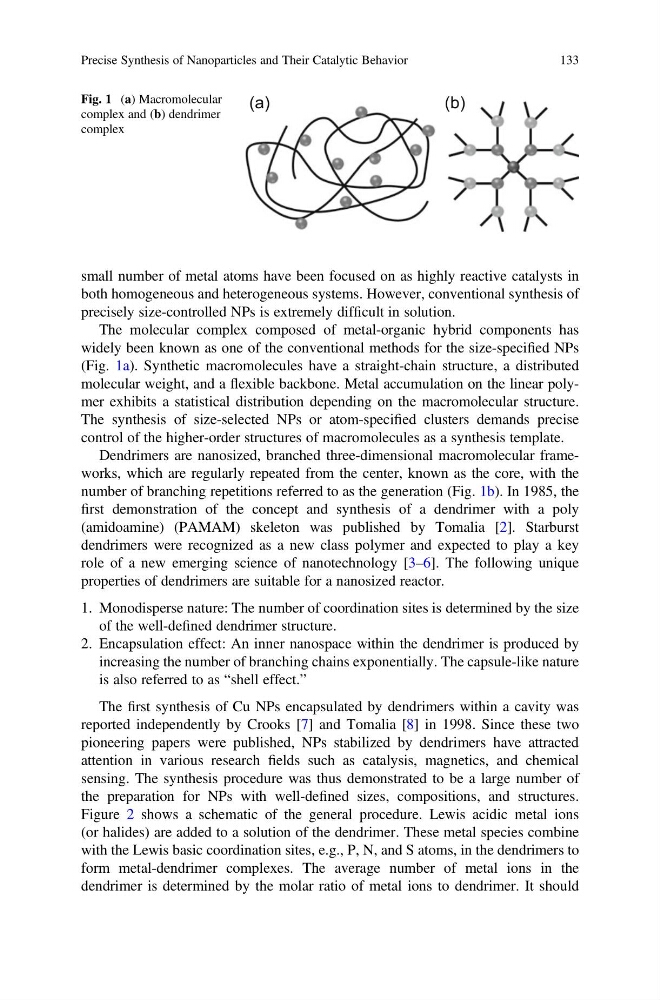
The molecular complex composed of metal-organic hybrid components has
widely been known as one of the conventional methods for the size-specified NPs
(Fig. 1a). Synthetic macromolecules have a straight-chain structure, a distributed
molecular weight, and a flexible backbone. Metal accumulation on the linear polymer exhibits a statistical distribution depending on the macromolecular structure.
The synthesis of size-selected NPs or atom-specified clusters demands precise
control of the higher-order structures of macromolecules as a synthesis template.
Dendrimers are nanosized, branched three-dimensional macromolecular frameworks, which are regularly repeated from the center, known as the core, with the
number of branching repetitions referred to as the generation (Fig. 1b). In 1985, the
first demonstration of the concept and synthesis of a dendrimer with a poly
(amidoamine) (PAMAM) skeleton was published by Tomalia [2]. Starburst
dendrimers were recognized as a new class polymer and expected to play a key
role of a new emerging science of nanotechnology [3–6]. The following unique
properties of dendrimers are suitable for a nanosized reactor.
1. Monodisperse nature: The number of coordination sites is determined by the size
of the well-defined dendrimer structure.
2. Encapsulation effect: An inner nanospace within the dendrimer is produced by
increasing the number of branching chains exponentially. The capsule-like nature
is also referred to as “shell effect.”
The first synthesis of Cu NPs encapsulated by dendrimers within a cavity was
reported independently by Crooks [7] and Tomalia [8] in 1998. Since these two
pioneering papers were published, NPs stabilized by dendrimers have attracted
attention in various research fields such as catalysis, magnetics, and chemical
sensing. The synthesis procedure was thus demonstrated to be a large number of
the preparation for NPs with well-defined sizes, compositions, and structures.
Figure 2 shows a schematic of the general procedure. Lewis acidic metal ions
(or halides) are added to a solution of the dendrimer. These metal species combine
with the Lewis basic coordination sites, e.g., P, N, and S atoms, in the dendrimers to
form metal-dendrimer complexes. The average number of metal ions in the
dendrimer is determined by the molar ratio of metal ions to dendrimer. It should
(a)
(b)
Fig. 1 (a) Macromolecular
complex and (b) dendrimer
complex
Precise Synthesis of Nanoparticles and Their Catalytic Behavior
133
both homogeneous and heterogeneous systems. However, conventional synthesis of
precisely size-controlled NPs is extremely difficult in solution.
The molecular complex composed of metal-organic hybrid components has
widely been known as one of the conventional methods for the size-specified NPs
(Fig. 1a). Synthetic macromolecules have a straight-chain structure, a distributed
molecular weight, and a flexible backbone. Metal accumulation on the linear polymer exhibits a statistical distribution depending on the macromolecular structure.
The synthesis of size-selected NPs or atom-specified clusters demands precise
control of the higher-order structures of macromolecules as a synthesis template.
Dendrimers are nanosized, branched three-dimensional macromolecular frameworks, which are regularly repeated from the center, known as the core, with the
number of branching repetitions referred to as the generation (Fig. 1b). In 1985, the
first demonstration of the concept and synthesis of a dendrimer with a poly
(amidoamine) (PAMAM) skeleton was published by Tomalia [2]. Starburst
dendrimers were recognized as a new class polymer and expected to play a key
role of a new emerging science of nanotechnology [3–6]. The following unique
properties of dendrimers are suitable for a nanosized reactor.
1. Monodisperse nature: The number of coordination sites is determined by the size
of the well-defined dendrimer structure.
2. Encapsulation effect: An inner nanospace within the dendrimer is produced by
increasing the number of branching chains exponentially. The capsule-like nature
is also referred to as “shell effect.”
The first synthesis of Cu NPs encapsulated by dendrimers within a cavity was
reported independently by Crooks [7] and Tomalia [8] in 1998. Since these two
pioneering papers were published, NPs stabilized by dendrimers have attracted
attention in various research fields such as catalysis, magnetics, and chemical
sensing. The synthesis procedure was thus demonstrated to be a large number of
the preparation for NPs with well-defined sizes, compositions, and structures.
Figure 2 shows a schematic of the general procedure. Lewis acidic metal ions
(or halides) are added to a solution of the dendrimer. These metal species combine
with the Lewis basic coordination sites, e.g., P, N, and S atoms, in the dendrimers to
form metal-dendrimer complexes. The average number of metal ions in the
dendrimer is determined by the molar ratio of metal ions to dendrimer. It should
(a)
(b)
Fig. 1 (a) Macromolecular
complex and (b) dendrimer
complex
Precise Synthesis of Nanoparticles and Their Catalytic Behavior
133