

support, are prepared from metal salts, while the third is prepared essentially
from bulk gold possessing silver or other less noble metal impurities [64, 65].
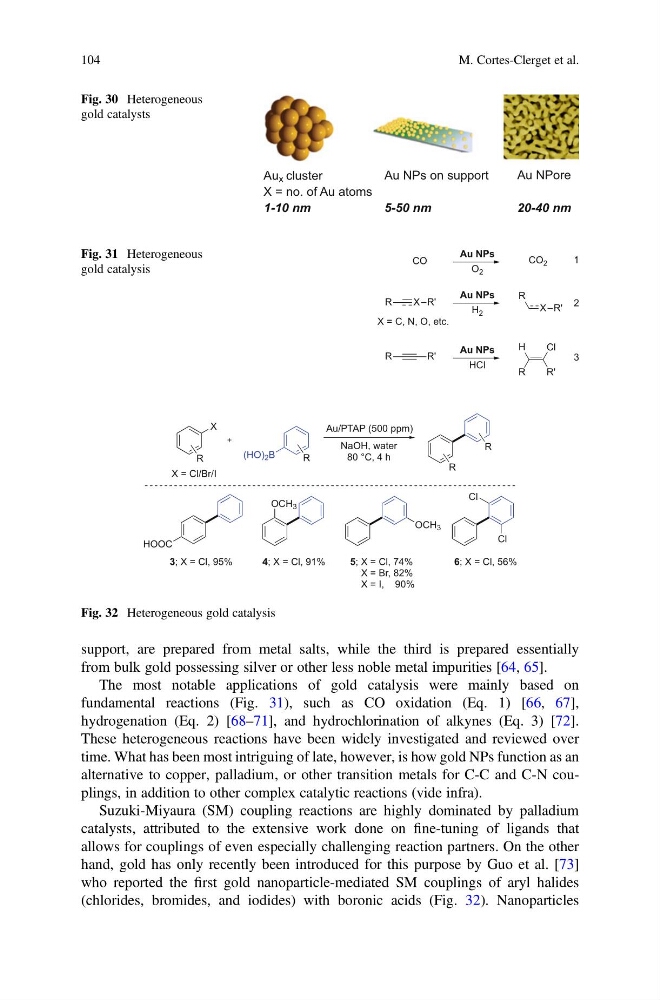
The most notable applications of gold catalysis were mainly based on
fundamental reactions (Fig. 31), such as CO oxidation (Eq. 1) [66, 67],
hydrogenation (Eq. 2) [68–71], and hydrochlorination of alkynes (Eq. 3) [72].
These heterogeneous reactions have been widely investigated and reviewed over
time. What has been most intriguing of late, however, is how gold NPs function as an
alternative to copper, palladium, or other transition metals for C-C and C-N couplings, in addition to other complex catalytic reactions (vide infra).
Suzuki-Miyaura (SM) coupling reactions are highly dominated by palladium
catalysts, attributed to the extensive work done on fine-tuning of ligands that
allows for couplings of even especially challenging reaction partners. On the other
hand, gold has only recently been introduced for this purpose by Guo et al. [73]
who reported the first gold nanoparticle-mediated SM couplings of aryl halides
(chlorides, bromides, and iodides) with boronic acids (Fig. 32). Nanoparticles
Au x cluster
X = no. of Au atoms
Au NPs on support
Au NPore
1-10 nm
5-50 nm
20-40 nm
Fig. 30 Heterogeneous
gold catalysts
CO
Au NPs
O 2
CO 2
Au NPs
H 2
X
R
R'
X = C, N, O, etc.
X R'
R
Au NPs
HCl
1
2
3
R
R'
Cl
H
R
R'
Fig. 31 Heterogeneous
gold catalysis
X
(HO) 2 B
Au/PTAP (500 ppm)
NaOH, water
80 °C, 4 h
R
R
X = Cl/Br/I
R
R
HOOC
OCH 3
OCH 3
Cl
Cl
3; X = Cl, 95%
4; X = Cl, 91%
5; X = Cl, 74%
X = Br, 82%
X = I, 90%
6; X = Cl, 56%
Fig. 32 Heterogeneous gold catalysis
104
M. Cortes-Clerget et al.
from bulk gold possessing silver or other less noble metal impurities [64, 65].
The most notable applications of gold catalysis were mainly based on
fundamental reactions (Fig. 31), such as CO oxidation (Eq. 1) [66, 67],
hydrogenation (Eq. 2) [68–71], and hydrochlorination of alkynes (Eq. 3) [72].
These heterogeneous reactions have been widely investigated and reviewed over
time. What has been most intriguing of late, however, is how gold NPs function as an
alternative to copper, palladium, or other transition metals for C-C and C-N couplings, in addition to other complex catalytic reactions (vide infra).
Suzuki-Miyaura (SM) coupling reactions are highly dominated by palladium
catalysts, attributed to the extensive work done on fine-tuning of ligands that
allows for couplings of even especially challenging reaction partners. On the other
hand, gold has only recently been introduced for this purpose by Guo et al. [73]
who reported the first gold nanoparticle-mediated SM couplings of aryl halides
(chlorides, bromides, and iodides) with boronic acids (Fig. 32). Nanoparticles
Au x cluster
X = no. of Au atoms
Au NPs on support
Au NPore
1-10 nm
5-50 nm
20-40 nm
Fig. 30 Heterogeneous
gold catalysts
CO
Au NPs
O 2
CO 2
Au NPs
H 2
X
R
R'
X = C, N, O, etc.
X R'
R
Au NPs
HCl
1
2
3
R
R'
Cl
H
R
R'
Fig. 31 Heterogeneous
gold catalysis
X
(HO) 2 B
Au/PTAP (500 ppm)
NaOH, water
80 °C, 4 h
R
R
X = Cl/Br/I
R
R
HOOC
OCH 3
OCH 3
Cl
Cl
3; X = Cl, 95%
4; X = Cl, 91%
5; X = Cl, 74%
X = Br, 82%
X = I, 90%
6; X = Cl, 56%
Fig. 32 Heterogeneous gold catalysis
104
M. Cortes-Clerget et al.