

cation [111]. For example, bigger cations like Cs
+ tend to make zeolites more
hydrophobic as they decrease pore volume and display weaker interactions with
H 2 O.
Given that the hydrophilicity and hydrophobicity of zeolites can be tuned by
controlling their Si/Al ratio, high- or pure-silica zeolites can be excellent candidates
for the selective adsorption of a hydrophobic adsorbate in the presence of H 2 O, when
their pore size allows access for the target adsorbate [112]. Manabu et al. reported
that pure-silica chabazite exhibits a somewhat impressive CO 2 adsorption capacity
(5.0 mmol g
À1 ) at 313 K and 30 bar compared to the hydrophilic commercial zeolite
Na-X (6.2 mmol g
À1 ) [113]. Unlike the case of Na-X, however, its adsorption
capacity is not influenced by the presence of H 2 O. Another method to change the
hydrophilic nature of zeolites is to functionalize them with amine groups, as has been
explored for CO 2 capture in wet flue gas. However, the functionalized zeolites suffer
from significant amine degradation, due to acidic impurities such as SO 2 , as well as
urea formed upon CO 2 adsorption [114]. The more hydrophilic nature of AlPO 4
molecular sieves compared to pure-silica molecular sieves can also be utilized for
CO 2 adsorption in the presence of H 2 O, because many of them (e.g., AlPO 4 -18,
AlPO 4 -21 (AWO), AlPO 4 -25, AlPO 4 -53, etc.) exhibit negligible water uptake at low
partial pressures [58].
5.3 Nitrogen Oxides
Nitrogen oxides (NO x ) emission is one of the main contributors to stratospheric
ozone depletion and global warming. To adsorb NO x from dry and wet flue gases,
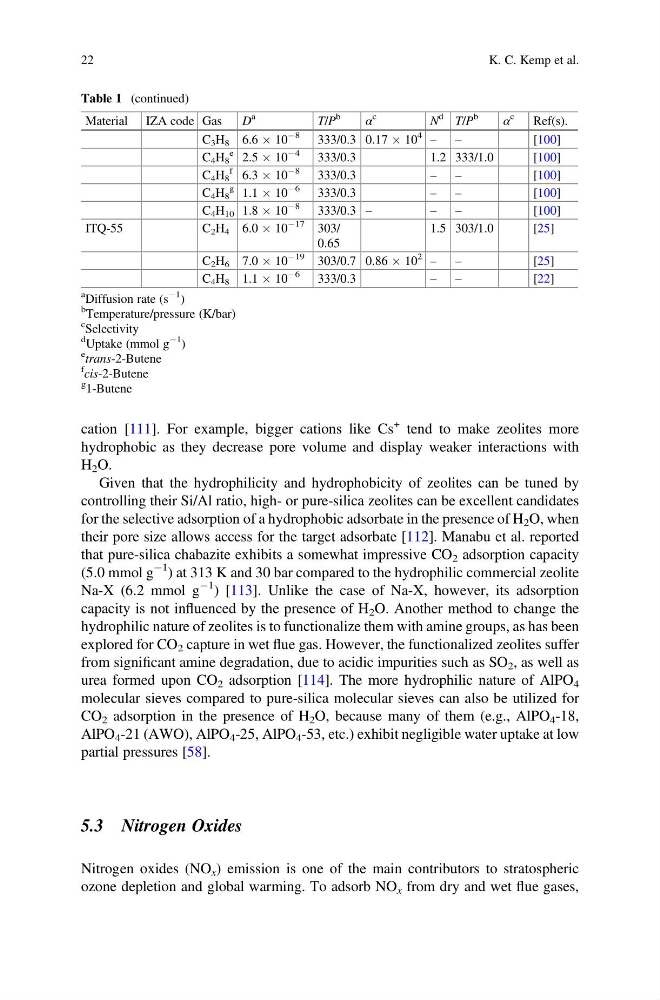
Table 1 (continued)
Material IZA code Gas
D
a
T/P
b
α
c
N
d T/P
b
α
c
Ref(s).
C 3 H 8 6.6 Â 10
À8
333/0.3 0.17 Â 10
4 – –
[100]
C 4 H 8
e 2.5 Â 10
À4
333/0.3
1.2 333/1.0
[100]
C 4 H 8
f 6.3 Â 10
À8
333/0.3
– –
[100]
C 4 H 8
g 1.1 Â 10
À6
333/0.3
– –
[100]
C 4 H 10 1.8 Â 10
À8
333/0.3 –
– –
[100]
ITQ-55
C 2 H 4 6.0 Â 10
À17
303/
0.65
1.5 303/1.0
[25]
C 2 H 6 7.0 Â 10
À19
303/0.7 0.86 Â 10
2 – –
[25]
C 4 H 8 1.1 Â 10
À6
333/0.3
– –
[22]
a Diffusion rate (s
À1
)
b
Temperature/pressure (K/bar)
c Selectivity
d
Uptake (mmol g
À1
)
e trans-2-Butene
f
cis-2-Butene
g
1-Butene
22
K. C. Kemp et al.
+ tend to make zeolites more
hydrophobic as they decrease pore volume and display weaker interactions with
H 2 O.
Given that the hydrophilicity and hydrophobicity of zeolites can be tuned by
controlling their Si/Al ratio, high- or pure-silica zeolites can be excellent candidates
for the selective adsorption of a hydrophobic adsorbate in the presence of H 2 O, when
their pore size allows access for the target adsorbate [112]. Manabu et al. reported
that pure-silica chabazite exhibits a somewhat impressive CO 2 adsorption capacity
(5.0 mmol g
À1 ) at 313 K and 30 bar compared to the hydrophilic commercial zeolite
Na-X (6.2 mmol g
À1 ) [113]. Unlike the case of Na-X, however, its adsorption
capacity is not influenced by the presence of H 2 O. Another method to change the
hydrophilic nature of zeolites is to functionalize them with amine groups, as has been
explored for CO 2 capture in wet flue gas. However, the functionalized zeolites suffer
from significant amine degradation, due to acidic impurities such as SO 2 , as well as
urea formed upon CO 2 adsorption [114]. The more hydrophilic nature of AlPO 4
molecular sieves compared to pure-silica molecular sieves can also be utilized for
CO 2 adsorption in the presence of H 2 O, because many of them (e.g., AlPO 4 -18,
AlPO 4 -21 (AWO), AlPO 4 -25, AlPO 4 -53, etc.) exhibit negligible water uptake at low
partial pressures [58].
5.3 Nitrogen Oxides
Nitrogen oxides (NO x ) emission is one of the main contributors to stratospheric
ozone depletion and global warming. To adsorb NO x from dry and wet flue gases,
Table 1 (continued)
Material IZA code Gas
D
a
T/P
b
α
c
N
d T/P
b
α
c
Ref(s).
C 3 H 8 6.6 Â 10
À8
333/0.3 0.17 Â 10
4 – –
[100]
C 4 H 8
e 2.5 Â 10
À4
333/0.3
1.2 333/1.0
[100]
C 4 H 8
f 6.3 Â 10
À8
333/0.3
– –
[100]
C 4 H 8
g 1.1 Â 10
À6
333/0.3
– –
[100]
C 4 H 10 1.8 Â 10
À8
333/0.3 –
– –
[100]
ITQ-55
C 2 H 4 6.0 Â 10
À17
303/
0.65
1.5 303/1.0
[25]
C 2 H 6 7.0 Â 10
À19
303/0.7 0.86 Â 10
2 – –
[25]
C 4 H 8 1.1 Â 10
À6
333/0.3
– –
[22]
a Diffusion rate (s
À1
)
b
Temperature/pressure (K/bar)
c Selectivity
d
Uptake (mmol g
À1
)
e trans-2-Butene
f
cis-2-Butene
g
1-Butene
22
K. C. Kemp et al.