

namely, the largest Si fraction, showed not only a non-negligible CO 2 uptake of
3.0 mmol g
À1 at 1.0 bar and 298 K but also a fairly high CO 2 /CH 4 selectivity of
20, mainly due to the trapdoor effect.
Small-pore aluminophosphate (AlPO 4 ) molecular sieves with different framework topologies have also been tested as CO 2 adsorbents [58–60]. Liu et al. examined the CO 2 adsorption capacities and CO 2 /N 2 selectivities of AlPO 4 -17 (ERI),
AlPO 4 -18 (AEI), AlPO 4 -25 (ATV), and AlPO 4 -53 (AEN) at 273 K and 1.0 bar and
observed that AlPO 4 -17 has the highest adsorption capacity (2.3 mmol g
À1 ) among
these AlPO 4 materials, whereas the CO 2 /N 2 selectivities (46 and 76, respectively) of
AlPO 4 -25 and AlPO 4 -53 are considerably higher than the selectivity (27) of the
former material. It is interesting to note that the monoliths of AlPO 4 -17 and AlPO 4 -
53 outperform commercial Na-X granules under PSA conditions, with working
capacities of 1.4, 0.8, and 0.7 mmol g
À1 at 298 K and 0.9 to 0.15 bar,
respectively [60].
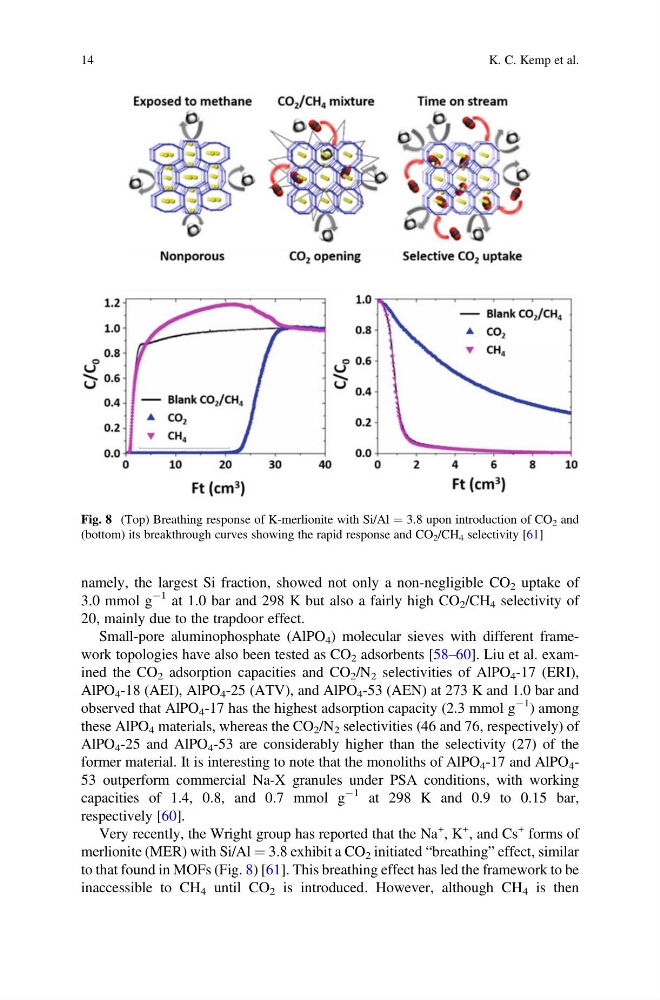
Very recently, the Wright group has reported that the Na
+
, K
+
, and Cs
+ forms of
merlionite (MER) with Si/Al ¼ 3.8 exhibit a CO 2 initiated “breathing” effect, similar
to that found in MOFs (Fig. 8) [61]. This breathing effect has led the framework to be
inaccessible to CH 4 until CO 2 is introduced. However, although CH 4 is then
Fig. 8 (Top) Breathing response of K-merlionite with Si/Al ¼ 3.8 upon introduction of CO 2 and
(bottom) its breakthrough curves showing the rapid response and CO 2 /CH 4 selectivity [61]
14
K. C. Kemp et al.
3.0 mmol g
À1 at 1.0 bar and 298 K but also a fairly high CO 2 /CH 4 selectivity of
20, mainly due to the trapdoor effect.
Small-pore aluminophosphate (AlPO 4 ) molecular sieves with different framework topologies have also been tested as CO 2 adsorbents [58–60]. Liu et al. examined the CO 2 adsorption capacities and CO 2 /N 2 selectivities of AlPO 4 -17 (ERI),
AlPO 4 -18 (AEI), AlPO 4 -25 (ATV), and AlPO 4 -53 (AEN) at 273 K and 1.0 bar and
observed that AlPO 4 -17 has the highest adsorption capacity (2.3 mmol g
À1 ) among
these AlPO 4 materials, whereas the CO 2 /N 2 selectivities (46 and 76, respectively) of
AlPO 4 -25 and AlPO 4 -53 are considerably higher than the selectivity (27) of the
former material. It is interesting to note that the monoliths of AlPO 4 -17 and AlPO 4 -
53 outperform commercial Na-X granules under PSA conditions, with working
capacities of 1.4, 0.8, and 0.7 mmol g
À1 at 298 K and 0.9 to 0.15 bar,
respectively [60].
Very recently, the Wright group has reported that the Na
+
, K
+
, and Cs
+ forms of
merlionite (MER) with Si/Al ¼ 3.8 exhibit a CO 2 initiated “breathing” effect, similar
to that found in MOFs (Fig. 8) [61]. This breathing effect has led the framework to be
inaccessible to CH 4 until CO 2 is introduced. However, although CH 4 is then
Fig. 8 (Top) Breathing response of K-merlionite with Si/Al ¼ 3.8 upon introduction of CO 2 and
(bottom) its breakthrough curves showing the rapid response and CO 2 /CH 4 selectivity [61]
14
K. C. Kemp et al.