

4.1 Natural Gas and Air Drying
The extremely well-suited characteristics of zeolites (mainly small pore zeolites like
LTA but not only) for gas drying led to the first industrial implementation of zeolites
in separative applications. The very high selectivity (molecular sieving effect) of
different forms of LTA for water adsorption combined with high capacities at low
partial pressures made evident the choice of the mentioned zeolites for drying
purposes.
The choice of the zeolite is based on the nature of the treated stream. When high
polar molecules such as short chain alcohols, amines, or H 2 S are involved, the
potassium form of LTA (3A) is selected in order to maximize the sieving effect.
The exclusion mechanism is also selected when potentially reactive gases must be
treated (risk of unsaturated hydrocarbon polymerization among others). When the
gases present high content of acids, zeolites presenting high Si/Al ratios like
chabazite or mordenite are preferred [10] because of their resistance to harsh
conditions.
4.2 Oxygen Production
Although cryogenic distillation is still the main method by which liquid oxygen is
produced, a large variety of adsorption-based process concepts has been developed
for direct production of oxygen from ambient air. When considering the distillation
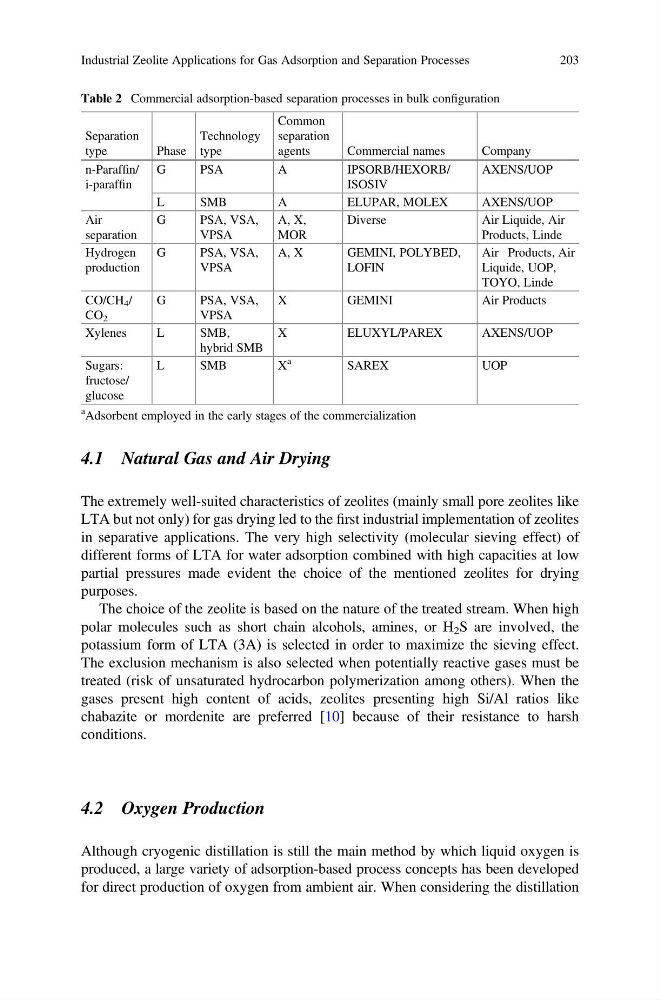
Table 2 Commercial adsorption-based separation processes in bulk configuration
Separation
type
Phase
Technology
type
Common
separation
agents
Commercial names
Company
n-Paraffin/
i-paraffin
G
PSA
A
IPSORB/HEXORB/
ISOSIV
AXENS/UOP
L
SMB
A
ELUPAR, MOLEX
AXENS/UOP
Air
separation
G
PSA, VSA,
VPSA
A, X,
MOR
Diverse
Air Liquide, Air
Products, Linde
Hydrogen
production
G
PSA, VSA,
VPSA
A, X
GEMINI, POLYBED,
LOFIN
Air Products, Air
Liquide, UOP,
TOYO, Linde
CO/CH 4 /
CO 2
G
PSA, VSA,
VPSA
X
GEMINI
Air Products
Xylenes
L
SMB,
hybrid SMB
X
ELUXYL/PAREX
AXENS/UOP
Sugars:
fructose/
glucose
L
SMB
X
a
SAREX
UOP
a Adsorbent employed in the early stages of the commercialization
Industrial Zeolite Applications for Gas Adsorption and Separation Processes
203
The extremely well-suited characteristics of zeolites (mainly small pore zeolites like
LTA but not only) for gas drying led to the first industrial implementation of zeolites
in separative applications. The very high selectivity (molecular sieving effect) of
different forms of LTA for water adsorption combined with high capacities at low
partial pressures made evident the choice of the mentioned zeolites for drying
purposes.
The choice of the zeolite is based on the nature of the treated stream. When high
polar molecules such as short chain alcohols, amines, or H 2 S are involved, the
potassium form of LTA (3A) is selected in order to maximize the sieving effect.
The exclusion mechanism is also selected when potentially reactive gases must be
treated (risk of unsaturated hydrocarbon polymerization among others). When the
gases present high content of acids, zeolites presenting high Si/Al ratios like
chabazite or mordenite are preferred [10] because of their resistance to harsh
conditions.
4.2 Oxygen Production
Although cryogenic distillation is still the main method by which liquid oxygen is
produced, a large variety of adsorption-based process concepts has been developed
for direct production of oxygen from ambient air. When considering the distillation
Table 2 Commercial adsorption-based separation processes in bulk configuration
Separation
type
Phase
Technology
type
Common
separation
agents
Commercial names
Company
n-Paraffin/
i-paraffin
G
PSA
A
IPSORB/HEXORB/
ISOSIV
AXENS/UOP
L
SMB
A
ELUPAR, MOLEX
AXENS/UOP
Air
separation
G
PSA, VSA,
VPSA
A, X,
MOR
Diverse
Air Liquide, Air
Products, Linde
Hydrogen
production
G
PSA, VSA,
VPSA
A, X
GEMINI, POLYBED,
LOFIN
Air Products, Air
Liquide, UOP,
TOYO, Linde
CO/CH 4 /
CO 2
G
PSA, VSA,
VPSA
X
GEMINI
Air Products
Xylenes
L
SMB,
hybrid SMB
X
ELUXYL/PAREX
AXENS/UOP
Sugars:
fructose/
glucose
L
SMB
X
a
SAREX
UOP
a Adsorbent employed in the early stages of the commercialization
Industrial Zeolite Applications for Gas Adsorption and Separation Processes
203