

[100] direction, having a size of 5.5 Å Â 5.1 Å (Fig. 3b). The typical micropore
volume of MFI-type materials lies around 0.15 mL/g [134].
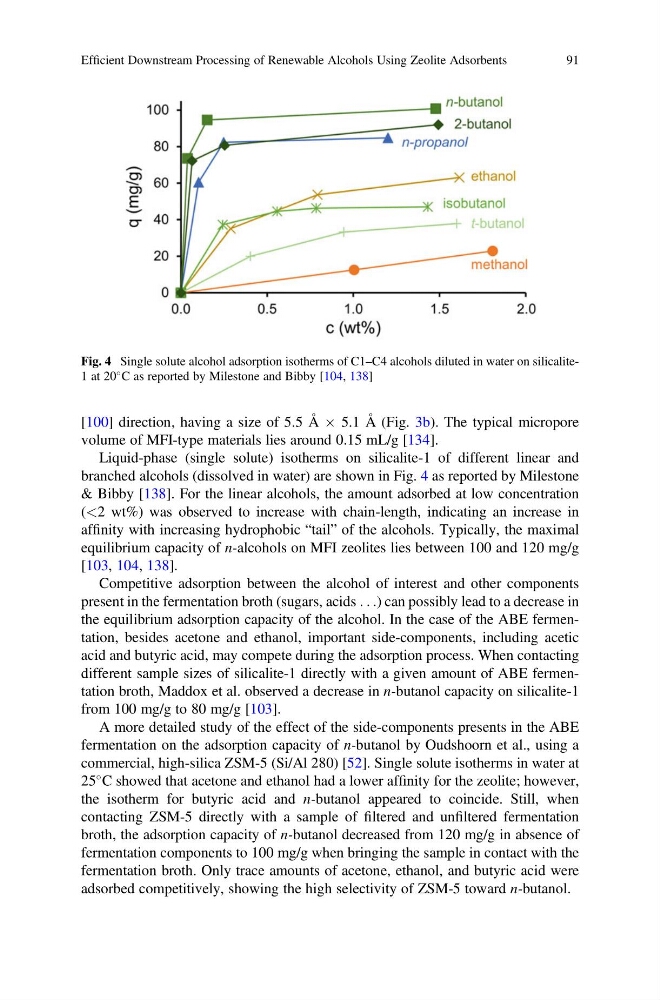
Liquid-phase (single solute) isotherms on silicalite-1 of different linear and
branched alcohols (dissolved in water) are shown in Fig. 4 as reported by Milestone
& Bibby [138]. For the linear alcohols, the amount adsorbed at low concentration
(<2 wt%) was observed to increase with chain-length, indicating an increase in
affinity with increasing hydrophobic “tail” of the alcohols. Typically, the maximal
equilibrium capacity of n-alcohols on MFI zeolites lies between 100 and 120 mg/g
[103, 104, 138].
Competitive adsorption between the alcohol of interest and other components
present in the fermentation broth (sugars, acids . . .) can possibly lead to a decrease in
the equilibrium adsorption capacity of the alcohol. In the case of the ABE fermentation, besides acetone and ethanol, important side-components, including acetic
acid and butyric acid, may compete during the adsorption process. When contacting
different sample sizes of silicalite-1 directly with a given amount of ABE fermentation broth, Maddox et al. observed a decrease in n-butanol capacity on silicalite-1
from 100 mg/g to 80 mg/g [103].
A more detailed study of the effect of the side-components presents in the ABE
fermentation on the adsorption capacity of n-butanol by Oudshoorn et al., using a
commercial, high-silica ZSM-5 (Si/Al 280) [52]. Single solute isotherms in water at
25
C showed that acetone and ethanol had a lower affinity for the zeolite; however,
the isotherm for butyric acid and n-butanol appeared to coincide. Still, when
contacting ZSM-5 directly with a sample of filtered and unfiltered fermentation
broth, the adsorption capacity of n-butanol decreased from 120 mg/g in absence of
fermentation components to 100 mg/g when bringing the sample in contact with the
fermentation broth. Only trace amounts of acetone, ethanol, and butyric acid were
adsorbed competitively, showing the high selectivity of ZSM-5 toward n-butanol.
Fig. 4 Single solute alcohol adsorption isotherms of C1–C4 alcohols diluted in water on silicalite1 at 20
C as reported by Milestone and Bibby [104, 138]
Efficient Downstream Processing of Renewable Alcohols Using Zeolite Adsorbents
91
volume of MFI-type materials lies around 0.15 mL/g [134].
Liquid-phase (single solute) isotherms on silicalite-1 of different linear and
branched alcohols (dissolved in water) are shown in Fig. 4 as reported by Milestone
& Bibby [138]. For the linear alcohols, the amount adsorbed at low concentration
(<2 wt%) was observed to increase with chain-length, indicating an increase in
affinity with increasing hydrophobic “tail” of the alcohols. Typically, the maximal
equilibrium capacity of n-alcohols on MFI zeolites lies between 100 and 120 mg/g
[103, 104, 138].
Competitive adsorption between the alcohol of interest and other components
present in the fermentation broth (sugars, acids . . .) can possibly lead to a decrease in
the equilibrium adsorption capacity of the alcohol. In the case of the ABE fermentation, besides acetone and ethanol, important side-components, including acetic
acid and butyric acid, may compete during the adsorption process. When contacting
different sample sizes of silicalite-1 directly with a given amount of ABE fermentation broth, Maddox et al. observed a decrease in n-butanol capacity on silicalite-1
from 100 mg/g to 80 mg/g [103].
A more detailed study of the effect of the side-components presents in the ABE
fermentation on the adsorption capacity of n-butanol by Oudshoorn et al., using a
commercial, high-silica ZSM-5 (Si/Al 280) [52]. Single solute isotherms in water at
25
C showed that acetone and ethanol had a lower affinity for the zeolite; however,
the isotherm for butyric acid and n-butanol appeared to coincide. Still, when
contacting ZSM-5 directly with a sample of filtered and unfiltered fermentation
broth, the adsorption capacity of n-butanol decreased from 120 mg/g in absence of
fermentation components to 100 mg/g when bringing the sample in contact with the
fermentation broth. Only trace amounts of acetone, ethanol, and butyric acid were
adsorbed competitively, showing the high selectivity of ZSM-5 toward n-butanol.
Fig. 4 Single solute alcohol adsorption isotherms of C1–C4 alcohols diluted in water on silicalite1 at 20
C as reported by Milestone and Bibby [104, 138]
Efficient Downstream Processing of Renewable Alcohols Using Zeolite Adsorbents
91