

enantiomer can fit (homoselectivity) or where the specular enantiomer fits better
(heteroselectivity). It is surprising to see that in the latter case, the arrangement of
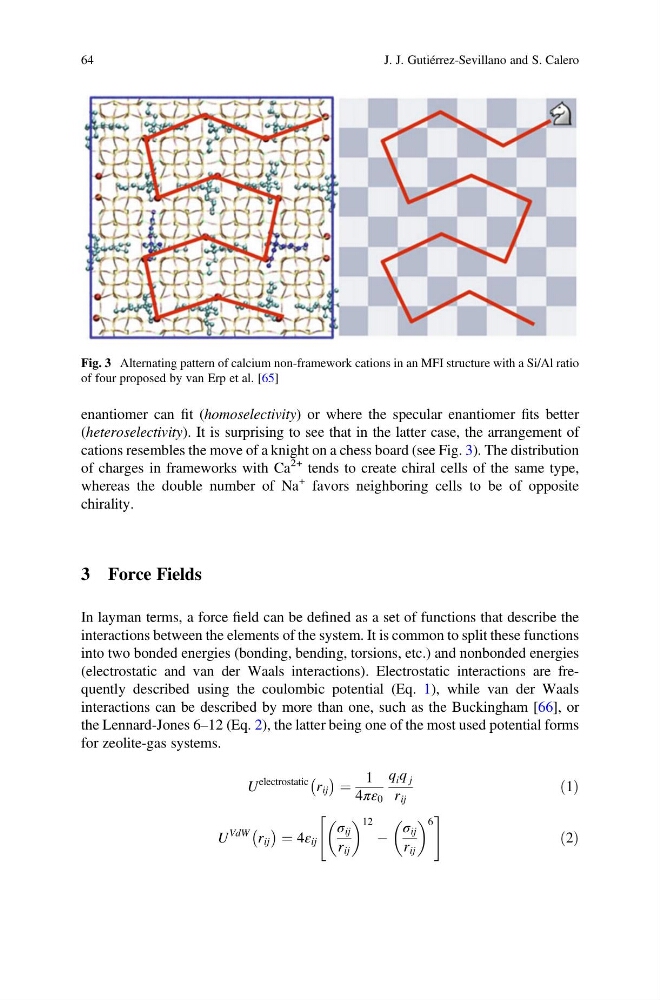
cations resembles the move of a knight on a chess board (see Fig. 3). The distribution
of charges in frameworks with Ca
2+ tends to create chiral cells of the same type,
whereas the double number of Na
+ favors neighboring cells to be of opposite
chirality.
3 Force Fields
In layman terms, a force field can be defined as a set of functions that describe the
interactions between the elements of the system. It is common to split these functions
into two bonded energies (bonding, bending, torsions, etc.) and nonbonded energies
(electrostatic and van der Waals interactions). Electrostatic interactions are frequently described using the coulombic potential (Eq. 1), while van der Waals
interactions can be described by more than one, such as the Buckingham [66], or
the Lennard-Jones 6–12 (Eq. 2), the latter being one of the most used potential forms
for zeolite-gas systems.
U
electrostatic r ij
À Á ¼
1
4πε 0
q i q j
r ij
ð1Þ
U
VdW r ij
À Á ¼ 4ε ij
σ ij
r ij
12
À
σ ij
r ij
6
"
#
ð2Þ
Fig. 3 Alternating pattern of calcium non-framework cations in an MFI structure with a Si/Al ratio
of four proposed by van Erp et al. [65]
64
J. J. Gutiérrez-Sevillano and S. Calero
(heteroselectivity). It is surprising to see that in the latter case, the arrangement of
cations resembles the move of a knight on a chess board (see Fig. 3). The distribution
of charges in frameworks with Ca
2+ tends to create chiral cells of the same type,
whereas the double number of Na
+ favors neighboring cells to be of opposite
chirality.
3 Force Fields
In layman terms, a force field can be defined as a set of functions that describe the
interactions between the elements of the system. It is common to split these functions
into two bonded energies (bonding, bending, torsions, etc.) and nonbonded energies
(electrostatic and van der Waals interactions). Electrostatic interactions are frequently described using the coulombic potential (Eq. 1), while van der Waals
interactions can be described by more than one, such as the Buckingham [66], or
the Lennard-Jones 6–12 (Eq. 2), the latter being one of the most used potential forms
for zeolite-gas systems.
U
electrostatic r ij
À Á ¼
1
4πε 0
q i q j
r ij
ð1Þ
U
VdW r ij
À Á ¼ 4ε ij
σ ij
r ij
12
À
σ ij
r ij
6
"
#
ð2Þ
Fig. 3 Alternating pattern of calcium non-framework cations in an MFI structure with a Si/Al ratio
of four proposed by van Erp et al. [65]
64
J. J. Gutiérrez-Sevillano and S. Calero