

Both nitrogen and argon have slow diffusion at ultralow pressure at cryogenic
temperature and sometimes hinder a proper measurement in the ultramicropore
region (< 0.7 nm) [22]. To solve this inconvenience, the use of CO 2 at 273 K
appears as an alternative to evaluate this narrow microporosity. Although the kinetic
diameters of nitrogen, argon, and carbon dioxide are similar (i.e., 0.36, 0.34, and
0.33 nm, respectively) [25], the adsorption behavior of these three adsorptives is
quite different. At 273 K the CO 2 molecule has higher mobility, and its saturation
pressure is around 3.5 MPa; therefore, up to atmospheric pressure (0.1 MPa), the
narrow micropores (0.4–1 nm) can be filled, whereas, at 1 MPa, it reaches pores up
to 1.5 nm. Although CO 2 has advantages to assess micropores, this adsorptive has a
higher quadrupole moment than nitrogen, affecting the adsorption analysis of
materials with surface functional groups [26]. In spite of that, CO 2 adsorption can
still be useful for assessing the microporosity of materials with pores where neither
nitrogen nor argon can access.
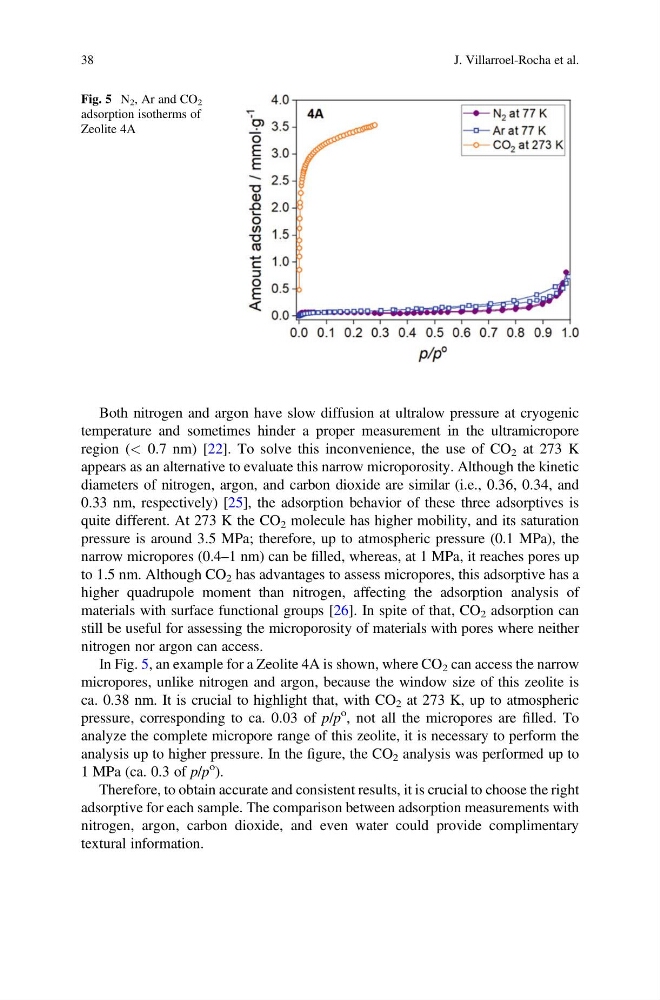
In Fig. 5, an example for a Zeolite 4A is shown, where CO 2 can access the narrow
micropores, unlike nitrogen and argon, because the window size of this zeolite is
ca. 0.38 nm. It is crucial to highlight that, with CO 2 at 273 K, up to atmospheric
pressure, corresponding to ca. 0.03 of p/p
o , not all the micropores are filled. To
analyze the complete micropore range of this zeolite, it is necessary to perform the
analysis up to higher pressure. In the figure, the CO 2 analysis was performed up to
1 MPa (ca. 0.3 of p/p
o ).
Therefore, to obtain accurate and consistent results, it is crucial to choose the right
adsorptive for each sample. The comparison between adsorption measurements with
nitrogen, argon, carbon dioxide, and even water could provide complimentary
textural information.
Fig. 5 N 2 , Ar and CO 2
adsorption isotherms of
Zeolite 4A
38
J. Villarroel-Rocha et al.
temperature and sometimes hinder a proper measurement in the ultramicropore
region (< 0.7 nm) [22]. To solve this inconvenience, the use of CO 2 at 273 K
appears as an alternative to evaluate this narrow microporosity. Although the kinetic
diameters of nitrogen, argon, and carbon dioxide are similar (i.e., 0.36, 0.34, and
0.33 nm, respectively) [25], the adsorption behavior of these three adsorptives is
quite different. At 273 K the CO 2 molecule has higher mobility, and its saturation
pressure is around 3.5 MPa; therefore, up to atmospheric pressure (0.1 MPa), the
narrow micropores (0.4–1 nm) can be filled, whereas, at 1 MPa, it reaches pores up
to 1.5 nm. Although CO 2 has advantages to assess micropores, this adsorptive has a
higher quadrupole moment than nitrogen, affecting the adsorption analysis of
materials with surface functional groups [26]. In spite of that, CO 2 adsorption can
still be useful for assessing the microporosity of materials with pores where neither
nitrogen nor argon can access.
In Fig. 5, an example for a Zeolite 4A is shown, where CO 2 can access the narrow
micropores, unlike nitrogen and argon, because the window size of this zeolite is
ca. 0.38 nm. It is crucial to highlight that, with CO 2 at 273 K, up to atmospheric
pressure, corresponding to ca. 0.03 of p/p
o , not all the micropores are filled. To
analyze the complete micropore range of this zeolite, it is necessary to perform the
analysis up to higher pressure. In the figure, the CO 2 analysis was performed up to
1 MPa (ca. 0.3 of p/p
o ).
Therefore, to obtain accurate and consistent results, it is crucial to choose the right
adsorptive for each sample. The comparison between adsorption measurements with
nitrogen, argon, carbon dioxide, and even water could provide complimentary
textural information.
Fig. 5 N 2 , Ar and CO 2
adsorption isotherms of
Zeolite 4A
38
J. Villarroel-Rocha et al.