

2.3 Choice of Adsorptive Gas
The nitrogen at its boiling temperature (77 K) has been generally accepted as the
most common and standard probe gas to perform the adsorption-desorption isotherms [7]. However, it is well-known that its quadrupole moment leads to specific
interactions with different surface functional groups. The more known are the silanol
groups on silica surfaces or ionic charges in zeolites channels or windows of the
micropore region. To avoid this issue, it is possible to use another probe gas, such as
argon, which lacks a quadrupole moment; therefore, it does not interact with surface
functional groups. Argon isotherms can be measured at 77 K (6.5 K below its triple
point) where its experimental saturation pressure is close to 205 Torr. At this
conditions, argon fills narrow micropores at similar pressures to nitrogen at the
same temperature. Also, the pore size analysis with argon at 77 K only can be
measured up to 15 nm [21], and the micropore analysis is obtained in a narrow range
of relative pressures, where argon molecules have low mobility. The better and more
complete analysis can be made using Ar at 87 K, where its saturation pressure is near
the atmospheric. In this case, the narrow micropores are filled at a higher pressure,
with faster molecular mobility than N 2 and Ar at 77 K, and the porosity range of
analysis is similar to the obtained with nitrogen at 77 K. Because commercial
transducers are very accurate in the pressure range where the Ar isotherms at 87 K
are carried out, the adsorption isotherms are obtained with high resolution, which are
often considered as a fingerprint of the pore structure [22]. Figure 3 shows argon
isotherms at 77 and 87 K and nitrogen isotherm at 77 K for the ITQ-29 zeolite. In this
figure, we can see the behavior discussed above.
Nakai et al. [24] investigated the advantage of using Ar isotherms at 87 K to
obtain more realistic information about the pore structure of zeolites in the presence
of surface functional groups. In this work, they present high-resolution adsorption
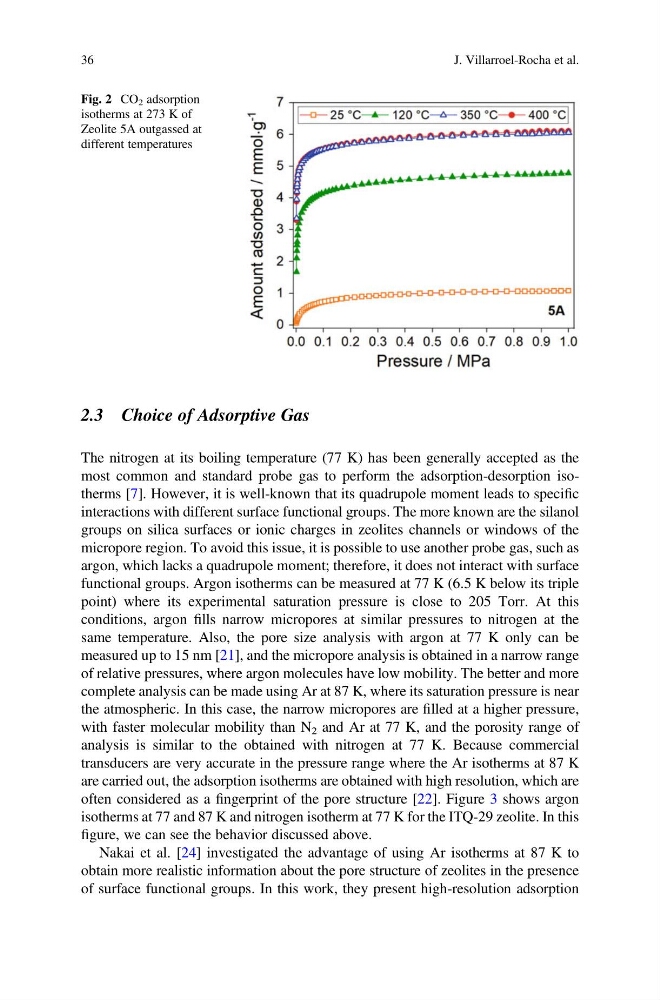
Fig. 2 CO 2 adsorption
isotherms at 273 K of
Zeolite 5A outgassed at
different temperatures
36
J. Villarroel-Rocha et al.
The nitrogen at its boiling temperature (77 K) has been generally accepted as the
most common and standard probe gas to perform the adsorption-desorption isotherms [7]. However, it is well-known that its quadrupole moment leads to specific
interactions with different surface functional groups. The more known are the silanol
groups on silica surfaces or ionic charges in zeolites channels or windows of the
micropore region. To avoid this issue, it is possible to use another probe gas, such as
argon, which lacks a quadrupole moment; therefore, it does not interact with surface
functional groups. Argon isotherms can be measured at 77 K (6.5 K below its triple
point) where its experimental saturation pressure is close to 205 Torr. At this
conditions, argon fills narrow micropores at similar pressures to nitrogen at the
same temperature. Also, the pore size analysis with argon at 77 K only can be
measured up to 15 nm [21], and the micropore analysis is obtained in a narrow range
of relative pressures, where argon molecules have low mobility. The better and more
complete analysis can be made using Ar at 87 K, where its saturation pressure is near
the atmospheric. In this case, the narrow micropores are filled at a higher pressure,
with faster molecular mobility than N 2 and Ar at 77 K, and the porosity range of
analysis is similar to the obtained with nitrogen at 77 K. Because commercial
transducers are very accurate in the pressure range where the Ar isotherms at 87 K
are carried out, the adsorption isotherms are obtained with high resolution, which are
often considered as a fingerprint of the pore structure [22]. Figure 3 shows argon
isotherms at 77 and 87 K and nitrogen isotherm at 77 K for the ITQ-29 zeolite. In this
figure, we can see the behavior discussed above.
Nakai et al. [24] investigated the advantage of using Ar isotherms at 87 K to
obtain more realistic information about the pore structure of zeolites in the presence
of surface functional groups. In this work, they present high-resolution adsorption
Fig. 2 CO 2 adsorption
isotherms at 273 K of
Zeolite 5A outgassed at
different temperatures
36
J. Villarroel-Rocha et al.